A
Ab : (Semitic magical month). Crossing a river on the 20th of that month was supposed to bring sickness. In ancient texts it states that if a man should eat the flesh of swine on the 30th of Ab, he will be plagued with boils.
Abaddon : (The Destroyer). Chief of the demons of the seventh hierarchy. Abaddon is the name given by St John in the Apocalypse to the king of the grasshoppers. He is sometimes regarded as the destroying angel.
Abadie (Jeannette) : A young sorceress of the village of Sibourre, in Gascony. She was sleeping One day in her father's house while high mass was being said. A demon, profiting by the opportunity, carried her off to the Devil's Sabbath, where she soon awoke to find herself in the midst of a large company. She observed that the principal demon had on his head two faces, like Janus. She did not participate in the revelry, and was transported to her home by the same means as she had been conveyed thence. On the threshold she found her amulet, which the demon had taken the precaution to remove from her bosom before carrying her off. She made a confession of all that had happened, renounced her sorcery, and thus saved herself from the common fate of witches and sorcerer - the stake.
Abaris : A Scythian, high priest of Apollo, and renowned magician. In so flattering a manner did he chant the praises of Apollo, his master, that the god gave him a golden arrow, on which he could ride through the air like a bird, so that the Greeks called him the Aerobate. Pythagoras, his pupil, stole this arrow from him, and accomplished many wonderful feats by its aid. Abaris foretold the future, pacified storms, banished disease, and lived without eating or drinking. He made with the bones of Pelops, a statue of Minerva, which he sold to the Trojans as a talisman descended from heaven. This was the famous Palladium, which protected and rendered impregnable the town wherein it was lodged.
Abdelazys : An Arabian astrologer of the tenth century, generally known in Europe by his Latin name of Alchabitius. His treatise on astrology was so much prized that it was translated into Latin and printed in 1473. Other editions have since appeared, the best being that of Venice (1503) entitled Alchabitius cum commento. Translated by John of Seville. (Hispalensis.)
Aben-Ragel : An Arabian astrologer, born at Cordova, at the beginning of the fifth century. He was the author of a book of horoscopes according to the inspection of the stars, a Latin translation of which was published at Venice, 1485, under the title of De Judiciis seu fatis stellarum. It was said that his predictions were fulfilled in a remarkable manner.
Abigor : According to Wierius (q.v.), Grand Duke of Hades. He is shown in the form of a handsome knight, bearing lance, standard, or sceptre. He is a demon of the superior order, and responds readily to questions concerning war. He can foretell the future, and instructs the leaders how to make themselves respected by the soldiers. Sixty of the infernal regions are at his command.
Abishai : (See Devil.) Abou-Ryhan : An Arabian astrologer whose real name was Mohammed-ben-Ahmed, to whom is ascribed the introduction of Judicial Astrology (q.v.) Many stories were told of him in the East, to show that he possessed in an extraordinary degree the power to read the future.
Abra Melin: (See Abraham the Jew.)
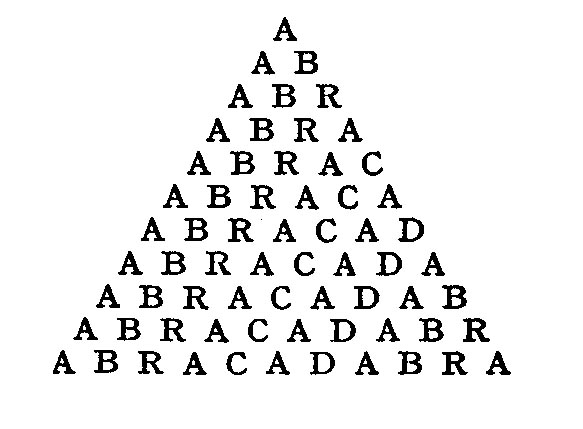
Abracadabra : A magical word said to be formed from the letters of the abraxas, and written thus:
or the reverse way. The pronunciation of this word, according to Julius Africanus, was equally efficacious either way. By Serenus Sammonicus it was used as a spell to cure asthma. Abracalan or aracalan is another form of the word, and is said to have been regarded as the name of a god in Syria and as a magical symbol by the Jews. But it seems doubtful whether the abracadabra, or its synonyms, was really the name of a deity or not. (See Abraxas.)
Abraham, The Jew : (Alchemist and magician, circa, 1400). Comparatively few biographical facts are forthcoming concerning this German Jew, who was at once alchemist, magician and philosopher; and these few facts are mostly derived from a very curious manuscript, now domiciled in the Archives of the Bibliotheque de l'Arsenal, Paris, an institution rich in occult documents. This manuscript is couched throughout in French, but purports to be literally translated from Hebrew, and the style of the handwriting indicates that the scribe lived at the beginning of the eighteenth century, or possibly somewhat earlier. A distinct illiteracy characterises the French script, the punctuation being inaccurate, indeed frequently conspicuous by its absence, but an actual description of the document must be waived till later. Abraham was probably a native of Mayence, and appears to have been born in 1362. We find that his father, Simon by name, was something of a seer and magician, and that the boy accordingly commenced his occult studies under the parental guidance, while at a later date he studied under one, Moses, whom he himself describes as, "indeed a good man, but entirely ignorant of The True Mystery, and of The Veritable Magic." Leaving this preceptor, Abraham decided to glean knowledge by travelling, and along with a friend called Samuel, a Bohemian by birth, he wandered through Austria and Hungary into Greece, and thence penetrated to Constantinople, where he remained fully two years. He is found next in Arabia, in those days a veritable centre of mystic learning; and from Arabia he went to Palestine, whence betimes he proceeded to Egypt. Here he had the good fortune to make the acquaintance of Abra-Melin, the famous Egyptian philosopher, who, besides entrusting to him certain documents, confided in him by word of mouth a number of invaluable secrets; and armed thus, Abraham left Egypt for Europe, where eventually he settled at Wurzburg in Germany. Soon he was deep in alchemistic researches, but these did not prevent him from espousing a wife, who appears to have been his cousin; and by her he had three daughters and also two sons, the elder named Joseph and the younger Lamech. He took great pains to instruct both of them in occult affairs, while, on each of his three daughters, he settled a dowry of a hundred thousand golden florins. This considerable sum, together with other vast wealth, he claims to have gained by travelling as an alchemist; and whatever the truth of this statement, he certainly won great fame, being summoned to perform acts of magic before many rich and influential people, notably the Emperor Sigismund of Germany, the Bishop of Wurzburg, King Henry VI. of England, the Duke of Bavaria, and Pope John XXIII. The remainder of Abraham's career is shrouded in mystery, while even the date of his death is uncertain, but it is commonly supposed to have occurred about 1460.
The curious manuscript cited above, and from which the foregoing facts have been culled, is entitled The Book of the Sacred Magic of Abra-Melin, as delivered by Abraham the Jew unto his son Lamech. This title, however, is rather misleading, and not strictly accurate, for Abra-Melin had absolutely no hand in the opening part of the work, this consisting of some account of Abraham's own youth and early travels in search of wisdom, along with advice to the young man aspiring to become skilled in occult arts. The second part, on the other hand, is based on the documents which the Egyptian sage handed to the Jew, or at least on the confidences wherewith the former favoured the latter; and it may be fairly accurately defined as dealing with the first principles of magic in general, the titles of some of the more important chapters being as follows: "How Many, and what are the Classes of Veritable Magic?" "What we Ought to Take into Consideration before the Undertaking of the Operation," Concerning the Convocation of the Spirits," and "In what Manner we ought to Carry out the Operations." Passing to the third and last part, this likewise is mostly derived straight from Abra-Melin; and here the author, eschewing theoretical matter as far as possible, gives information about the actual practice of magic. In the first place he tells how "To procure divers Visions," How one may retain the Familiar Spirits, bound or free, in whatsoever form," and how "To excite Tempests," while in one chapter he treats of raising the dead, another he devotes to the topic of transforming oneself into" divers shapes and forms," and in further pages he descants on flying in the air, on demolishing buildings, on discovering thefts, and on walking under the water. Then he dilates on the Thaumaturgic healing of leprosy, dropsy, paralysis, and various more common ailments such as fever and seasickness, while he offers intelligence on " How to be be-loved by a Woman," and this he supplements by directions for commanding the favour of popes, emperors, and other influential people. Finally, he reverts to the question of summoning visions, and his penultimate chapter is entitled, "How to cause Armed Men to Appear," while his concluding pages treat of evoking "Comedies, Operas, and all kinds of Music and Dances."
It is by employing Kabalistic squares of letters that all these things are to be achieved, or at least, almost all of them, and lack of space makes it impossible to deal with the many different signs of this sort, whose use the seer counsels. But it behoves to ask what manner of personality exhales from these curious pages? What kind of temperament? And the answer is that Abraham is shown as a man of singularly narrow mind, heaping scorn on most other magicians, and speaking with great derision of nearly all mystical writings save his own and those of his hero, Abra-Melin. Moreover, he inveighs fiercely against all those who recant the religion in which they were bred, and contends that no one guilty of this will ever attain skill in magic; yet it should be said, in justice to the seer, that he manifests little selfishness, and seems to have striven after success in his craft with a view to using it for the benefit of mankind in general. His writings reflect besides, a firm belief in that higher self existing in every man, and a keen desire to develop it. (See Flamel.)
Abraxas : (or Abracax). The Basilidian (q.v.) sect of Gnostics, of the second century, claimed Abraxas as their supreme god, and said that Jesus Christ was only a phantom sent to earth by him. They believed that his name contained great mysteries, as it was composed of the seven Greek letters which form the number 365, which is also the number of days in a year. Abraxas, they thought, had under his command 365 gods, to whom they attributed 365 virtues, one for each day. The older Mythologists placed him among the number of Egyptian gods, and demonologists have described him as a demon, with the head of a king and with serpents forming his feet. He is represented on ancient amulets, with a whip in his hand. It is from his name that the mystic word, Abracadabra (q.v.) is taken. Many stones and gems cut in various symbolic forms, such as the head of a fowl, a serpent, and so forth, were worn by the Basilidians as amulets.
Abred : The innermost of three concentric circles representing the totality of being in the British Celtic cosmogony. (See Celts.) The stage of struggle and evolution against Cythrawl, the power of evil. (See also Barddas.)
Absolute (Theosophist) : Of the Absolute, the Logos, the Word of God, Theosophists profess to know nothing further than that it exists. The universes with their solar systems are but the manifestations of this Being, which man is capable of perceiving, and all of them are instinct with him, but what man can perceive is not the loftier manifestations but the lower. Man himself is an emanation from the Absolute with which he will ultimately be re-united.
Abyssum : A herb used in the ceremony of exorcising a haunted house. It is signed with the sign of the cross, and hung up at the four corners of the house.
Acherat : (See Cagliostro.)
Achmet : An Arabian soothsayer of the ninth century. He wrote a book on The Interpretation of Dreams, following the doctrines of the East. The original is lost. but the Greek and Latin translations were printed at Paris, in 1603.
Aconce (Jacques) : Curate of the diocese of Trent, who became a Calvinist in 1557, and came to England, While there he dedicated to Queen Elizabeth his famous work, on The Stratagems of Satan. This book, however, is not, as its title might indicate, a dissertation on demonology, but a spirited attack on intolerance.
Adalbert : A French pseudo-mystic of the eighth century. He boasted that an angel had brought him relics of extraordinary sanctity from all parts of the earth. He claimed to be able to foretell the future, and to read thoughts. " I know what you have done," he would say to the people, "there is no need for confession. Go in peace, your sins are forgiven." His so-called "miracles" gained for him the awe of the multitude, and he was in the habit of giving away parings of his nails and locks of his hair as powerful amulets. He is even said to have set up an altar in his own name. In his history of his life, of which only a fragment remains, he tells us of miraculous powers bestowed by an angel at his birth. He showed to his disciples a letter which he declared had been brought to him from Jesus Christ by the hand of St. Michael. These, and similar blasphemies were put an end to by his being cast into prison, where he died.
Adam, Book of the Penitence of : A manuscript in the Library of the Arsenal at Paris, which deals with Kabalistic tradition. It recounts how the sons of Adam, Cain and Abel, typifying brute force and intelligence, slew each other, and that A dam's inheritance passed to his third son. Seth. Seth, it is stated, was permitted to advance as far as the gate of the Earthly Paradise without being threatened by the guardian angel with his flaming sword, which is to say that he was an initiate of occult science. He beheld the Tree of Life and the Tree of Knowledge, which had become grafted upon each other so that they formed one tree. This is supposed by some to have symbolised the harmony of science and religion in the Kabala. The guardian angel presented Seth with three seeds from this tree, directing him to place them within the mouth of his father, Adam, when he expired. From this planting arose the burning bush out of which God communicated to Moses his holy name, and from a part of which Moses made his magic wand. This was placed in the Ark of the Covenant, and was planted by King David on Mount Zion, grew into a triple tree and was cut down by Solomon to form the pillars, Jachin and Boaz, which were placed at the entrance to the Temple. A third portion was inserted in the threshold of the great gate, and acted as a talisman, permitting no unclean thing to enter the sanctuary. Certain wicked priests removed it however for purposes of their own, weighted it with stones, and cast it into the Temple reservoir, where it was guarded by an angel, who kept it from the sight of men. During the lifetime of Christ the reservoir was drained and the beam of wood discovered and thrown across the brook Kedron, over which our Saviour passed after his apprehension in the Garden of Olives. It was taken by his executioners and made into the cross. In this legend we can see a marked similarity to those from which the conception of the Holy Grail arose. Man is restored by the wood through the instrumentality of which Adam, the first man, fell. The idea that the Cross was a cutting of the Tree of Knowledge was widespread in the middle ages, and may be found in the twelfth century Quete del St. Graal, ascribed to Walter Map, but probably only redacted by him. All the Kabalistic traditions are embodied in the allegory contained in the Book of the Penitence of Adam, and it undoubtedly supplements and throws considerable light on the entire Kabalistic literature.
Adam, (L'Abbe) : About the time that the Templars were being driven from France, the Devil appeared, under various guises, to the Abbe Adam, who was journeying, attended by one of the servants from his convent, to a certain part of his abbacy of the Vaux de Cernay. The evil spirit first opposed the progress of the worthy Abbe under the form of a tree white with frost, which rushed towards him with inconceivable swiftness. The Abbe's horse trembled with fear, as did the servant, but the Abbe himself made the sign of the Cross, and the tree disappeared. The good man concluded that he had seen the Devil, and called upon the Virgin to protect him. Nevertheless, the fiend shortly reappeared in the shape of a furious black knight. "Be-gone," said the Abbe. "Why do you attack me far from my brothers? " The Devil once more left him, only to return in the shape of a tall man, with a long, thin neck. Adam, to get rid of him, struck him a blow with his fist. The evil spirit shrank and took the stature and countenance of a little cloaked monk, with a glittering weapon under his dress. His little eyes could be seen darting and glancing under his cowl. He tried hard to strike the Abbe with the sword he held, but the latter repulsed the strokes with the sign of the Cross. The demon became in turn a pig and a long-eared ass. The Abbe, impatient to be gone, made a circle on the ground with a cross in the centre. The fiend was then obliged to withdraw to a little distance. He changed his long ears into horns, which did not hinder the Abbe from boldly addressing him. Offended by his plain-speaking, the Devil changed himself into a barrel and rolled into an adjoining field. In a short time he returned in the form of a cart-wheel, and, without giving the brother time to put himself on the defensive, rolled heavily over his body, without, however, doing him any injury. After that he left him to pursue his journey in peace. (See Gaguin, Regne de Philippe le Bel, and Gerinet, Hist. de la Magie en France, p.82.)
Adamantius : A Jewish doctor, who became a Catholic at Constantinople in the time of Constantine, to whom he dedicated his two books on Physiognomy, or, the art of judging people by their faces. This book, full of contradictions and fantasies, was printed in the Scriptores Physiognomoniae veteres, of Franzius, at Attembourg, in 1780.
Adamnan : (See Scotland.)
Addane of the lake : A monster that figures in the Mabinogi legend of Peredur. Peredur obtains a magic stone which renders him invisible, and he thus succeeds in slaying this monster, which had daily killed the inhabitants of the palace of the King of Tortures.
Adelung, (Jean Christophe) : A German author, born in 1732, who has left a work entitled, Histoire des folies humains, on Biographie des plus celebres necromanciens, alchimistes, devins, etc. (Leipsic, 1785-1789.) Adelung died at Dresden in 1806.
Adepts : are men who after stern self-denial and by means of consistent self-development, have fitted themselves to assist in the ruling of the world. The means by which this position is attained is said to be long and arduous, but in the end the successful one has fulfilled the purpose for which he was created and transcends his fellows. The activities of Adepts are multifarious, being concerned with the direction and guidance of the activities of the rest of mankind. Their knowledge, like their powers, say Theosophists, far exceeds that of man, and they can control forces both in the spiritual and the physical realm, and are said to be able to prolong their lives for centuries. They are also known as the Great White Brotherhood, Rishis, Rahats, or Mahatmas. Those who earnestly desire to work for the betterment of the world may become apprentices or chelas to Adepts, in which case the latter are known as "masters," but the apprentice must first have practised self-denial and self-development in order to become sufficiently worthy. The master imparts teaching and wisdom otherwise unattainable, and helps the apprentice by communion and inspiration. Madame Blavatsky (q.v.) alleged that she was the apprentice of these masters, and claimed that they dwelt in the Tibetan Mountains. The term Adept was also employed by mediaeval magicians and alchemists to denote a master of their sciences.
Adhab-Algal : The Mohammedan purgatory, where the wicked are tormented by the dark angels Munkir and Nekir.
Adjuration : A formula of exorcism by which the evil spirit is commanded, in the name of God, to do or say what the exorcist requires of him.
Adonai : A Hebrew word signifying "the Lord," and used by the Hebrews when speaking or writing of Jehovah, the awful and ineffable name of the God of Israel. The Jews entertained the deepest awe for this incommunicable and mysterious name, and this feeling led them to avoid pronouncing it and to the substitution of the word Adonai for " Jehovah" in their sacred text. This custom still prevails among the Jews, who attribute to the pronouncement of the Holy Name the power of working miracles. The Jehovah of the Israelites was their invisible protector and king, and no image of him was made. He was worshipped according to his commandments, with an observance of the ritual instituted through Moses. The term "Jehovah" means the revealed Absolute Deity, the Manifest, Only, Personal, Holy Creator and Redeemer. (See Magic, God, Egypt, Kabala.)
Adoptive Masonry : Masonic societies which adopt women as members. Early in the eighteenth century such societies were established in France, and speedily spread to other countries. One of the first to "adopt" women were the Mopses. The Felicitaries existed in 1742. The Fendeurs or Woodcutters were instituted in 1763 by Bauchaine, Master of a Parisian Lodge. It was modelled on the Carbonari, and its popularity led to the establishment of other lodges, notably the Fidelity, the Hatchet, etc. In 1774 the Grand Orient Lodge of France established a system of three degrees called the Rite of Adoption, and elected the Duchess of Bourbon as Grand Mistress of France. The rite has been generally adopted into Freemasonry, and various degrees added from time to time, to the number of about twelve in all. Latin and Greek mysteries were added to the rite by the Ladies' Hospitallers of Mount Tabor. The greatest ladies in France joined the French lodges of adoption. The Rite of Mizraim created lodges for both sexes in 1819, 1821, 1838 and 1853, and the Rite of Memphis in 1839. America founded the Rite of the Eastern Star in five points. In these systems admission is generally confined to the female relations of Masons. The Order of the Eastern Star and that of Adoptive Masonry were attempted in Scotland, but without success.
Adramelech : According to Wierius (q.v.,) Chancellor of the infernal regions, Keeper of the Wardrobe of the Demon King, and President of the High Council of the Devils. He was worshipped at Sepharvaim, an Assyrian town, where children were burned on his altar. The rabbis say that he shows himself in the form of a mule, or sometimes, of a peacock.
Adventists : (See America, U.S. of.)
Aeromancy : The art of foretelling future events by the observation of atmospheric phenomena, as, for example, when the death of a great man is presaged by the appearance of a comet. Francois de la Tour Blanche says that aeromancy is the art of fortune-telling by means of spectres which are made to appear in the air, or the representation by the aid of demons, of future events, which are projected on the clouds as if by a magic lantern. "As for thunder and lightning," he adds, "these are concerned with auguries, and the aspect of the sky and of the planets belong to the science of astrology."
Aetites or Aquilaeus : A precious stone of magical properties, composed of oxide of iron with a little silex and alumina, and said to be found in the stomach or neck of the eagle. It is supposed to heal falling sickness, and prevent untimely birth. It should be worn bound on the arm to prevent abortion, and on the thigh to aid parturition.
Africa : (See Arabs, Egypt, Semites.) The north of Africa is Mohammedan. This applies also to the Sudan and the Sahara. For Moorish Magic and Alchemy see Arabs, Instances of Arabic sorcery will also be found in the article "Semites." In West Africa Obeah is practised, for which see West Indies.)
Magic in savage Africa is of the lower cultus, and chiefly of the kind known as "sympathetic."
(See Magic.) But spiritualistic influence shows itself in fetishism, the cult of the dead, ju-ju or witchcraft, and the cult of the witch-doctor.
Bantu Tribes. Among the Zulu and other Bantu tribes the cult of witchcraft was practised, but in secret. for the results of detection were terrible. For the tracking of the witch, a caste of witch-finders was instituted, called "witch-doctors," whose duty it was to " smell out" the offenders. These were nearly all women.
"It is not difficult to understand," says Lady Barker, "bearing in mind the superstition and cruelty which existed in remote parts of England not so very long ago; how powerful such women become among a savage people, or how tempting an opportunity they could furnish of getting rid of an enemy. Of course they are exceptional individuals; more observant, more shrewd, and more dauntless than the average fat, hard-working Kaffir women, besides possessing the contradictory mixture of great physical powers and strong hysterical tendencies. They work themselves up to a pitch of frenzy, and get to believe as firmly in their own supernatural discernment as any individual among the trembling circle of Zulus to whom a touch from the whisk they carry is a sentence of instant death."
The Zulu witch-finders are attended by a circle of black girls and women, who, like a Greek chorus, clap their hands together, and drone through a low monotonous chant, the measure and rhythm of which change at times with a stamp and a swing. Not less necessary is a ceremonial dress for such things appeal directly to the imagination of the crowd, and prepare them to be readily influenced by the necromancers devices. The " Isinyanga," "Abangoma" or "witch-finders," whom Lady Barker describes for us, were attired with an eye for effect which would have done credit to a London theatre. It will suffice to depict one of them, by name Nozinyanga. Her fierce face, spotted with gouts of red paint on cheek and brow, was partly overshadowed by a helmet-like plume of the tall feathers of the sakabula bird. In her right hand she carried a light sheaf of assegais or lances, and on her left arm was slung a small and pretty shield of dappled ox-hide. Her petticoat, made of a couple of large gay handkerchiefs, was worn kilt-wise. But if there were little decoration in her skirts, the deficiency was more than compensated by the bravery of the bead-necklaces, the goat's-hair fringes, and the scarlet tassels which covered her from coat to waist. Her ample chest rose and fell beneath the baldric of leopard skin, fastened across it with huge brazen knobs, while down her back hung a beautifully dried and flattened skin of an enormous boa-constrictor.
When the community had resolved that a certain misfortune was due to the witches, the next step obviously would be to detect and punish them. For this purpose the king would summon a great meeting, and cause his subjects to sit on the ground in a ring or circle for four or five days. The witch-finders took their places in the centre, and as they gradually worked themselves up to a frantic state of frenzy, resembling demoniacal possession, they lightly switched with their quagga-tail one or other of the trembling spectators, who was immediately dragged away and butchered on the spot. And not only he, but all the living things in his hut-wives and children, dogs and cats-not one was left alive, nor was a stick left standing. Sometimes a whole kraal would be exterminated in this way, and the reader will perceive how terrible the cruel custom could be made to gratify private revenge or to work the king's tyrannical inclinations.
A terrible little sorceress is described by Lady Barker under the name of Nozilwane, whose weird wistful glance had in it something uncanny and uncomfortable. She was dressed beautifully for her part, in lynx skins folded over and over from waist to knee, the upper part of her body being covered by strings of wild beasts' teeth and fangs, beads, skeins of gaily-coloured yarn, strips of snake's skin, and fringes of Angora goat fleece. This, as a decoration, was both graceful and effective; it was worn round the body and above each elbow, and fell in soft white flakes among the brilliant colouring and against the dusky skin. Lynx-tails depended like lappets on each side of her face, which was over-shadowed and almost hidden by a profusion of sakabula feathers. "This bird," says Lady Barker, "has a very beautiful plumage, and is sufficiently rare for the natives to attach a peculiar value and charm to the tail-feathers; they are like those of a young cock, curved and slender, and of a dark chesnut colour, with a white eye at the extreme tip of each feather." Among all this thick, floating plumage were interspersed small bladders, and skewers or pins wrought out of tusks. Each witch-finder wore her own hair, or rather wool, highly greased and twisted up with twine until it ceases to wear the appearance of hair, and hangs around the face like a thick fringe, dyed deep red.
Bent double, and with a creeping, cat-like gait, as if seeking a trail, out stepped Nozilwane. Every movement of her undulating body kept time to the beat of the girls' hands and their low crooning chant. Presently she pretended to find the thing she sought, and with a series of wild pirouettes, leaped into the air, shaking her spears and brandishing her little shield like a Bacchante. Nowamso, another of the party, was determined that her companion should not carry off all the applause, and she too, with a yell and a leap, sprang into the dance to the sound of louder grunts and harder hand-claps. Nowamso showed much anxiety to display her back, where a magnificent snake skin, studded in a regular pattern with brass-headed nails, floated like a stream. She was attired also in a splendid kilt of leopard skins, decorated with red rosettes, and her toilet was considered more careful and artistic than any of the others. Brighter her bangles, whiter her goat-fringes, and more elaborately painted her face. Nozilwane, however, had youth and a wonderful self-reliance on her side. The others, though they all joined in and hunted out an imaginary enemy, and in turn exulted over his discovery, soon became breathless and spent, and were glad when their attendants led them away to be anointed and to drink water.
Central Africa. The magical beliefs of Central and Eastern Africa are but little known. They are for the most part connected with the cult of the dead and that of the fetish. As regards the first
When the dead are weary of staying in the bush, they come for one of their people whom they most affect. And the spirit will say to the man "I am tired of dwelling in the bush, please to build for me in the town a little house as close as possible to your own." And he tells him to dance and sing too, and accordingly the man assembles the women at night to join in dance and song.
Then, next day, the people repair to the grave of the Obambo, or ghost, and make a rude idol, after which the bamboo bier, on which the body is conveyed to the grave, and some of the dust of the ground. are carried into a little hut erected near the house of the visited, and a white cloth is draped over the door.
It is a curious fact, which 'seems to show that these people have a legend something like the old Greek myth of Charon and the Styx, that in one of the songs chanted during this ceremony occurs the following line "You are well dressed, but you have no canoe to carry you across to the other side."
Possession. Epileptic diseases, in almost all uncivilised countries, are assumed to be the result of demoniac possession. In Central Africa the sufferer is supposed to be possessed by Mbwiri, and he can be relieved only by the intervention of the medicine-man or fetish. In the middle of the street a hut is built for his accommodation, and there he resides until cured, or maddened, along with the priest and his disciples. There for ten days or a fortnight a continuous revel is held; much eating and drinking at the expense of the patient's relatives, and unending dances to the sound of flute and drum. For obvious reasons the fetish gives out that Mbwiri regards good living with aversion. The patient dances, usually shamming madness, until the epileptic attack comes on, with all its dreadful concomitants-the frenzied stare, the convulsed limbs, the gnashing teeth, and the foam-flecked lips. The man's actions at this period are not ascribed to himself, but to the demon which has control of him. When a cure has been effected, real or pretended, the patient builds a little fetish-house, avoids certain kinds of food, and performs certain duties. Sometimes the process terminates in the patient's insanity; he has been known to run away to the bush, hide from all human beings, and live on the roots and berries of the forest.
"These fetish-men," says Read, "are priest doctors, like those of the ancient Germans. They have a profound knowledge of herbs, and also of human nature, for they always monopolise the real power in the state. But it is very doubtful whether they possess any secrets save that of extracting virtue and poison from plants. During the first trip which I made into the bush I sent for one of these doctors. At that time I was staying among the Shekani, who are celebrated for their fetish, He came attended by half-a-dozen disciples. He was a tall man dressed in white, with a girdle of leopard's skin, from which hung an iron bell, of the same shape as our sheep bells. He had two chalk marks over his eyes. I took some of my own hair, frizzled it with a burning glass, and gave it to him. He popped it with alacrity into his little grass bag; for white man's hair is fetish of the first order. Then I poured out some raspberry vinegar into a glass, drank a little of it first, country fashion, and offered it to him. telling him that it was blood from the brains of great doctors. Upon this he received it with great reverence, and dipping his fingers into it as if it was snap-dragon, sprinkled with it his forehead, both feet between the two first toes, and the ground behind his back. He then handed his glass to a disciple, who emptied it, and smacked his lips afterwards in a very secular manner. I then desired to see a little of his fetish. He drew on the ground with red chalk some hieroglyphics, among which I distinguished the circle, the cross, and the crescent. He said that if I would give him a fine' dush,' he would tell me all about it. But as he would not take anything in reason, and as I knew that he would tell me nothing of very great importance in public, negotiations were suspended."
The fetish-man seldom finds a native disposed to question his claim of supernatural powers. He is not only a doctor and a priest-two capacities in which his influence is necessarily very powerful-he is also a witch-finder, and this is an office which invests him with a truly formidable authority. When a man of worth dies, his death is in-variably ascribed to witchcraft, and the aid of the fetish-man is invoked to discover the witch.
When a man is sick a long time, they call Ngembi, and if she cannot make him well, the fetish-man. He comes at night, in a white dress, with cock's feathers on his head, and having his bell and little glass. He calls two or three relations together into a room. He does not speak, but always looks in his glass. Then he tells them that the sickness is not of Mbwiri, nor of Obambo, nor of God, but that it comes from a witch. They say to him, "What shall we do?" He goes out and says," I have told you. I have no more to say." They give him a dollar's worth of cloth, and every night they gather together in the street, and they cry," I know that man who bewitched my brother-. It is good for you to make him well." Then the witch makes him well. But if the man do not recover they call the bush doctor from the Shekani country. He sings in the language of the bush. At night he goes into the street; all the people flock about him. With a tiger-cat skin in his hand, he walks to and fro, until, singing all the while, he lays the tiger-skin at the feet of the witch. At the conclusion of his song the people seize the witch, and put him or her in chains, saying, "If you don't restore our brother to health, we will kill you."
African Builders' Architects : A mystical association founded by one, C. F. Koffen, a German official (1734-1797). Its ostensible object was that of literary culture and intellectual study, but masonic qualifications were required of its members, and it attracted to itself some of the most distinguished Continental literati of the period. it had branches at Worms, Cologne and Paris. It is asserted that it was affiliated with the Society of Alethophilas or Lovers of Truth, which, indeed, is the name of one of its grades, the designations of which were as follow: Inferior Grades : (I) Apprentice of Egyptian Secrets; (2) Initiate into Egyptian Secrets; (3) Cosmopolitan; (4) Christian Philosopher; (5) Alethophilos. Higher Grades: (r) Esquire; (2) Soldier; (3) Knight-thus supplying Egyptian, Christian and Templar mysteries to the initiate. In 1806 there was published at Berlin a pamphlet entitled A Discovery Concerning the System of the Order of African Architects.
Ag : A red flower used by the natives of Hindustan to propitiate their god, Sanee. It is made into a wreath with jasoon, also a red-coloured flower, which is hung round the neck of the god, who is of a congenial nature. This ceremony is performed by night.
Agaberte : Daughter of a certain giant called Vagnoste, dwelling in Scandinavia. She was a powerful enchantress, and was rarely seen in her true shape. Sometimes she would take the form of an old woman, wrinkled and bent, and hardly able to move about. At one time she would appear weak and ill, and at another tall and strong. so that her head seemed to touch the clouds. These transformations she effected without the smallest effort or trouble. People were so struck with her marvels that they believed her capable of overthrowing the mountains, tearing up the trees, drying up the rivers with the greatest of ease. They held that nothing less than a legion of demons must be at her command for the accomplishment of her magic feats. She seems to be like the Scottish Cailleach Bheur, a nature hag.
Agapis : This is a yellow stone, so called because it promotes love or charity. It cures stings and venomous bites, by being dipped in water and rubbed over the wound.
Agares : According to Wierius (q.v.) Grand Duke of the eastern region of Hades. He is shown under the form of a benevolent lord mounted on a crocodile, and carrying a hawk on his fist. The army he protects in battle is indeed fortunate, for he disperses their enemies, and puts new courage into the hearts of the cowards who fly before superior numbers. He distributes place and power, titles and prelacies, teaches all languages, and has other equally remarkable powers. Thirty-one legions are under his command.
Agate, or Achates : Good against the biting of scorpions or serpents, soothes the mind, drives away contagious air, and puts a stop to thunder and lightning. It is said also to dispose to solitude, promote eloquence, and secure the favour of princes. It gives victory over their enemies to those who wear it.
Agathion : A familiar spirit which appears only at mid-day. It takes the shape of a man or a beast, or even encloses itself in a talisman, bottle, or magic ring.
Agathodemon : A good demon, worshipped by the Egyptians under the shape of a serpent with a human head. The dragons or flying serpents venerated by the ancients were also called Agathodemons, or good genies.
Agla : A kabalistic word used by the rabbis for the exorcisms of the evil spirit. It is made up of the initial letters of the Hebrew words, Athah gabor leolam, Adonai, meaning, Thou art powerful and eternal, Lord." Not only among the Jews was this word employed. but among the more superstitious Christians it was a favourite weapon with which to combat the evil one, even so late as the sixteenth century. It is also to be found in many books on, magic, notably in the Enchiridion of Pope Leo III.
Aglaophotis : A kind of herb which grows in the deserts of Arabia, and which was much used by sorcerers for the evocation of demons. Other plants were then employed to retain the evil spirits so long as the sorcerer required them.
Agreda (Marie of) : A Spanish nun, who published about the middle of the seventeenth century a work entitled, The Mystic City of God, a Miracle of the All-powerful, the Abyss of Grace Divine History of the Life of the Most Holy Virgin Mary, Mother of God, our Queen and Mistress, manifested in these last times by the Holy Virgin to the Sister Marie of Jesus, Abbess of the Convent of the Immaculate Conception of the town of Agreda, and written by that same Sister by order of her Superiors and Confessors.
This work, which was condemned by the Sorbonne, is a pretended account of many strange and miraculous happenings which befell the Virgin from her birth onwards, including a visit to Heaven in her early years, when she was given a guard of nine hundred angels.
Agrippa von Nettesheim, Henry Cornelius (1486-1535) : A German soldier and physician, and an adept in alchemy, astrology and magic. He was born at Cologne on the 14th of September, 1486, and educated at the University of Cologne. While still a youth he served under Maximilian I. of Germany. In 1509 he lectured at the University of Dole, but a charge of heresy brought against him by a monk named Catilinet compelled him to leave Dole, and he resumed his former occupation of soldier. In the following year he was sent on a diplomatic mission to England, and on his return followed Maximilian to Italy, where he passed seven years, now serving one noble patron, now another. Thereafter he held a post at Metz, returned to Cologne, practised medicine at Geneva, and was appointed physician to Louise of Savoy, mother of Francis I.; but, on being given some task which he found irksome, he left the service of his patroness and denounced her bitterly. He then accepted a post offered him by Margaret, Duchess of Savoy, Regent of the Netherlands. On her death in 1830, he repaired to Cologne and Bonn, and thence to France, where he was arrested for some slighting mention of the Queen. Mother, Louise of Savoy. He was soon released, however, and died at Grenoble in 1535. Agrippa was a man of great talent and varied attainments. He was acquainted with eight languages, and was evidently a physician of no mean ability, as well as a soldier and a theologian. He had, moreover, many noble patrons. Yet, notwithstanding these advantages, he never 'seemed to be free from misfortune; persecution and financial difficulties dogged his footsteps, and in Brussels he suffered imprisonment for debt He himself was in a measure responsible for his troubles. He was, in fact, an adept in the gentle art of making enemies, and the persecution of the monks with whom he frequently came into conflict was bitter and increasing. His principal works were a defence of magic, entitled De occulta philosophia, which was not published until 1531, though it was written some twenty years earlier, and a satirical attack on the scientific pretensions of his day, De incertitudine et Vanitate Scientiarum et Artium atque Excellentia Verbi Dei Declamatio, also published at Antwerp in 1531. His other works included a treatise Dei Nobilitate et Praecellentia Feminu Sexus, dedicated to Margaret of Burgundy out of gratitude for her patronage.
His interest in alchemy and magic dated from an early period of his life, and gave rise to many tales of his occult powers. It was said that he was always accompanied by a familiar in the shape of a large black dog. On his death he renounced his magical works and addressed his familiar thus: Begone, wretched animal, the entire cause of my destruction!" The animal fled from the room and straightway plunged into the Saom, where it perished. At the inns where he stayed, Agrippa paid his bills with money that appeared genuine enough at the time, but which afterwards turned to worthless horn or shell, like the fairy money which turned to earth after sunset. He is said to have summoned Tully to pronounce his oration for Roscius, in the presence of John George, elector of Saxony, the Earl of Surrey, Erasmus, and other eminent people. Tully duly appeared, delivered his famous oration, and left his audience deeply moved. Agrippa had a magic glass, wherein it was possible to see objects distant in time or place. On one occasion Surrey saw therein his mistress, the beautiful Geraldine, lamenting the absence of her noble lover.
One other story concerning the magician is worthy of record. Once when about to leave home for a short time, he entrusted to his wife the key of his museum, warning her on no account to permit anyone to enter. But the curiosity of a boarder in their house prompted him to beg for the key, till at length the harrassed hostess gave it to him. The first thing that caught the student's attention was a book of spells, from which he began to read. A knock sounded on the door. The student took no notice, but went on reading, and the knock was repeated. A moment later a demon entered, demanding to know why he had been summoned. The student was too terrified to make reply, and the angry demon seized him by the threat and strangled him. At the same moment Agrippa entered, having returned unexpectedly from his journey. Fearing that he would be charged with the murder of the youth, he persuaded the demon to restore him to life for a little while, and walk him up and down the market place. The demon consented: the people saw the student apparently alive and in good health, and when the demon allowed the semblance of life to leave the body, they thought the young man had died a natural death. However, an examination dearly showed that he had been strangled. The true state of affairs leaked out, and Agrippa was forced to flee for his life.
These fabrications of the popular imagination were probably encouraged rather than suppressed by Agrippa, who loved to surround his comparatively harmless pursuits of alchemy and astrology with an air of mystery calculated to inspire awe and terror in the minds of the ignorant. It is known that he had correspondents in all parts of the world, and that from their letters, which he received in his retirement, he gleaned the knowledge which he was popularly believed to obtain from his familiars.
Ahazu-Demon (The Seizer). Practically nothing is known of this Semitic demon unless it is the same ahazie told of in medical texts, where a man can be stricken by a disease bearing this name.
Ahi : (See Devil.)
Ahrimanes : The name given to the Chief of the Cacodaemons, or fallen angels, by the Persians and Chaldeans. These Cacodaemons were believed to have been expelled from Heaven for their sins; they endeavoured to settle down in various parts of the earth, but were always rejected, and out of revenge they find their pleasure in injuring the inhabitants. Xenocritus thought that penance and self-mortification, though not agreeable to the gods, pacified the malice of the Cacodaemons. Ahrimanes and his
followers finally took up their abode in all the space between the earth and the fixed stars, and there established their domain, which is called Arhiman-abad. As Ahrimanes was the spirit of evil his counterpart in Persian dualism was Ormuzd, tile creative and benevolent being. (See Persia.)
Ainsarii : An Ishmaelite sect of the Assassins (q.v.) who continued to exist after the stronghold of that society was destroyed. They held secret meetings for receptions, and possessed signs, words, and a catechism. (See The Asian Mystery, Rev. C. L. Lyde.)
Air Assisting Ghosts to become Visible : It was formerly believed by some authorities that a ghost was wrapped in air, by which means it became visible. Thus a spectre might appear wherever there was air.
Akasa, or Soniferous Ether : One of the five elementary principles of nature, mentioned in The Science of Breath, a Hindu Yoga. It is the first of these principles; is given by" The Great Power," and out of it the others are created. These ethers may be likened to the five senses of man. In order to hear distinct sounds, the Hindu theosophist "concentrates" himself upon Akasa.
Akathaso : Evil spirits inhabiting trees. (See Burma.)
Akhnim : A town of Middle Thebais, which at one time possessed the reputation of being the habitation of the greatest magicians. Paul Lucas, in his Second Voyage, speaks of the wonderful Serpent of Akhnim, which was worshipped by the Mussuimans as an angel, and by the Christians believed to be the demon Asmodeus.
Akiba : A Jewish rabbi of the first century, who, from being a simple shepherd, became a learned scholar, spurred by the hope of winning the hand of a young lady he greatly admired. The Jews say that he was taught by the elemental spirits, that he was a conjurer, and that, in his best days, he had as many as 24,000 disciples. He is said to be the author of a famous work, entitled, Yetzirah (q.v., On the Creation), which is by some ascribed to Abraham, and even to Adam. It was first printed at Paris in 1552.
Aksakof, (Alexandre) : A Russian statesman, whose name stands high in the spiritualistic annals of his country. Born in 1832, he was educated at the Imperial Lyceum of St. Petersburg, and afterwards became Councillor of State to the Emperor of Russia. He made his first acquaintance with spiritualism through the writings of Swedenborg, some of which he afterwards translated. Later, he studied the works of other spiritualistic writers. He was instruments in bringing many mediums to Russia, and identified himself with Home, Slade, and other well-known mediums, and later with Eusapia Palladino. Mainly at the instance of M. Aksakof, a Russian Scientific Committee was appointed in 1877 to inquire into spiritualism, but its enquiry was conducted in a very half-hearted manner. M. Aksakof was for many years compelled to publish his psychic works and journals in Germany and other countries, on account of the prohibition of the Russian Government. (See Russia.)
Al : Part of inscription on a pantacle which forms a frontis piece to the grimoire doctrine. Along with other inscriptions, it denotes the name of God.
Alain of Lisle : It has been Said by some writers that there were two men to whom was given the name of Alanus Insulensis, one of whom was Bernardine, Bishop of Auxerre, and author of a Commentary on the Prophecies of Merlin; the other, that "Universal Doctor:' whose brilliant career at the Paris University was followed by his withdrawal to a cloister, where he devoted himself entirely to the study of philosophy. Others again maintain that the Bishop of Auxerre and the "Universal Doctor" were one and the same. Even the date when they lived is very uncertain, being variously placed in the twelfth and thirteenth centuries. In the year 1600 a treatise on alchemy, entitled Dicta de Lapide Phitosophico was published at Leyden, bearing on its title-page the name of Alanus Insulensis. It was thus ascribed to Bernardine, to the
"Universal Doctor," and, by still others, to a German named Alanus. Supposing the two first-mentioned to be separate and distinct persons. we have nevertheless no proof that either was interested in alchemy and as for the third, there is no proof that he existed at all. On the other hand, we know that it was customary at that time to ascribe works of a very inferior nature to illustrious persons who had died, and were thus unable to deny them. The Dicta de Lapide Philosophico, a work of no great alchemistical value, on account of its vague and indefinite nature, may be, and probably is, a spurious work, wrongly ascribed to Alain.
Alamut : A mountain in Persia. (See Assassins.)
Alary (Francois) : A visionary, who had printed at Rouen in 1701, The Prophecy of Count Bombaste, (Chevalier de la Rose-Croix), nephew of Paracelsus, (published in 1609 on the birth of Louis the Great.)
Alastor : A cruel demon, who, according to Wierius, filled the post of chief executioner to the monarch of Hades. The conception of him somewhat resembles that of Nemesis. Zoroaster is said to have called him " The Executioner." Others confound him with the destroying angel. Evil genies were formerly called Alastors. Plutarch says that Cicero, who bore a grudge against Augustus, conceived the plan of committing suicide on the emperor's hearth, and thus becoming his Alastor.
Albertus Magnus : No fewer than twenty-one folio volumes are attributed to this alchemist, and though it is highly improbable that all of them are really his, the ascription in several cases resting on but slender evidence, those others which are incontestably from his pen, are sufficiently numerous to constitute him a surprisingly voluminous writer. It is noteworthy, moreover, that according to tradition, he was the inventor of the pistol and the cannon; but, while it is unlikely that the credit is due to him for this, the mere fact that he was thus acknowledged indicates that his scientific skill was recognised by a few, if only a few, of the men of his own time.
Albertus was born at Larvingen, on the Danube, in the year 1205, and the term Magnus, which is usually applied to him, is not the result of his reputation, but is the Latin equivalent of his family name, de Groot. Like many another man destined to become famous, he was distinctly stupid as a boy, but from the outset be showed a predilection for religion, and so it came about that one night the blessed Virgin appeared to him, whereupon his intellect suddenly became metamorphosed, acquiring extraordinary vitality. Albertus therefore decided that he must show his gratitude to the Madonna by espousing holy orders, and eventually he won eminence in the clerical profession, and was made Bishop of Ratisbon; but he held this office for only a little while, resigning it that he might give his entire time to scientific researches. Thenceforth, until his death, the exact date whereof is uncertain, he lived chiefly at a pleasant retreat in Cologne; and it is reported that here his mental vigour gradually forsook him, being replaced by the dullness which characterised him as a youth.
Albertus was repeatedly charged by some of his unfriendly contemporaries with holding communications with the devil, and practising the craft of magic; while apropos of his reputed leanings in this particular, a curious story is recounted in an early history of the University of Paris. The alchemist, it seems, had invited some friends to his house at Cologne, among them being William, Count of Holland, and when the guests arrived they were amazed to find that, though the season was mid-winter and the ground was covered with snow, they were expected to partake of a repast outside in the garden. Great chagrin was manifested by everybody, while some even declared themselves insulted; but their host bade them be seated, assuring them that all would be well. They continued to be dubious withal, yet they took their places, and hardly had they began to eat and drink ere their annoyance vanished, for lo! the snow around them melted away, the sun shone brightly, the birds sang, and summer appeared to be reigning indeed.
Michael Maier, the author of Museum Chimicum and numerous other alchemistic works, declares that Albertus succeeded in evolving the philosopher's stone, and that ere his death he handed it over to his distinguished pupil, St. Thomas Aquinas, who subsequently destroyed the precious article, suspecting it to be a contrivance of the devil. The alleged discoverer himself says nothing on this subject, but, in his De Rebus Metallisis et Mineralibus, he tells how he had personally tested some gold which had been manufactured by an alchemist, and which resisted many searching fusions. And, be this story true or not, Albertus was certainly an able scientist, while it is clear that his learning ultimately gained wide recognition, for a collected edition of his vast writings was issued at Leyden so late as 1653.
Albigenses : A sect which originated in the south of France in the twelfth century. They were so called from one of their territorial centres, that of Albi. It is probable that their heresy came originally from Eastern Europe, and they were often designated Bulgarians, and undoubtedly kept up intercourse with certain secretaries of Thrace, the Bogomils; and they are sometimes connected with the Paulicians. It is difficult to form any exact idea of their doctrines, as Albigensian texts are rare, and contain little concerning their ethics, but we know that they were strongly opposed to the Roman Catholic Church, and protested against the corruption of its clergy. But it is not as a religious body that we have to deal with the Albigenses here, but to consider whether or not their cult possessed any occult significance. It has been claimed by their opponents that they admitted two fundamental principles, good and bad, saying that God had produced Lucifer from Himself; that indeed Lucifer was the son of God who revolted against Him; that he had carried with him a rebellious party of angels, who were driven from Heaven along with him; that Lucifer in. his exile had created this world with its inhabitants, where he reigned, and where all was evil. It is alleged that they further believed that God for the re-establishment of order had produced a second son, who was Jesus Christ. Further-more the Catholic writers on the Albigenses charged them with believing that the souls of men were demons lodged in mortal bodies in punishment of their crimes.
All this is, of course, mere tradition, and we may be sure that tile dislike of the Albigenses for the irregularities then current in the Roman Church, brought such charges on their heads. They were indeed the lineal ancestors of Protestantism. A crusade was brought against them by Pope Innocent III., and wholesale massacres took place. The Inquisition was also let loose upon them, and they were driven to hide in the forests and among the mountains, where, like the Covenanters of Scotland, they held surreptitious meetings. The Inquisition terrorised the district in which they had dwelt so thoroughly that the very name of Albigenses was practically blotted out, and by the year 1330, the records of the Holy Office show no further writs issued against the heretics,
Albigerius : A Carthaginian soothsayer mentioned by St. Augustine. He would fall into strange ecstacies in which his soul, separated from his body, would travel abroad and find out what was taking place in distant parts. He could read people's inmost thoughts, and discover anything he wished to learn. These wonders were ascribed to the agency of the Devil. St. Augustine also speaks of another case, in which the possessed man was ill of a fever. Though not in a trance, but wide awake, he saw the priest who was coming to visit him while he was yet six leagues away, and told the company assembled round his couch the exact moment when the good man would arrive.
Albumazar : An astrologer of the ninth century, born in Korassan, known principally by his astrological treatise, entitled, Thousands of Years, in which he declares that the world could only have been created when the seven planets were in conjunction in the first degree of the ram, and that the end of the world would take place when these seven planets (the {number has now risen to twelve) will be together in the last degree of the fish. Several of Albumazar's treatises on astrology have been printed in Germany, of which one was his Tractus Florum Astrologiae, Augsburg, 1488. (See Astrology.)
Alcahest : The universal solvent. (See Alchemy.)
Alchemist, A Modern Egyptian : A correspondent writing to the Liverpool Post of Saturday, November 28th, 1907, gives an interesting description of a veritable Egyptian alchemist whom he had encountered in Cairo not long before, as follows: ' I was not slow in seizing an opportunity of making the acquaintance of the real alchemist living in Cairo, which the winds of chance had blown in my direction. He received me in his private house in the native quarter, and I was delighted to observe that the appearance of the man was in every way in keeping with my notions of what an alchemist should be. Clad in the flowing robes of a graduate of Al Azhar, his long grey beard giving him a truly venerable aspect, the sage by the eager, far-away expression of his eyes, betrayed the mind of the dreamer, of the man lost to the meaner comforts of the world in his devotion to the secret mysteries of the universe. After the customary salaams, the learned man informed me that he was seeking three things-the philosopher's stone, at whose touch all metal should become gold-the elixir of life, and the universal solvent which would dissolve all substances as water dissolves sugar; the last, he assured me, he had indeed discovered a short time since. I was well aware of the reluctance of the mediaeval alchemists to divulge their secrets, believing as they did that the possession of them by the vulgar would bring about ruin of states and the fall of divinely constituted princes; and I feared that the reluctance of the modern alchemist to divulge any secrets to a stranger and a foreigner would be no less. However, I drew from my pocket Sir William Crookes's spinthariscope -a small box containing a particle of radium highly magnified-and showed it to the sheikh. When he applied it to his eye and beheld the wonderful phenomenon of this dark speck flashing out its fiery needles on all sides, he was lost in wonder, and when I assured him that it would retain this property for a thousand years, he hailed me 55 a fellow-worker, and as one who had indeed penetrated into the secrets of the world. His reticence disappeared at once, and he began to tell me the aims and methods of alchemical research, which were indeed the same as those of the ancient alchemists of yore. His universal solvent he would not show me, but assured me of its efficacy. I asked him in what he kept it if it dissolved all things. He replied ' In wax,' this being the one exception. I suspected that he had found some hydrofluoric acid, which dissolves glass, and so has to be kept in wax bottles, but said nothing to dispel his illusion.
"The next day I was granted the unusual privilege of inspecting the sheikh's laboratory, and duly presented myself at the appointed time. My highest expectations were fulfilled; everything was exactly what an alchemist's laboratory should be. Yes, there was the sage, surrounded by his retorts, alembics, crucibles, furnace, and bellows, and, best of all, supported by familiars of gnome-like appearance, squatting on the ground, one blowing the fire (a task to be performed daily for six hours continuously), one pounding substances in a mortar, and another seemingly engaged in doing odd jobs. Involuntarily my eyes sought the pentacle inscribed with the mystic word ' Abracadabra,' but here I was disappointed, for the black arts had no place in this laboratory. One of the familiars had been on a voyage of discovery to London, where he bought a few alchemical materials; another had explored Spain and Morocco, without finding any alchemists, and the third had indeed found alchemists in Algeria, though they had steadily guarded their secrets. After satisfying my curiosity in a general way, I asked the sage to explain the principles of his researches and to tell me on what his theories were based. I was delighted to find that his ideas were precisely those of the medieval alchemists namely, that all metals are debased forms of the original gold, which is the only pure, non-composite metal; all nature strives to return to its original purity, and all metals would return to gold if they could ; nature is simple and not complex, and works upon one principle, namely, that of sexual reproduction. It was not easy, as will readily be believed, to follow the mystical explanations of the sheikh. Air was referred to by him as the 'vulture,' fire as the 'scorpion,' water as the
'serpent,' and earth as 'calacant'; and only after considerable cross-questioning and confusion of mind was I able to disentangle his arguments. Finding his notions so entirely medieval, I was anxious to discover whether he was familiar with the phlogistic theory of the seventeenth century. The alchemists of old had noticed that the earthy matter which remains when a metal is calcined is heavier than the metal itself, and they explained this by the hypothesis, that the metal contained a spirit known as 'phlogiston,' which becomes visible when it escapes from the metal or combustible substance in the form of flame; thus the presence of the phlogiston lightened the body just as gas does, and on its being expelled, the body gained weight. I accordingly asked the chemist whether he had found that iron gains weight when it rusts, an experiment lie had ample means of making. But no, he had not yet reached the seventeenth century; he had not observed the fact, but was none the less ready with his answer; the rust of iron was an impurity proceeding from within, and which did not effect the weight of the body in that way. He declared that a few days would bring the realisation of his hopes, and that he would shortly send me a sample of the philosopher's stone and of the divine elixir; but although his promise was made some weeks since, I have not yet scene the fateful discoveries."
Alchemy : The science by aid of which the chemical philosophers of medieval times attempted to transmute the baser metals into gold and silver. There is considerable divergence of opinion as to the etymology of the word, but it would seem to be derived from the Arabic al=the, and kimya=chemistry, which in turn derives from late Greek chemeia=chemistry, from chumeia a mingling, or cheein "to pour out," or "mix," Aryan root ghu, to pour, whence the word "gush." Mr. A. Wallis Budge in his Egyptian Magic, however, states that it is possible that it may be derived from the Egyptian word khemeia, that is to say " the preparation of the black ore," or "powder," which was regarded as the active principle in the transmutation of metals. To this name the Arabs affixed the article al, thus giving al-khemeia, or alchemy.
History of Alchemy.-From an early period the Egyptians possessed the reputation of being skilful workers in metals, and, according to Greek writers, they were conversant with their transmutation, employing quicksilver in the process of separating gold and silver from the native matrix. The resulting oxide was supposed to possess marvellous powers, and it was thought that there resided within it the individualities of the various metals-that in it their various substances were incorporated. This black powder was mystically identified with the underworld form of the god Osiris, and consequently was credited with magical properties. Thus there grew up in Egypt the belief that magical powers existed in fluxes and alloys. Probably such a belief existed throughout Europe in connection with the bronze-working castes of its several races. (See Shelta Thari.) It was probably in the Byzantium of the fourth century, however, that alchemical science received embryonic form. There is little doubt that Egyptian tradition, filtering through Alexandrian Hellenic sources was the foundation upon which the infant science was built, and this is borne out by the circumstance that the art was attributed to Hermes Trismegistus (q.v.) and supposed to be contained in its entirety in his works. The Arabs, after their conquest of Egypt in the seventh century, carried on the researches of the Alexandrian school, and through their instrumentality the art was brought to Morocco and thus in the eighth century to Spain, where it flourished exceedingly. Indeed, Spain from the ninth to the eleventh century became the repository of alchemical science, and the colleges of Seville, Cordova, and Granada were the centres from which this science radiated throughout Europe. The first practical alchemist may be said to have been the Arabian Geber (q.v.), who flourished 720-750. From his Summa Perfectionis, we may be justified in assuming that alchemical science was already matured in his day, and that he drew his inspiration from a still older unbroken line of adepts. He was followed by Avicenna, Mesna and Rhasis (q.v.), and in France by Alain of Lisle, Arnold de Villanova and Jean de Meung (q.v.) the troubadour; in England by Roger Bacon and in Spain itself by Raymond Lully. Later, in French alchemy the most illustrious names are those of Flamel (b. ca. 1330), and Bernard Trevisan (li. Ca. 1406) after which the centre of interest changes to Germany and in some measure to England, ii, which countries Paracelsus, Khunrath (ca. 1560), Maier (ca. 1568), Bohme, Van Helmont, the Brabanter (1553), Ripley, Norton, Dalton, Charnock, and Fludd kept the alchemical flame burning brightly. It is surprising how little alteration we find throughout the period between the seventh and the seventeenth centuries, the heyday of alchemy, in the theory and practice of the art. The same sentiments and processes are found expressed in the later alchemical authorities as in the earliest, and a wonderful unanimity as regards the basic canons of the great art is evinced by the hermetic students of all time. On the introduction of chemistry as a practical art, alchemical science fell into desuetude and disrepute, owing chiefly to the number of charlatans practising it, and by the beginning of the eighteenth century, as a school, it may be said to have become defunct. Here and there, however, a solitary student of the art lingered,. and the department of this article on " Modern Alchemy" will demonstrate that the science has to a great extent revived during modern times, although it has never been quite extinct.
The Quests of Alchemy. The grand objects of alchemy were (i) the discovery of a process by which the baser metals might be transmuted into gold and silver; (2), the discovery of an elixir by which life might be prolonged indefinitely; and there may perhaps be added (3), the manufacture of an artificial process of human life. (For the latter see "Homunculus.")
The Theory and Philosophy of Alchemy. The first objects were to be achieved as follows: The transmutation of metals was to be accomplished by a powder, stone, or elixir often called the Philosopher's Stone, the application of which would effect the transmutation of the baser metals into gold or silver, depending upon the length of time of its application. Basing their conclusions on a profound examination of natural processes and research into the secrets of nature, the alchemists arrived at the axiom that nature was divided philosophically into four principal regions, the dry, the moist, the warm, the cold, whence all that exists must be derived. Nature is also divisible into the male and the female. She is the divine breath, the central fire, invisible yet ever active, and is typified by sulphur. which is the mercury of the sages, which slowly fructifies under the genial warmth of nature. The alchemist must be ingenuous, of a truthful disposition, and gifted with patience and prudence, following nature in every alchemical performance. He must recollect that like draws to like, and must know how to obtain the seed of metals, which is produced by the four elements through the will of the Supreme Being and the Imagination of Nature. We are told that the original matter of metals is double in its essence, being a dry heat combined with a warm moisture, and that air is water coagulated by fire, capable of producing a universal dissolvent. These terms the neophyte must be cautious of interpreting in their literal sense. Great confusion exists iii alchemical nomenclature, and the gibberish employed by the scores of charlatans who in later times pretended to a knowledge of alchemical matters did not tend to make things any more clear. The beginner must also acquire a thorough knowledge of the manner in which metals grow in the bowels of the earth. These are engendered by sulphur, which is male, and mercury, which is female, and the crux of alchemy is to obtain their seed-a process which the alchemistical philosophers have nut described with any degree of clarity. The physical theory of transmutation is based on the composite character of metals, and on the presumed existence of a substance which, applied to matter, exalts and perfects it. This, Eugenius Philalethes and others call " The Light." The elements of all metals are similar, differing only in purity and proportion. The entire trend of the metallic kingdom is towards the natural manufacture of gold, and the production of the baser metals is only accidental as the result of an unfavourable environment. The Philosopher's Stone is the combination of the male and female seeds which beget gold. The composition of these is so veiled by symbolism as to make their identification a matter of impossibility. Waite, summarizing the alchemical process once the secret of the stone is unveiled, says
Given the matter of the stone and also the necessary. vessel, the processes which must be then undertaken to accomplish the magnum opus are described with moderate perspicuity. There is the calcination or purgation of the stone, in which kind is worked with kind for the space of a philosophical year. There is dissolution which prepares the way for congelation, and which is performed during the black state of the mysterious matter. it is accomplished by water which does not wet the hand. There is the separation of the subtle and the gross. which is to be performed by means of heat. In the conjunction which follows, the elements are duly and scrupulously combined. Putrefaction afterwards takes place,
'Without which pole no seed may multiply.'
"Then, in the subsequent congelation the white colour appears, which is one of the signs of success. It becomes more pronounced in cibation. In sublimation the body is spiritualised, the spirit made corporeal. and again a more glittering whiteness is apparent. Fermentation afterwards fixes together the alchemical earth and water, and causes the mystic medicine to flow like wax. The matter is then augmented with the alchemical spirit of life, and the exaltation of the philosophic earth is accomplished by the natural rectification of its elements. When these processes have been successfully completed, the mystic stone will have passed through three chief stages characterised by different colours, black, white, and red, after which it is capable of infinite multication, and when projected on mercury, it will absolutely transmute it, the resulting gold bearing every test. The base metals made use of must be purified to insure the success of the operation. The process for the manufacture of silver is essentially similar, but the resources of the matter are not carried to so high a degree.
"According to the Commentary on the Ancient War of the Knights the transmutations performed by the perfect stone are so absolute that no trace remains of the original metal. It cannot, however, destroy gold, nor exalt it into a more perfect metallic substance; it, therefore, transmutes it into a medicine a thousand times superior to any virtues which can be extracted from it in its vulgar state. This medicine becomes a most potent agent in the exaltation of base metals."
There are not wanting authorities who deny that the transmutation of metals was the grand object of alchemy, and who infer from the alchemistical writings that the end of the art was the spiritual regeneration of man. Mrs. Atwood, author of A Suggestive Inquiry into the Hermetic Mystery, and an American writer named Hitchcock are perhaps the chief protagonists of the belief that by spiritual processes akin to those' of the chemical processes of alchemy, the soul of man may be purified and exalted. But both commit the radical error of stating that the alchemical writers did not aver that the transmutation of base metal into gold was their grand end. None of the passages they quote, is inconsistent with the physical object of alchemy, and in a work, The Marrow of Alchemy, stated to be by Eugenius Philalethes, it is laid down that the real quest is for gold. It is constantly impressed upon the reader, however, in the perusal of esteemed alchemical works, that only those who are instructed by God can achieve the grand secret. Others, again, state that a tyro may possibly stumble upon it, but that unless he is guided by an adept he has small chance of achieving the grand arcanum. It will be obvious to the tyro, however, that nothing can ever be achieved by trusting to the allegories of the adepts or the many charlatans who crowded the ranks of the art. Gold may have been made, or it may not, but the truth or fallacy of the alchemical method lies with modern chemistry. The transcendental view of alchemy, however, is rapidly gaining ground, and probably originated in the comprehensive nature of the Hermetic theory and the consciousness in the alchemical mind that what might with success be applied to nature could also be applied to man with similar results. Says Mr. Waite: "The gold of the philosopher is not a metal, on the other hand, man is a being who possesses within himself the seeds of a perfection which he has never realised, and that he therefore corresponds to those metals which the Hermetic theory supposes to be capable of development. It has been constantly advanced that the conversion of lead into gold was only the assumed object of alchemy, and that it was in reality in search of a process for developing the latent possibilities in the subject man." At the same time, it must be admitted that tile cryptic character of alchemical language was probably occasioned by a fear on the part of the alchemical mystic that he might lay himself open through his magical opinions to the rigours of the law.
The Elixir of Life has been specially treated elsewhere.
Records of Alleged Actual Transmutation. Several records of alleged transmutations of base metals into gold are in existence. These were achieved by Nicholas Flamel, Van Helmont, Martini, Richthausen, and Sethon. For a detailed account of the methods employed the reader is referred to the several articles on these hermetists. In nearly every case the transmuting element was a mysterious powder or the "Philosophers' Stone."
Modern Alchemy. That alchemy has been studied in modern times there can be no doubt. M. Figuier in his L'Alchimie et les Alchimistes, dealing with the subject of modern alchemy, as expressed by the initiates of the first half of the nineteenth century, states that many French alchemists of his time regarded the discoveries of modern science as merely so many evidences of the truth of the doctrines they embraced. Throughout Europe, he says, the positive alchemical doctrine had many adherents at the end of the eighteenth century and the beginning of the nineteenth. Thus a "vast. association of alchemists," founded in Westphalia in 1790, continued to flourish in thc year 1819, under the name of the " Hermetic Society." In 1837, an alchemist of Thuringia presented to the Societe Industrielle of Weimar a tincture which he averred would effect metallic transmutation. About the same time several French journals announced a public course of lectures on hermetic philosophy by a professor of the University of Munich. He further states that Hanoverian and Bavarian families pursued in common the search for the grand arcanum. Paris, however, was regarded as the alchemistical Mecca. There dwelt many theoretical alchemists and " empirical adepts." The first pursued the arcanum through the medium of books, the others engaged in practical efforts to effect transmutation. M. Figuier states that in the forties of last century he frequented the laboratory of a certain Monsieur L., which was the rendezvous of the alchemists of Paris. When Monsieur L's pupils left the laboratory for the day the modern adepts dropped in one by one, and Figuier relates how deeply impressed he was by the appearance and costumes of these strange men. In the daytime he frequently encountered them in the public libraries, buried in gigantic folios, and in the evening they might be seen pacing the solitary bridges with eyes fixed in vague contemplation upon the first pale stars of night. A long cloak usually covered their meagre limbs, and their untrimmed beards and matted locks lent them a wild appearance. They walked with a solemn and measured gait, and used the figures of speech employed by the medical illumines. Their expression was generally a mixture of the most ardent hope and a - fixed despair.
Among the adepts who sought the laboratory of Monsieur L., Figuier remarked especially a young man, in whose habits and language he could see nothing in common with those of his strange companions. He confounded the wisdom of the alchemical adept with the tenets of the modern scientist in the most singular fashion, and meeting him one day at the gate of the Observatory, M. Figuier renewed the subject of their last discussion, deploring that "a man of his gifts could pursue the semblance of a chimera." 'Without replying, the young adept led him into the Observatory garden, and proceeded to reveal to him the mysteries of modern alchemical science.
The young man proceeded to fix a limit to the researches of the modern alchemists. Gold, he said, according to the ancient authors, has three distinct properties: (t) that of resolving the baser metals into itself, and interchanging and metamorphosing all metals into one another; (2) the curing of afflictions and the prolongation of life; (3), as a spiritus mundi to bring mankind into rapport with the supermundane spheres. Modern alchemists, he continued, reject the greater part of these ideas, especially those connected with spiritual contact. The object of modern alchemy might be reduced to the search for a substance having the power to transform and transmute all other substances one into another-in short, to discover that medium so well known to the alchemists of old and lost to us. This was a perfectly feasible proposition. In the four principal substances of oxygen, hydrogen, carbon, and azote, we have the tetractus of Pythagoras and the tetragram of the Chaldeans and Egyptians. All the sixty elements are referable to these original four. The ancient alchemical theory established the fact that all the metals are the same in their composition, that all are formed from sulphur and mercury, and that the difference between them is according to the proportion of these substances in their composition. Further, all the products of minerals present in their composition complete identity with those substances most opposed to them. Thus fulminating acid contains precisely the same 'quantity of carbon, oxygen, and azote as cyanic acid, and cyanhydric" acid does not differ from formate ammoniac. This new property of matter is known as " isomerism." M. Figuier's friend then proceeds to quote in support of his thesis and operations and experiments of M. Dumas, a celebrated French savant, as well as those of Prout, and other English chemists of standing.
Passing to consider the possibility of isomerism in elementary as well as in compound substances, he points out to M. Figuier that if the theory of isomerism can apply to such bodies, the transmutation of metals ceases to be a wild, unpractical dream, and becomes a scientific possibility, the transformation being brought about by a molecular rearrangement. Isomerism can be established in the case of compound substances by chemical analysis, showing the identity of their constituent parts. In the case of metals it can be proved by the comparison of the properties of isomeric bodies with the properties of metals, in order to discover whether they have any common characteristics. Such experiments, he continued, had been conducted by M. Dumas, with the result that isomeric substances were found to have equal equivalents, or equivalents which were exact multiples one of another. This characteristic is also a feature of metals. Gold and osmium have identical equivalents, as have platinum and iridium. The equivalent of cobalt is almost the same as that of nickel, and the semi-equivalent of tin is equal to the equivalent of the two preceding metals.
M. Dumas, speaking before the British Association, had shown that when three simple bodies displayed great analogies in their properties, such as chlorine, bromide, and iodine, barium, strontium, and calcium, the chemical equivalent of the intermediate body is represented by the arithmetical mean between the equivalents of the other two. Such a statement well showed the isomerism of elementary substances, and proved that metals. however dissimilar in outward appearance, were composed of the same matter differently arranged and proportioned. This theory successfully demolishes the difficulties in the way of transmutation. Again, Dr. Prout says that the chemical equivalents of nearly all elementary substances are the multiples of one among them. Thus, if the equivalent of hydrogen be taken for the unit, the equivalent of every other substance will be an exact multiple of it-carbon will be represented by six, azote by fourteen, oxygen by sixteen, zinc by thirty-two. But, pointed out M. Figuier’s friend, if the molecular masses in compound substances have so simple a connection, does it not go to prove that all natural bodies are formed of one principle, differently arranged and condensed to produce all known compounds?
If transmutation is thus theoretically possible, it only remains to show by practical experiment that it is strictly in accordance with chemical laws, and by no means inclines to the supernatural. At this juncture the young alchemist proceeded to liken the action of the Philosophers' Stone on metals to that of a ferment on organic matter. When metals are melted and brought to red heat, a molecular change may be produced analogous to fermentation. Just as sugar, under the influence of a ferment, may be changed into lactic acid without altering its constituents, so metals can alter their character under the influence of the Philosophers' Stone. The explanation of the latter case is no more difficult than that of the former. The ferment does not take any part in the chemical changes it brings about, and no satisfactory explanation of its effects can be found either in the laws of affinity or in the forces of electricity, light, or heat. As with the ferment, the required quantity of the Philosophers' Stone is infinitesimal. Medicine, philosophy, every modern science was at one time a source of such errors and extravagances as are associated with medieval alchemy, but they are not therefore neglected and despised. Wherefore, then, should we be blind to the scientific nature of transmutation ?
One of the foundations of alchemical theories was that minerals grew and developed in the earth, like organic things. It was always the aim of nature to produce gold, the most precious metal, but when circumstances were not favourable the baser metals resulted. The desire of the old alchemists was to surprise nature's secrets, and thus attain the ability to do in a short period what nature takes years to accomplish. Nevertheless, the medieval alchemists appreciated the value of time in their experiments as modern alchemists never do. M. Figuier's friend urged him not to condemn these exponents of the hermetic philosophy for their metaphysical tendencies, for, he said, there are facts in our sciences which can only be explained in that light. If, for instance, copper be placed in air or water, there will be no result, but if a touch of some acid be added, it will oxidise. The explanation is that "the acid provokes oxidation of the metal, because it has an affinity for' the oxide which tends to form "-a material fact almost metaphysical in its production, and only explicable thereby.
He concluded his argument ','with an appeal for tolerance towards the medieval alchemists, whose work is underrated because it is not properly understood. (See also Elixir of Life, Homunculus, and the many lives of the alchemists throughout this book.)
LITERATURE. Atwood, A Suggestive Inquiry into the Hermetic Mystery, 1850 ; Hitchcock, Remarks on Alchemy and the Alchemists, Boston, 1857 ; Waite, Lives of the Alchemystical Philosophers, London, 1888 ; The Occult Sciences, London, 1891 ; Bacon, Mirror of Alchemy, 1597; The works of the Hon. Robert Boyle; S. le Doux, Dictionnaire Hermetique, 1695 ; Langlet de Fresnoy, Histoire de la Philosophie Hermetique,1792 ; Theatrum Chemicum, (Essays by many great alchemists), 1662; Valentine, Triumphal Chariot of Antimony, 1656 ; Redgrove, Alchemy Ancient and Modern ; Figuier, L'Alchimie et les Alchimistes, Paris, 1857.
Alchindi : (See Arabs.)
Alchindus : An Arabian doctor of the eleventh century, placed by some authorities among the number of magicians, but regarded by others as merely a superstitious writer. He used charmed words and combinations of figures in order to cure his patients. Demonologists maintained that the devil was responsible for his power, and based their statements on the fact that he had written a work entitled The Theory of the Magic Arts. He was probably, however, nothing more formidable than a natural philosopher at a time when all matter of science and philosophy were held in suspicion. Some of his theories were of a magical nature, it is true, as when he essayed to explain the phenomena of dreams by saying that they were the work of the elementals, who acted their strange fantasies before the mind of the sleeper as actors play in a theatre. But on the whole there is little to connect him with the practice of magic.
Aldinach : An Egyptian demon, whom the demonologists picture as presiding over the tempests, earthquakes, rainstorms, hail-storms, etc. It is he, also, who sinks ships. When he appears in visible form he takes the shape of a woman.
Alectorius : This stone is about the size of a bean, clear as crystal, sometimes with veins the colour of flesh. It is said to be taken from the cock's stomach. It renders its owner courageous and invincible, brings him wealth, assuages thirst, and makes the husband love his wife, or, as another author has it, "makes the woman agreeable to her husband." But its most wonderful property is, that it helps to regain a lost kingdom and acquire a foreign one.
Alectryomancy, or Alectormancy : An ancient method of divination with a cock. In practising it, a circle must be made in a good close place, and this must be divided equally into as many parts as there are letters in the alphabet. Then a wheat-corn must be placed on every letter, beginning with A, during which the depositor must repeat a certain verse. This must be done when the sun or moon is in Aries or Leo. A young cock, all white, should then be taken, his claws should be cut off, and these he should be forced to swallow with a little scroll of parchment made of lambskin upon which has been previously written certain words. Then the diviner holding the cock should repeat a form of incantation. Next, on placing the cock within the circle, he must repeat two verses of the Psalms, which are exactly the midmost of the seventy-two verses mentioned under the head of "Onimancy," and it is to be noted on the authority of an ancient Rabbi, that there is nothing in these seventy-two which is not of some use in the kabalistical secret. The cock being within the circle, it must be observed from which letters he pecks the grains, and upon these others must be placed, because some names and words contain the same letters twice or thrice. These letters should be written down and put together, and they will infallibly reveal the name of the person concerning whom inquiry has been made; it is said, though the story is doubted, that the magician lamblicus used this art to discover the person who should succeed Valens Caesar in the empire, but the bird picking up but four of the grains, those which lay on the letters T h e o, left it uncertain whether Theodosius, Theodotus, Theodorus, or Theodectes, was the person designed. Valens, however, learning what had' been done, put to death several individuals whose names unhappily began with those letters, and the magician, to avoid the effects of his resentment, took a draught of poison. A kind of Alectromancy was also sometimes practised upon the crowing of the cock, and' the periods at which it was heard.
Ammianus Marcellinus describes the ritual which accompanied this act rather differently. The sorcerers commenced by placing a basin made of different metals on the ground and drawing around it at equal distances the letters of the alphabet. Then he who possessed the deepest occult knowledge, advanced, enveloped in a long veil, holding in his hand branches of vervain, and emitting dreadful cries, accompanied by hideous convulsions. He stopped all at once before the magic basin, and became rigid and motionless. He struck on a letter several times with the branch in his hand, and then upon another, until he had selected sufficient letters to form a heroic verse, which was then given out to
the assembly. The Emperor Valens, informed of this circumstance, was ill-pleased that the infernal powers should have been consulted regarding his destiny. Indeed, he went further, for with unexampled severity, he proscribed not only all the sorcerers, but all the philosophers in Rome, and punished them so severely that many perished.
In the fourth song of the Caquet Bonbec, of Jonquieres, a poet of the fourteenth century, the details of an operation in Alectryomancy are exactly and curiously set forth.
Aleuromancy : A species of divination practised with flour. Sentences were written on slips of paper, each of which was rolled up in a little ball of flour. These were thoroughly mixed up nine times, and divided amongst the curious, who were waiting to learn their fate. Apollo, who was supposed to preside over this form of divination, was surnamed Aleuromantis. So late as the nineteenth century the custom lingered in remoter districts.
Alexander ab Alexandro : (Alessandro Alessandri.) A Neapolitan lawyer, who died in 1523. He published a dissertation on the marvellous, entitled De Rebus Admirabilibus, in which he recounts prodigies which happened in Italy, dreams which were verified, the circumstances connected with many apparitions and phantoms, which he says that he beheld himself. He followed this dissertation with his celebrated work Genialium Dierum, in which he recounts with much credulity many prodigious happenings. He tells how one evening he set out to join a party of several friends at a house in Rome which had been haunted for a long time by spectres and demons. In the middle of the night, when all of them were assembled in one chamber with many lights, there appeared to them a dreadful spectre, who called to them in a loud voice, and threw about the ornaments in the room. One of the most intrepid of the company advanced in front of the spectre bearing a light, on which it disappeared. Several times afterwards the same apparition re-entered through the door. Alexander, who had been lying on a couch, found that the demon had slid underneath it, and on rising from it, he beheld a great black arm appear on a table in front of him. By this time several of the company had retired to rest, and the lights were out, but torches were brought in answer to their cries of alarm, on which the spectre opened the door, slid past the advancing domestics, and disappeared. Alexander visited many other haunted houses, but he appears to have been easily duped, and by no means the sort of person to undertake psychical research. (See Avicenna.)
Alexander of Tralles : A physician born at Tralles in Asia Minor, in the sixth century, very learned, and with a leaning towards medico-magical practice. He prescribed for his patients amulets and charmed words, as, for instance, when he says in his Practice of Medicine that the figure of Hercules strangling the Nemean lion, graven on a stone and set in a ring, was an excellent cure for colic. He also claimed that charms and philacteries were efficacious remedies for gout, fevers, etc.
Alexander the Paphlagonian : The oracle of Abonotica, an obscure Paphlagonian town, who for nearly twenty years held absolute supremacy in the empirical art. Born about the end of the Second .century, a native of Abonotica, he possessed but little in the way of worldly wealth. His sole capital consisted in his good looks, fine presence, exquisite voice, and a certain talent for fraud, which he was soon to turn to account in an extraordinary manner. His idea was to institute a new oracle, and he fixed upon Chalcedon as a suitable place to commence operations. Finding no great encouragement there he made a fresh start by setting afoot a rumour to the effect that Apollo and his son AEsculapius intended shortly to take up residence at Abonotica. Naturally, the rumour at length reached the ears of his fellow-townsmen, who promptly set to work on a temple meet for the reception of the gods. The way was thus prepared for Alexander, who proceeded to Abonotica, diligently advertising his skill as a prophet, so that on his arrival people from many neighbouring towns applied to him, and ere long his fame had spread as far as Rome. We are told that the Emperor Aurelius himself consulted Alexander before undertaking an important military enterprise.
Lucian gives a suppositions explanation of the Paphlagonian prophet's remarkable popularity. Alexander, he says, came in the course of his early travels to Pella, in Macedon, where he found a unique breed of serpents, large, beautiful, and so tame and harmless that they were allowed by the inhabitants to enter their houses and play with children. A plan took shape in his brain which was to help him to attain the fame lie craved. Selecting the largest and finest specimen of the Macedonian snakes that he could find, he carried it secretly to his destination. The temple which the credulous natives of Abonotica had raised to Apollo was surrounded by a moat, and Alexander, ever ready to seize an opportunity wherever it presented itself, emptied a goose-egg of its contents, placed within the. shell a newly-hatched serpent, and sunk it in the moat. He then impressively informed the people that Apollo had arrived. Making for the moat with all speed. followed by a curious multitude, lie scooped up the egg, and in full vie' V of the people, broke the shell and exposed to their admiring eyes a little, wriggling serpent. When a few days had elapsed he judged the time ripe for a second demonstration. Gathering together a huge crowd from every part of Paphlagonia, he emerged from the temple with the large Macedonian snake coiled about his neck. By an ingenious arrangement the head of the serpent was concealed under the prophet's arm, and an artificial head, somewhat resembling that of a human being, allowed to protrude. The assembly was much astonished to find that the tiny serpent of a few days ago had already attained such remarkable proportions and possessed the face of a human being, and they appeared to have little doubt that it was indeed Apollo come to Abonotica.
By means of ingenious mechanical contrivances the serpent was apparently made to reply to questions put to it. In other cases scaled rolls containing the questions were handed to the oracle and returned with the seals intact and an appropriate answer written inside.
His audacity and ready invention enabled Alexander to impose at will upon the credulous people of his time, and these, combined with a strong and attractive personality, won, and preserved for him his remarkable popularity, as they have done for other "prophets" before and since.
Alfarabi : (d. 954.) An adept of remarkable gifts and an extensive knowledge of all the sciences; born at Othrar (or, as it was then called, Faral), in Asia Minor. His name was
Abou-Nasr-Mohammed-Ibn-Tarkaw, but he received, from the town of his birth, his better-known appellation of Farabi, or Alfarabi. Though he was of Turkish extraction, a desire to perfect himself in Arabic, led him to Bagdad, where he assiduously studied the Greek philosophers under Abou Bachar Maltey. He next stayed for a time in Hanan, where he learned logic from a Christian physician. Having far surpassed his fellow-scholars, he left Hanan and drifted at last to Egypt. During his wanderings lie came in contact with all the most learned philosophers of his time, and himself wrote books on philosophy, mathematics, astronomy and other sciences, besides acquiring proficiency in seventy languages. His treatise on music, proving the connection of sound with atmospheric vibrations, and mocking the Pythagorean theory of the music of the spheres, attained some celebrity.
He gained the good-will and patronage of the Sultan of Syria in a somewhat curious fashion. While passing through Syria lie visited the court of the Sultan, who was at that moment surrounded by grave doctors and astrologers, who were discussing abstruse scientific points with the potentate. Alfarabi entered the presence of the Sultan in his stained and dusty travelling attire (he had been on a pilgrimage to Mecca), and when the prince bade him be seated, he, either unaware of, or indifferent to the etiquette of court life, sat down boldly on a corner of the royal sofa. The monarch, unused to such an informal proceeding, spoke in a little-known tongue to a courtier, and bade him remove the presumptuous philosopher. The latter, however, astonished him by replying in the same language: Sire, he who acts hastily, in haste repents." The Sultan, becoming interested in his unconventional guest, questioned him curiously, and learned of the seventy languages and other accomplishments of Alfarabi. The sages who were present were also astounded at his wide learning. When the prince called at length for some music, Alfarabi accompanied the musicians on a lute with such marvellous skill and grace that the entire. company was charmed, When he struck up a lively measure, the gravest sages could not but dance to it. When he changed the melody to a softer lilt, tears sparkled in every eye, and at last, with a gentle lullaby, he put the court to sleep. The Sultan wished to keep such a valuable philosopher about his court, and some say that Alfarabi accepted his patronage and died peacefully in Syria. Others, again, maintain that he informed the Sultan that he would never rest till he had discovered the secret of the Philosophers' stone, which he believed himself on the point of finding. These say that he set out, but was attacked and killed by robbers in the woods of Syria.
Alfragenus : (See Astrology.)
Alfragius : (See Astrology.)
Alfridarya : A science resembling astrology, which lays down that all the planets, in turn influence the life of man. each one governing a certain number of years.
Alis de Telleux : In 1528, there was published in Paris a curious book, entitled, La merveilleuse histoire de l'esprit qui, depuis naguere, s'est apparu au monastere des religieuses de Saint Pierre de Lyon, laquelle est pleine de grande admiration, comme on pourra vois par la lecture de ce present livre, par Adrien de Montalemberi, aumonier du roi Francois Ier. This work dealt with the appearance in the monastery of the spirit of Alis de Telieux, a nun who had lived there before the reformation of the monastery in 1513. Alis, it seems, had led rather a worldly life, following pleasure and enjoyment in a manner unbecoming to a nun, finally stealing the ornaments from the altar and selling them. After this last enormity, she, of course, left the monastery, and for a time continued her disgraceful career outside, but before she died she repented of her sins, and through the intercession of the Virgin, received pardon. This, however, did not gain for her Christian burial, and she was interred without the usual prayers and funeral rites. A number of years afterwards, when the monastery was occupied by other and better nuns, one of their number, a girl of about eighteen years, was aroused from her sleep by the apparition of Sister Alis. For some time afterwards the spirit haunted her wherever she went, continually rapping on the ground near where she stood, and even communicating with the interested nuns. From all indications, it was a good. and devout spirit who thus entered the monastery, but the good sisters, well versed in the wiles of the devil, had their doubts on the subject. The services of the Bishop of Lyons and of the narrator, Adrien de Montalembert, were called in to adjure the evil spirit. After many prayers and formalities, the spirit of Alis was found to be an innocent one, attended by a guardian angel. She answered a number of questions regarding her present state and her desire for Christian burial, and confirmed the doctrines of the Catholic Church, notably that of purgatory, which latter spirit-revelation the author advances triumphantly for the confusion of the Lutherans. The remains of Sister Alis were conveyed to consecrated ground, and prayers made for the release of her soul from purgatory, but for some reason or other she continued to follow the young nun for a time, teaching her, on her last visit, five secret prayers composed by St. John the Evangelist.
All Hallow's Eve : One of the former four great Fire festivals in Britain, is supposed to have taken place on the 1st of November, when all fires, save those of the Druids, were extinguished, from whose altars only the holy fire must be purchased by the householders for a certain price. The festival is still known in Ireland as Samhein, or La Samon, i.e., the Feast of the Sun, while in Scotland, it has assumed the name of Hallowe’en. All Hallow's Eve, as observed in the Church of Rome, corresponds with the Feralia of the ancient Romans. when they sacrificed in honour of the dead, offered up prayers for them. and made oblations to them. In ancient times, this festival was celebrated on the twenty-first of February. but the Roman Church transferred it in her calendar to the first of November. It was originally designed to give rest and peace to the souls of the departed. In some parts of Scotland, it is still customary for young people to kindle fires on the tops of hills and rising grounds, and fire of this description goes by the name of a" Hallowe’en bleeze." Formerly it was customary to surround these bonfires with a circular trench symbolical of the sun. Sheriff Barclay tells us that about seventy years ago, while travelling from Dunkeld to Aberfeldy on Hallowe’en, he counted thirty fires blazing on the hilltops, with the phantom figures of persons dancing round the flames.
In Perthshire, the " Hallowe'en bleeze is made in the following picturesque fashion. Heath, broom, and dressings of flax are tied upon a pole. The faggot is then kindled; a youth takes it upon his shoulders and carries it about. When the faggot is burned out a second is tied to the pole and kindled in the same manner as the former one. Several of these blazing faggots are often carried through the villages at the same time.
Hallowe'en is believed by. the superstitious in Scotland to be a night on which the invisible world has peculiar power. His Satanic Majesty is supposed to have great latitude allowed him on this anniversary, in common with that malignant class of beings known as witches, some of whom, it is said, may be seen cleaving the air on broomsticks, in a manner wondrous to behold. Others again, less aerially disposed, jog comfortably along over by-road and heath, seated on the back of such sleek tabby cats as have kindly allowed themselves to be transformed into coal-black steeds for their accommodation. The green-robed fays are also said to hold special festive meetings at their favourite haunts. The ignorant believe that there is no such night in all the year for obtaining an insight into futurity. The following are the customs pertaining to this eve of mystic ceremonies: The youths and maidens, who engage in the ceremony of Pulling the Green Kail, go hand-in-hand, with shut eyes, into a bachelor's or spinster's garden, and pull up the first "kail stalks" which come in their way. Should the stalks thus secured prove to be of stately growth, straight in stem, and with a goodly supply of earth at their roots, the future husbands (or wives) will be young, good-looking and rich in proportion. But if the stalks be stunted, crooked, and have little or no earth at their roots, the future spouses will be found lacking in good looks and fortune. According as the heart or stem proves sweet or sour to the taste, so will be the temper of the future partner. the stalks thus tasted are afterwards placed above the doors of the respective houses, and the Christian names of those persons who first pass underneath will correspond with those of the future husbands or wives.
There is also the custom of Eating the Apple at the Glass. Provide yourself with an apple, and, as the clock strikes twelve, go alone into a room where there is a looking glass. Cut the apple into small pieces, throw one of them over your left shoulder, and advancing to the mirror without looking back, proceed to eat the remainder, combing your hair carefully the while before the glass. while thus engaged, it is said that the face of the person you are to marry will be seen peeping over your left shoulder. This Hallowe'en" game is supposed to be a relic of that form of divination with mirrors which was condemned as sorcery by the former Popes.
The Burning Nuts. Take two nuts and place them in the fire, bestowing on one of them your own name; on the other that of the object of your affections. Should they burn quietly away, side by side, then the issue of your love affair will be prosperous; but if one starts away from the other, the result will be unfavourable.
And for the Sowing Hemp Seed, steal forth alone towards midnight and sow a handful of hemp seed, repeating the following rhyme:
"Hemp seed, I sow thee, hemp seed, I sow thee:
And he that is my true love, come behind and harrow me." Then look over your left shoulder and you will see the person thus adjured in the act of harrowing.
The ceremony of Winnowing Corn must also be gone through in solitude. Go to the barn and open both doors, taking them off the hinges if possible, lest the being you expect to appear, may close them and do you some injury. Then take the instrument used in winnowing corn, and go through all the attitudes of letting it down against the wind. Repeat the operation three times, and the figure of your future partner will appear passing in at one door and out at the other. Should those engaging in this ceremony be fated to die young, it is believed that a coffin, followed by mourners, will enter and pursue the too adventurous youth or maiden, who thus wishes to pry into the hidden things of the future, round the barn.
Another is Measuring the Bean Stack. Go three times round a bean stack with outstretched arms, as if measuring it, and the third time you will clasp in your arms the shade of your future partner.
Eating the Herring. Just before retiring to rest eat a raw or roasted salt herring, and in your dreams your husband (or wife) that is to be, will come and offer you a drink of water to quench your thirst.
Dipping the Shirt Sleeve. Go alone, or in company with others, to a stream where "three lairds' lands meet," and dip in the left sleeve of a shirt; after this is done not one word must be spoken, otherwise the spell is broken. Then put your sleeve to dry before your bedroom fire. Go to bed, but be careful to remain awake, and you will see the form of your future helpmate enter and turn the sleeve in order that the other side may get dried.
The Three Plates. Place three plates in a row on a table. In one of these put clean water, in another foul, and leave the third empty. Blindfold the person wishing to try his or her fortune, and lead them up to the table. The left hand must be put forward. Should it come in contact with the clean water, then the future spouse will be young, handsome, and a bachelor or maid. The foul signifies a widower or a widow: and the empty dish, single blessedness. This ceremony is repeated three times, and the plates must be differently arranged after each attempt.
Throwing the Clue. Steal forth alone and at night, to
the nearest lime-kiln, and throw in a clue of blue yarn, winding it off on to a fresh clue, As you come near the end, someone will grasp hold of the thread lying in the kiln. You then ask, ' Who holds?" when the name of your future partner will be uttered from beneath.
Allantara : (See Spain.)
Allat : Wife of Allah, and joint ruler with him over the Chaldean Hell. M. Maspero describes her as "the lady of the great country where all go after death who have breathed here below," and as their terrible judge.
Allen Kardec : (See Spiritualism.)
Alli Allahis A continuation of the old sect of the Persian Magi, (q.v.).
Alimuseri : An African secret society with secret rites akin to those of the Cabiric and Orphic Mysteries. Their reception takes place once a year in a wood, and the candidate is supposed to die. The Initiates surround the Neophyte and chant funereal songs. He is then brought to the temple erected for the purpose, and anointed with palm oil. After forty days of probation, he is said to have obtained a new soul, is greeted with hymns of joy, and conducted home. (See Heckethorn, Secret Societies.)
Alludels : (See Arabs.)
Almadel : (See Key of Solomon.)
Almagest : (See Astrology.)
Almanach du Diable : An almanac containing some very curious predictions for the years 1737 and 1738, which purported to be published in the infernal regions. It is a satire against the Jansenists, which was suppressed on account of some over-bold predictions, and which has become very rare. The authorship was ascribed to Quesnel, an ironmonger at Dijon. The Jansenists replied with a pamphlet directed against the Jesuits, which was also suppressed. It was entitled Almanac de Dieu, dedicated to M. Carre de Montgeron, for the year 1738, and, in contradistinction to the other, claimed satirically to be printed in heaven.
Almoganenses: The name given by the Spaniards to certain people who, by the flight and song of birds, meetings with wild animals, and various other means, foretold coming events, whether good or evil. " They carefully preserve among themselves," says Laurent Valla, "books which treat of this science, where they find rules of all sorts of prognostications and predictions. The soothsayers are divided into two classes, one, the masters or principals, the other the disciples and aspirants."
Another kind of knowledge is also attributed to them, that of being able to indicate not only the way taken by horses and other beasts of burden which are lost, but even the road followed by one or more persons. They can specify the kind and shape of the ground, whether the earth is hard or soft, covered with sand or grass, whether it is a broad road, paved or sanded, or narrow, twisting paths, and tell also how many passengers are on the road. They can thus follow the track of anyone, and cause thieves to be pursued and apprehended. Those writers who mention the Almoganenses, however, do not specify either the period when they flourished, or the country or province they occupied, but it seems possible from their name and other considerations that they were Moorish.
Alocer : A powerful demon, according to Wierius, Grand Duke of Hades. He appears in the shape of a knight mounted on an enormous horse. His face has leonine characteristics; he has a ruddy complexion and burning eyes; and he speaks with much gravity. He is said to give family happiness to those whom he takes under his protection, and to teach astronomy and liberal arts. Thirty-six legions are controlled by him.
Alomancy : Divination by means of salt, of which process little is known. It is this science which justifies people in saying that misfortune is about to fall on the household when the salt cellar is overturned.
Alopecy : A species of charm by the aid of which one can fascinate an enemy against whom he has a grudge, and whom he wishes to harm.
Alphabet, Magical : (See Kabala.)
Alphabet of the Magi : (See Tarot.)
Alphitomancy : A method of divination carried out with the help of a loaf of barley, which has been practised since the earliest days. It was used to prove the guilt or innocence of a suspected person. When many persons were accused of a crime, and it was desired to find the true culprit, a loaf of barley was made and a portion given to each of the suspected ones. The innocent people suffered no ill-effects, while the criminal betrayed himself by an attack of indigestion. This practice gave rise to a popular imprecation:
If I am deceiving you, may this piece of bread choke me." By means of it a lover might know if his mistress was faithful to him, or a wife, her husband. The procedure was as follows : A quantity of pure barley flour was kneaded with milk and a little salt, and without any leaven. It was then rolled up in greased paper, and cooked among the cinders. It was afterwards taken out and rubbed with verbena leaves, and given to the person Suspected of deceit, who, if the suspicion was justified, would be unable to digest it.
There was said to be near Lavinium a sacred wood, where A lphitomancy was practised in order to test the purity of the women. The priests kept a serpent, or, as some say, a dragon, in a cavern in the wood. On certain days of the year the young women were sent thither, blind-folded, and carrying a cake made of barley flour and honey. The devil, we are told, led them by the right road. Those who were innocent had their cakes eaten by the serpent, while the cakes of the others were refused.
Alpiel : An angel or demon, who, according to the Talmud, presides over fruit-trees.
Alraun : Images made of the roots of the ash tree, which are sometimes mistakenly called mandrakes, (q.v.)
Alrunes : Female demons or sorceresses, the mothers of the Huns. They took all sorts of shapes, but without changing their sex. The name was given by the Germans to little statues of old sorceresses, about a foot high. To these they attributed great virtues, honouring them as the negroes honour their fetishes; clothing-them richly, housing them comfortably, and serving them with food and drink at every meal. They believed that if these little images were neglected they would cry out, a catastrophe which was to be avoided at all costs, as it brought dire misfortunes upon the household. They may have been mandrakes, and it was claimed for them that they could foretell the future, answering by means of motions of the head, or unintelligible words. They are still consulted in Norway.
Alruy, David : A Jewish magician, mentioned in his Voyages by Benjamin the Jew. Alruy boasted himself a descendant of King David. He was educated in Bagdad, receiving instruction in the magic arts to such good purpose that he came to be more proficient than his masters. His false miracles gained so much popularity for him that some of the Jews believed him to be that prophet who was to restore their nation to Jerusalem. The King of Persia caused him to be cast into prison, but no bolts and bars could hold for long so redoubtable a magician. He escaped from his prison and appeared before the eyes of the astonished king, though the courtiers standing round saw nothing, and only heard his voice. In vain the king called angrily for someone to arrest the imposter. No one could see him, and while they groped in search of him, like men blindfolded, he slipped from the palace, with the king in pursuit, all the amazed assembly running after their prince. At length they reached the sea shore, and Alruy turned and showed himself to all the people. Then, spreading a scarf on the surface of the water, he walked over it lightly, before the boats which were to pursue him were ready. This adventure confirmed his reputation as the greatest magician who had lived within the memory of man. But at last a Turkish prince, a subject of the Persian king, bribed the father-in-law of the sorcerer to kill him, and one night. when Alruy was sleeping peacefully in his bed, a dagger thrust put an end to his existence.
Althotas : The presumed "master" and companion of Cagliostro. Considerable doubt has been expressed regarding his existence. Figuier states that he was no imaginary character; that the Roman Inquisition collected many proofs of his existence, but none as regards his origin or end, as he vanished like a meteor. "But," states the French author, "he was a magician and doctor as well, possessed divinatory abilities of a high order, was in possession of several Arabic manuscripts, and had great skill in chemistry." His connection with Cagliostro will be found detailed in the article on that adept. Eliphas Levi states that the name Althotas is composed of the word "thot" with the syllables "al" and "as," which if read cabalistically are sala, meaning messenger or envoy; the name as a whole therefore signifies "Thot, the Messenger of the Egyptians," and such, says Levi, in effect he was. Althotas has been sometimes identified with Kolmer, the instructor of Weishaupt in magic, and at other times with the Comte de Sainte-Germain (both of whom see). It would indeed be difficult to say with any definiteness whether or not Althotas was merely a figment of Cagliostro's brain. The accounts concerning him are certainly conflicting, for whereas Cagliostro stated at his trial in Paris that Althotas had been his lifelong preceptor, another account says that he met him first on the quay at Messina, and the likelihood is that his character is purely fictitious, as there does not appear to be any exact evidence that he was ever encountered in the flesh by anyone.
Alu-Demon : This Semitic demon owes his parentage to a human being; he hides himself in caverns and corners, and slinks through the streets at night. He also lies in wait for the unwary, and at night enters bed-chambers and terrorises folks, threatening to pounce upon them if they shut their eyes.
Amadeus : A visionary who experienced an apocalypse and revelations, in one of which he learned the two psalms composed by Adam, one a mark of joy at the creation of Eve, and the other the dialogue he held with her after they had sinned. Both psalms are printed in Fabricius' Codex Pseudepigraphus Veteris Testamenti.
Amaimon : One of the four spirits who preside over the four parts of the universe. A maimon, according to the magicians, was the governor of the eastern part.
Amandinus : A variously coloured stone, which enables the wearer of it to solve any question concerning dreams or enigmas.
Amaranth : A flower which is one of the symbols of immortality. It has been said by magicians that a crown made with this flower has supernatural properties, and will bring fame and favour to those who wear it.
Ambassadors, Demon : (See Demonology.)
Amduscias : Grand Duke of Hades. He has, according to Wierius (q.v.), the form of a unicorn, but when evoked, appears in human shape. He gives concerts, at the command of men, where one hears the sound of all the musical instruments but can see nothing. It is said that the trees themselves incline to his voice. He commands twenty-nine legions.
America, United States of : Occultism amongst the aboriginal tribes of America will be found dealt with under the article "North-American Indians." The occult history of the European races which occupy the territory now known as the United States of America does not commence until some little time after their entrance into the North American continent. It is probable that the early English and Dutch settlers carried with them the germs of the practice of witchcraft, but it is certain that they brought with them an active belief in witchcraft and sorcery. It is significant, however, that no outbreak of fanaticism occurred in connection with this belief until nearly the end of the seventeenth century, in 1692, when an alarm of witchcraft was raised in the family of the Minister of Salem, and several black servants were charged with the supposed crime. It is quite likely that these negroes practised voodoo or obeah (q.v.), but, however this may be, the charges did not stop at them. The alarm spread rapidly, and in a brief space numerous persons fell under suspicion on the most frivolous pretexts. The new Governor of the Colony. Sir William Phipps, appears to have been carried away with the excitement, and authorised judicial prosecutions. The first person tried, a woman named Bridget Bishop, was hanged, and the Governor feeling himself embarrassed among the extraordinary number of charges made after this, called in the assistance of the clergy of Boston. As events proved, this was a fatal thing to do. Boston, at this time, possessed a distinguished family of puritanical ministers of the name of Mather. The original Mather had settled in Dorchester in 1636, and three years later had a son born to him, whom he called Increase Mather. He became a clergyman, as did his son, Cotton Mather, born in 1663. Increase was President of Harvard College, and his son occupied a distinguished position therein, and also preached at Boston. The fanaticism and diabolical cruelty of these two men has probably never been equaled in the history of human persecution. Relying implicitly upon the scriptural injunction: "Thou shalt not suffer a witch to live," and blinded by their fanatic zeal, they cost the colony many precious lives. Indeed, beside their regime, the rigours of Sprenger (q.v.) and Bodin (q.v.), pale into insignificance. That ministers professing to preach a gospel of charity and love could have so far descended as to torture and condemn thousands of human beings to the gallows and the stake, can only be regarded as astounding. In 1688 an Irish washer woman, named Glover, was employed by a mason of Boston, one Goodwin, to look after his children, and these shortly afterwards displayed symptoms which Cotton Mather, on examination, stated were those of diabolical possession. The wretched washer-woman was brought to trial, found guilty, and hanged; and Cotton Mather launched into print upon the case under the title of Late Memorable Providences Relating to Witchcraft and Possession which displayed an extraordinary amount of ingenuity and an equally great lack of anything like sound judgment. As was the case with the works of the European writers on witchcraft and sorcery, this book fanned the flame of credulity, and thousands of the ignorant throughout the colony began to cast about for similar examples of witchcraft. Five other persons were brought to trial and executed, and a similar number shortly met the same fate, among them a minister of the Gospel, by name George Borroughs, who disbelieved in witchcraft. This was sufficient, and he was executed forthwith. Popular sentiment was on his side, but the fiendish Cotton Mather appeared at the place of execution on horseback, denounced Borroughs as an impostor, and upheld the action of his judges. Another man, called Willard, who had been employed to arrest suspected witches, refused to continue in his office, and was himself arrested. He attempted to save himself by flight, but was pursued and overtaken, and duly executed. Even dogs accused of witchcraft were put to death. but the magistrates who had undertaken the proceedings, ignorant as they were, began to have some suspicion that the course they had adopted was a violent and dangerous one. and popular sentiment rose so high that the Governor requested Cotton Mather to write a treatise in defence of what had been done. The result was the famous volume, Wonders of the Invisible World, in which the author gives an account of several of the trials at Salem, compares the doings of witches in New England with those in other parts of the world, and discourses elaborately on witchcraft generally. The witch mania now spread throughout the whole colony. One of the first checks it received was the accusation of the wife of Mr. Hale, a minister. Her husband had been a zealous promotor of the prosecutions, but this accusation altered his views, and he became convinced of the injustice of the whole movement. But certain persons raised the question as to whether the Devil could not assume the shape of an innocent and pious person as well as a wicked one for his own purposes, and the assistance of Increase Mather, President of Harvard College, was called in to decide this. He wrote a book, A Further Account of the Trials of the New England Witches, and added many cases concerning witchcraft and evil spirits personating men, in the course of which he unhesitatingly affirmed that it was possible for the enemy of mankind to assume the guise of a person in whom there was no guile. A new scene of agitation was the town of Andover, where a great many persons were accused of witchcraft and thrown into prison, until a certain justice of the peace. named Bradstreet, who deserves special mention for his enlightened policy, refused to grant any more warrants for arrest. The accusers immediately fastened upon him, and declared that he had killed several people by means of sorcery, and so alarmed was he that he fled from the town. But the fanatics who made it their business to accuse, became bolder, and aimed at persons of rank, until at last they had the audacity to impeach the wife of Governor Phipps himself. This withdrew from them the countenance of the Governor, and a certain Bostonian who was accused, brought an action of damages against his accusers for 'defamation of character. After this, the whole agitation died down, and scores of persons who had made confessions retracted; but the Mathers obstinately persisted in the opinions they had published, and regarded the reactionary feeling as a triumph of Satan. A Boston girl, named Margaret Rule, was seized with convulsions, and when visited by Cotton Mather, was found by him to be suffering from a diabolical attack of obsession. He did his best to renew the agitation, but to no purpose, for a certain Robert Calif, an influential merchant of the town, also examined the girl, and satisfied himself that the whole thing was a delusion. He penned an account of his examination exposing the theories of the Mathers, which is published under the title of More Wonders of the Invisible World. This book was publicly burned by the partisans of the fanatical clergy, but the eyes of the public were now opened, and opinion generally was steadfastly against the accusation and prosecutions of reputed witches. The people of Salem drove from their midst the minister, Paris, with whom the prosecution had begun, and a deep remorse settled down upon the community. Indeed, most of the persons concerned in the judicial proceedings proclaimed their regret ; the jurors signed a paper stating their repentance and pleading delusion. But even all this failed to convince the Mathers, and Cotton wrote his Magnolia, an ecclesiastical history of New England, published 1700, which repeats his original view of the power of Satan at Salem, and evinces no regret for the part he had taken in the matter. In 1723, he edited The Remarkables of his father, in which he took occasion to repeat his theories. Increase Mather died in 1723, at the age of eighty-five, and Cotton lived on to 1728. It has been claimed that they acted according to their lights and conscience, but there is no doubt that their vanity would not permit them to retract what they had once set down regarding witchcraft, and their names will go down to posterity with those of the inquisitors and torturers of the middle ages, as men, who with less excuse than these, tormented and bereft of life hundreds of totally innocent people.
For the history of Spiritualism in America, See Spiritualism, where a full summary of the subject will be found.
Apart from the doings at Salem, colonial America has little to offer in the way of occult history; but the modern United States of America is extremely rich in occult history. This, however, is a history of outstanding individuals-Thomas Lake Harris, Brigham Young, the Foxes, Andrew Jackson Davis, and so on, biographies of whom will be found scattered throughout this work. But that is not to say that various occult movements have not from time to time either originated in, or found a home in the United States. Indeed, the number of occult or semi-occult sects which have originated there, is exceedingly great, and the foundation of occult communities has been frequent. Such were the Mountain Cove community of Harris; the Society of Hopedale, founded by Ballou; and so on. The notorious community, or rather nation of Mormons had undoubtedly a semi-occult origin. Its founder, Joseph Smith, and its first great prophet, Brigham Young, both had occult ideas, which rather remind us of those of Blake (q.v.), and were decidedly of biblical origin. Smith purported to discover tablets of brass upon which was engraved the new law. This was the germ of the Book of Mormon the Prophet, and a certain pseudo-mysticism was associated with the Mormon movement. This, however, wore off after a while. More fresh' in the recollection are the blasphemous absurdities of the prophet Dowie, who purported to be a prophet of the new Christianity, and succeeded in amassing very considerable wealth. Later, however, he became discredited, and many of his disciples seceded from him. Sects of Adventists have also been fairly numerous. These persons at the call of their leaders have met in cemeteries and elsewhere arrayed in white robes, in the belief that the Last Day had arrived; but finding themselves duped, they invariably turned upon the charlatans who had aroused these false hopes. There is an instance on record, however, where one such person succeeded in bringing about the repetition of such a scene.
Theosophy, as will be seen in the central article on that subject, owes much to America, for it may be said that in the United States it received an almost novel interpretation at the hands of William Q. Judge, and Katherine B. Tingley, the founder of the theosophic colony at Point Loma, California.
The United States is frequently alluded to as the home and birth-place of " queer" religions par excellence. If Paris be excepted this charge holds good, for nowhere is pseudo-occultism so rife. It would indeed be difficult to account for this state of things. Shrewd as the average American is, there is no question that he is prone to extremes, and the temper of the nation as a whole is not a little hysterical. Such sects are often founded by unscrupulous foreign adventurers, and worshippers of Isis, diabolic societies and such-like abound in the larger cities, and even in some of the lesser communities. But on the other hand many such cults, take names of which for obvious reasons we cannot mention here, are of native American origin. In course of time these duly invade Europe, with varying fortunes. There exist, however, in America, numbers of cultured persons who make a serious study of the higher branches of mysticism and occultism, and who compare favourably in erudition and character with advanced European mystics. It might indeed with truth be said that America has produced the greatest occult leaders of the last quarter of a century.
American Indians. Among the various native races of the American continent, the supernatural has ever flourished as universally as among peoples in an analogous condition of civilisation in other parts of the world. They will be treated in the present article according to their geographical situation. Mexico, Central America and Peru have been noticed in separate articles.
North American Indians. The oldest writers on the North American Indians agree that they practised sorcery and the magic arts, and often attributed this power of the Indians to Satan. The Rev. Peter Jones, writing as late as the first decade of the nineteenth century. says: " I have sometimes been inclined to think that if witchcraft still exists in the world, it is to be found among the aborigines of America." The early French settlers called the Nipissing Jongleurs because of the surprising expertness in magic of their medicine men. Carver and Fletcher observed the use of hypnotic suggestion among the Menominee and Sioux about the middle of last century, and it is generally admitted that this art, which is known to modern Americanists as orenda, is known among most Indian tribes as Mooney has proved in his Ghost Dance Religion. Brinton, alluding to Indian medicine-men and their connection with the occult arts, says: "They were also adepts in tricks of sleight of hand, and had no mean acquaintance with what is called natural magic. They would allow themselves to be tied hand and foot with knots innumerable, and at a sign would shake them loose as so many wisps of straw; they would spit fire and swallow hot coals, pick glowing stones from the flames, walk with naked feet over live ashes, and plunge their arms to the shoulder in kettles of boiling water with apparent impunity.
"Nor was this all. With a skill not inferior to that of the jugglers of India; they could plunge knives into vital parts, vomit blood, or kill one another out and out to all appearances, and yet in a few minutes be as well as ever; they could set fire' to articles of clothing and even houses, and by a touch of their magic restore them instantly as perfect as before. Says Father Bautista: 'They can make a stick look like a serpent, a mat like a centipede, and a piece of stone like a scorpion.' If it were not within our power to see most of these miracles performed any night in our great cities by a well-dressed professional, we should at once deny their possibility. As it is they astonish us but little.
"One of the most peculiar and characteristic exhibitions of their power, was to summon a spirit to answer inquiries concerning the future and the absent. A great similarity marked this proceeding in all northern tribes, from the Eskimos to the Mexicans. A circular or conical lodge of stout poles, four or eight in number, planted firmly in the ground was covered with skins or mats, a small aperture only being left for the seer to enter. Once in, he carefully closed the hole and commenced his incantations. Soon the lodge trembles, the strong poles shake and bend as with the united strength of a dozen men, and strange, unearthly sounds, now far aloft in the air, now deep in the ground. anon approaching near and nearer, reach the ears of the spectators.
At length the priest announces that the spirit is present, and is prepared to answer questions. An indispensable preliminary to any inquiry is to insert a handful of tobacco, or a string of beads, or some such douceur under the skins, ostensibly for the behoof of the celestial visitor, who would seem not to be above earthly wants and vanities. The replies received, though occasionally singularly clear and correct, are usually of that profoundly ambiguous purport which leaves the anxious inquirer little wiser than he was before.
"For all this, ventriloquism, trickery, and shrewd knavery are sufficient explanations. Nor does it materially interfere with this view, that converted Indians, on whose veracity we can implicitly rely, have repeatedly averred that in performing this rite they themselves did not move the medicine lodge; for nothing is easier than in the state of nervous excitement they were then in to be self-deceived, as the now familiar phenomenon of table-turning illustrates.
"But there is something more than these vulgar arts now and then to be perceived. There are statements sup-ported by unquestionable testimony. which ought not to be passed over in silence, and yet I cannot but approach them with hesitation. They are so revolting to the laws of exact science, so alien, I had almost said, to the experience of our lives. Yet is this true, or are such experiences only ignored and put aside without serious consideration? Are there not in the history of each of us passages which strike our retrospective thought with awe, almost with terror? Are there not in nearly every community individuals who possess a mysterious power, concerning whose origin, mode of action, and limits, we and they are alike, in the dark?
I refer to such organic forces as are popularly summed up under the words clairvoyance, mesmerism,
rhabdomancy, animal magnetism, physical spiritualism. Civilised thousands stake their faith and hope here and hereafter, on the truth of these manifestations; rational medicine recognises their existence, and while she attributes them to morbid, and exceptional influences, confesses her want of more exact knowledge, and refrains from barren theorising. Let us follow her example, and hold it enough to show that such powers, whatever they are, were known to the native priesthood as well as the modern spiritualists and the miracle mongers of the Middle Ages.
"Their highest development is what our ancestors called 'second sight.' That under certain conditions knowledge can pass from one mind to another otherwise than through the ordinary channels of the senses, is shown by the examples of persons en rapport. The limit to this we do not know, but it is not unlikely that clairvoyance or second sight is based upon it."
In his autobiography, the celebrated Sac chief, Black Hawk, relates that his great grandfather "was inspired by a belief that at the end of four years he should see a white man, who would be to him a father." Under the direction of this vision he travelled eastward to a certain spot, and there, as he was forewarned, met a Frenchman, through whom the nation was brought into alliance with France.
No one at all versed in the Indian character will doubt the implicit faith with which ,this legend was told and heard. But we may be pardoned our scepticism, seeing there are so many chances of error. It is not so with an anecdote related by Captain Jonathan Carver, a coolheaded English trader, whose little book of travels is an unquestioned authority. In 1767 he was among the Killistenoes at a time when they were in great straits for food, and depending upon the arrival of the traders to rescue them from starvation. They persuaded the chief priest to consult the divinities as to when the relief would arrive. After the usual preliminaries, their magnate announced that the next day precisely, when the sun reached the zenith, a canoe would arrive with further tidings. At the appointed hour, the whole village, together with the incredulous Englishman, was on the beach, and sure enough, at the minute specified, a canoe swung
round a distant point of land, and rapidly approaching the shore, brought the expected news. Charlevoix is nearly as trustworthy a writer as Carver. Yet he deliberately relates an equally singular instance.
But these examples are surpassed by one described in the Atlantic Monthly, of July. 1866, the author of which, the late Col. John Mason Brown, has testified to its accuracy in every particular. Some years since at the head of a party of voyageurs, he set forth in search of a band of Indians somewhere on the vast plains along the tributaries of the Copper-mine and Mackenzie rivers. Danger, disappointment, and the fatigues of the road, induced one after another to turn back, until of the original ten only three remained. They also were on the point of giving up the apparently hopeless quest, when they were met by some warriors of the very band they were seeking. These had been sent out by one of their medicine men to find three whites, whose horses, arms, attire, and personal appearance he minutely described, which description was repeated to Col. Brown by the warriors before they saw his two companions. When afterwards, the priest, a frank and simple-minded man, was asked to explain this extraordinary occurrence, he could offer no other explanation than that " he saw them coming, and heard them talk on their journey."
Many tales such as these have been recorded by travellers, and however much they may shock our sense of probability, as well-authenticated exhibitions of a power which sways the Indian mind, and which has ever prejudiced it so unchangeably against Christianity and civilisation, they cannot be disregarded. Whether they too are but specimens of refined knavery, whether they are instigations of the devil, or whether they must be classed with other facts as illustrating certain obscure and curious mental faculties, each may decide as the bent of his mind inclines him, for science makes no decision.
Those nervous conditions associated with the name of Mesmer were nothing new to the Indian magicians. Rubbing and stroking the sick, and the laying on of hands, were very common parts of their clinical procedures, and at the initiations to their societies they were frequently exhibited. Observers have related that among the Nez Perces of Oregon, the novice was put to sleep by songs. incantations, and "certain passes of the hand," and that with the Dakotas he would be struck lightly on the breast at a pre-concerted moment, and instantly "would drop prostrate on his face, his muscles rigid and quivering in every fibre."
There is no occasion to suppose deceit in this. It finds its parallel in every race and every age, and rests on a characteristic trait of certain epochs and certain man, which leads them to seek the divine, not in thoughtful contemplation on the laws of the universe and the facts of self-consciousness, but in an entire immolation of the latter, a sinking of their own individuality in that of the spirits whose alliance they seek.
The late Washington Mathews, writing in Bulletin 30 of the Bureau of American Ethnology, says:
"Sleight-of-hand was not only much employed in the treatment of disease, but was used on many other occasions. A very common trick among Indian charlatans was to pretend to suck foreign bodies, such as stones, out of the persons of their patients. Records of this are found among many tribes, from the lowest in culture to the highest, even among the Aztecs. Of course, such trickery was not without some therapeutic efficacy, for, like many other proceedings of the shamans, it was designed to cure disease by influence on the imagination. A Hidatsa, residing in Dakota, in 1865, was known by the name of Cherry-in-the-mouth, because he had a trick of producing from his mouth, at any season, what seemed to be fresh wild cherries. He had found some way of preserving cherries, perhaps in whisky, and it was easy for him to hide them in his mouth before intending to play the trick; but many of the Indians considered it wonderful magic.
The most astonishing tricks of the Indians were displayed in their fire ceremonies and in handling hot
substances, accounts of which performances pertain to various tribes. It is said that Chippewa sorcerers could handle with impunity red-hot stones and burning brands, and could bathe the hands in boiling water or syrup; such magicians were called ' fire-dealers' and 'fire-handlers.' There are authentic accounts from various parts of the world of fire-dancers and fire-walks among barbarous races, and extraordinary fire acts are performed also among widely separated Indian tribes. Among the Ankara of what is now North Dakota, in the autumn of 1865, when a large fire in the centre of the medicine lodge had died down until it became a bed of glowing embers, and the light in the lodge was dim, the performers ran with apparently bare feet among the hot coals and threw these around in the lodge with their bare hands, causing the spectators to flee. Among the Navaho, performers, naked except for breechcloth and moccasins, and having their bodies daubed with a white infusorial clay, run at high speed around a fire, holding in their hands great faggots of flaming cedar bark, which they apply to the bare backs of those in front of them and to their own persons. Their wild race around the fire is continued until the faggots are nearly all consumed, but they are never injured by the flame. This immunity may be accounted for by supposing that the cedar bark does not make a very hot fire, and that the clay coating protects the body. Menominee shamans are said to handle fire, as also are the female sorcerers of Honduras.
"Indians know well how to handle venomous serpents with impunity. If they can not avoid being bitten, as they usually can, they seem to be able to avert the fatal consequences of the bite. The wonderful acts performed in the Snake Dance of the Hopi have often been described.
"A trick of Navaho dancers, in the ceremony of the mountain chant, is to pretend to thrust an arrow far down the throat. In this feat an arrow with a telescopic shaft is used ; the point is held between the teeth; the hollow part of the handle, covered with plumes, is forced down toward the lips, and thus the arrow appears to be swallowed. There is an account of an arrow of similar construction used early in the eighteenth century by Indians of Canada, who pretended a man was wounded by it and healed instantly. The Navaho also pretend to swallow sticks, which their neighbours of the pueblo of Zuni actually do in sacred rites, occasionally rupturing the esophagus in the ordeal of forcing a stick into the stomach. Special societies which practise magic, having for their chief object rainmaking and the cure of disease, exist among the southwestern tribes. Swallowing sticks, arrows, etc., eating and walking on fire, and trampling on cactus, are performed by members of the same fraternity.
"Magicians are usually men; but among the aborigines of the Mosquito Coast in Central America, they are often women who are called sukias, and are said to exercise great power. According to Hewitt, Iroquois women are reported traditionally to have been magicians.
" A trick of the juggler among many tribes of the North was to cause himself to be bound hand and foot and then, without visible assistance or effort on his part to release himself from the bonds. Civilised conjurers who perform a similar trick are hidden in a cabinet, and claim supernatural aid; but some Indian jugglers performed this feat under observation. It was common for Indian magicians to pretend they could bring rain, but the trick consisted simply of keeping up ceremonies until rain fell, the
last ceremony being the one credited with success. Catlin describes this among the Mandan, in 1832, and the practice is still common among the Pueblo tribes of the arid region. The rain-maker was a special functionary among the Menominee.
"To cause a large plant to grow to maturity in a few moments and out of season is another Indian trick. The Navaho plant the root stalk of a yucca in the ground in the middle of the winter, and apparently cause it to grow, blossom, and bear fruit in a few moments. This is done by the use of artificial flowers and fruit carried under the blankets of the performers; the dimness of the firelight and the motion of the surrounding dancers hide from the spectators the operations of the shaman when he exchanges one artificial object for another. In this way the Hopi grow beans, and the Zuni corn, the latter using a large cooking pot to cover the growing plant."
South American Indians. Throughout South America the magician caste analogous to the medicine men or shamans of North America are known as piaies or piaes. Of those of British Guiana, Brett writes:
"They are each furnished with a large gourd or calabash, which has been emptied of its seeds and spongy contents, and has a round stick run through the middle of it by means of two holes. The ends of this stick project-one forms the handle of the instrument, and the other has a long string to which beautiful feathers are attached, wound round it in spiral circles. Within the calabash are a few small white stones, which rattle when it is shaken or turned round. The calabash itself is usually painted red. It is regarded with great awe by the heathen Indians, who fear to touch it, or even to approach the place where it is kept.
"When attacked by sickness, the Indians cause themselves to be conveyed to some friendly sorcerer, to whom a present of more or less value must be made. Death is sometimes occasioned by those removals, cold being taken from wet or the damp of the river. If the patient cannot be removed, the sorcerer is sent for to visit him. The females are all sent, away from the 'place, and the men must keep at a respectful distance, as he does not like his proceedings to be closely inspected. He then commences his exorcisms, turning, and shaking his marakka, or rattle and chanting an address to the yauhahu. This is continued for hours, until about midnight the spirit is supposed to be present, and a conversation to take place, which is unintelligible to the Indians, who may overhear it. These ceremonies are kept up for successive nights.
"If the patient be strong enough to endure the disease the excitement, the noise, and the fumes of tobacco in which he is at times enveloped, and the sorcerer observe signs of recovery he will pretend to extract the cause of the complaint by sucking the part affected. After many ceremonies he will produce from his mouth some strange substance, such as a thorn or gravel-stone, a fish-bone or bird's claw, a snake's tooth, or a piece of wire, which some malicious yauhahu is supposed to have inserted in the affected part. As soon as the patient fancies himself rid of this cause of his illness his recovery is generally rapid, and the fame of the sorcerer greatly increased. Should death, however, ensue, the blame is laid upon the evil spirit, whose power and malignity have prevailed over the counteracting charms. Some rival sorcerer will at times come in for a share of the blame, whom the sufferer has unhappily made his enemy, and who is supposed to have employed the yauhahu in destroying him. The sorcerers being supposed to have the power of causing, as well as of curing diseases, are much dreaded by the common people, who never willfully offend them. So deeply rooted in the Indian's bosom is this belief concerning the origin of
diseases, that they have little idea of sickness arising from other causes. Death may arise from a wound or a contusion, or be brought on by want of food, but in other cases it is the work of the yauhahu.
"I once came upon a Warau practising his art upon a woman inflicted with a severe internal complaint. He was, when I first saw him, blowing violently into his hands and rubbing them upon the affected part. He very candidly acknowledged his imposture when I taxed him with it, put up his implements, and went away. The fate of the poor woman, as it was related to me some time afterwards, was very sad. Though a Venezuelan half-breed, and of the Church of Rome, she was wedded to the Indian superstitions, and after trying the most noted sorcerers without relief, she inflicted on herself a mortal wound with a razor in the vain attempt to cut out the imaginary cause of her internal pain.
"Some have imagined that those men have faith in the power of their own incantations from their performing them over their own children, and even causing them to be acted over themselves when sick. This practice it is indeed difficult to account for. The juggling part of their business is such a gross imposture as could only succeed with a very ignorant and credulous people; but it is perhaps in their case, as in some others, difficult to tell the precise point where credulity ends and imposture begins. It is certain that they are excited during their incantations in a most extraordinary way, and positively affirm that they hold intercourse with spirits; nor will they allow themselves to be laughed out of the assertion however ridiculous it may appear to us.
"The Waraus, in many points the most degraded of the tribes, are the most renowned as sorcerers. The huts which they set apart for the performance of their superstitious rites are regarded with great veneration.
"Mr. Nowers, on visiting a Warau settlement, entered one of those huts, not being aware of the offence he was committing, and found it perfectly empty, with the exception of the gourd, or mataro, as it is called by the tribe. There was, in the centre of the hut, a small raised place about eighteen inches high, on which the fire had been made for burning tobacco. The sorcerer being asked to give up the gourd, peremptorily refused, saying that if he did so his two children would die the same night.'
Keller, in his Amazon and Madeira Rivers, says : " As with the shamans of the North Asiatic nations, the influence a Paje may secure over his tribe depends entirely on the success of his cures and his more or less imposing personal qualities. Woe to him if by some unlucky ministration or fatal advice he forfeits his prestige. The hate of the whole tribe turns against him, as if to indemnify them for the fear and awe felt by them until then; and often he pays for his envied position with his life.
"And an influential and powerful position it is. His advice is first heard in war and peace. He has to mark the boundaries of the hunting-grounds; and, when quarrels arise, he has to decide in concert with the chieftain, sometimes even against the latter's wishes. By a majestically distant demeanour, and by the affectation of severe fasting and of nightly meetings with the spirits of another world, these augurs have succeeded in giving such an appearance of holiness to the whole caste, that their influence is a mighty one to the present day, even with the Indians of the Aldeamentos, where contact with the white race is sure by-and-by to produce a certain degree of scepticism.
When I was at the Aldeamento of San Ignacio, on the Paranapanema, Cuyaba, chieftain and Paje' of an independent horde of Cayowa Indians made his appearance, and I had the honour of being introduced to this magnificent sample of a conjurer. He was a man of about fifty, with large well-cut features, framed within a dense, streaming mane of long black hair. The long xerimbita on his under lip (a long, thin, cylinder qf a resin resembling amber), a great number of black and white beads covering his chest in regular rows like a cuirass, and a broad girdle holding his cherapi (sort of apron), which was fringed all round with rich, woven ornaments, gave him quite a stately, majestic appearance."
Their magicians were called by the Chilians gligua or dugol, and were subdivided into guenguenu, genpugnu and genpiru, meaning respectively " masters of the heavens," of epidemics," and " of insects or worms." There was also a sect called calcu, or "sorcerers," who dwelt in caves, and who were served by ivunches, or " man-animals," to whom they taught their terrible arts. The Araucanians believed that these wizards had the power to transform themselves at night into nocturnal birds, to fly through the air, and to shoot invisible arrows at their enemies, besides indulging in the malicious mischief with which folklore credits the wizards of all countries. Their priests proper they believed to possess numerous familiars who were attached to them after death-the belief of the magicians" of the Middle Ages. These priests or diviners were celibate, and led an existence apart from the tribe, in some communities being garbed as women. Many tales are told of their magical prowess, which lead us to believe that they were either natural epileptics or ecstatics, or that disturbing mental influences were brought about in their case by the aid of drugs. The Araucanians also held that to mention their real personal names gave magic power over them, which might be turned to evil ends. Regarding the wizards of the inhabitants of the territory around the River Chaco, in Paraguay, Mr. Barbrooke Grubb in his book, An Unknown People in an Unknown Land, says:
"The training necessary to qualify an Indian to become a witch-doctor consists, in the first place, in severe fastings, and especially in abstention from fluid. They carry this fasting to such an excess as to affect the nervous system and brain. Certain herbs are eaten to hasten this stage. They pass days in solitude, and, when thoroughly worked up to an hysterical condition, they see spirits and ghosts, and have strange visions. It is necessary, furthermore, that they should eat a few live toads and some kinds of snakes. Certain little birds are plucked alive and then devoured, their power of whistling being supposed to be thus communicated to the witch-doctor. There are other features in the preliminary training which need not be mentioned, and when the initiatory stage has been satisfactorily passed, they are instructed in the mysteries under pledge of secrecy. After that their future depends upon themselves.
It is unquestionable that a few of these wizards understand to a slight degree the power of hypnotism. They appear at times to throw themselves into a hypnotic state by sitting in a strained position for hours, fixing their gaze upon some distant object. In this condition they are believed to be able to throw their souls out-that is, in order to make them wander. It seems that occasionally, when in this state, they see visions which are quite the opposite of those they had desired. At other times they content themselves with concentrating their attention for a while upon one of their charms, and I have no doubt that occasionally they are sincere in desiring to solve some perplexing problems.
One of the chief duties of the wizard is to arrange the weather to suit his clansmen. If they want rain it is to him they apply. His sorceries are of such a kind that they may be extended over a long period. He is never lacking in excuses, and so, while apparently busy in combating the
opposing forces which are hindering the rain, he gains time to study weather signs. He will never or rarely venture an opinion as to the expected change until he is nearly certain of a satisfactory result. Any other Indian could foretell rain were he to observe signs as closely as does the wizard. The killing of a certain kind of duck, and the sprinkling of its blood upwards, is his chief charm. When he is able to procure this bird he is sure that rain cannot be far off, because these ducks do not migrate southwards until they know that there is going to be water in the swamps. These swamps are filled by the overflowing of the rivers as much as by the local rainfalls, and the presence of water in the rivers and swamps soon attracts rain-clouds.
"The wizards also observe plants and animals, study the sky and take note of other phenomena, and by these means can arrive at fairly safe conclusions. They are supposed to be able to foretell events, and to a certain extent they succeed so far as these events concern local interests. By judicious questioning and observation, the astute wizard is able to judge with some amount of exactitude how certain matters are likely to turn out.
"After we had introduced bullock-carts into their country, the people were naturally interested in the return of the carts from their periodical journeys to the river. When the wizards had calculated carefully the watering-places, and had taken into consideration the state of the roads, the character of the drivers, and the condition and number of the bullocks, all that they then required to know was the weight of the loads and the day on which it was expected that the carts would leave the river on their return journey. The last two items they had to obtain from us. When they had these data, by a simple calculation they could make a very shrewd guess, not only at the time when they might be expected to arrive at the village, but also at what particular part of the road they might happen to be on any given day. A great impression was made upon the simple people by this exhibition of power, but when we discovered what they were doing, we withheld the information, or only gave them part, with the result that their prophecies either failed ignominiously or proved very erroneous. Their reputation accordingly began to wane.
The wizards appear to be authorities on agricultural matters, and when application to the garden spirit has failed, the witch-doctor is called in. He examines the crop, and if he thinks it is likely to be a poor one, he says it is being blighted by an evil spirit, but that he will use what sorceries he can to preserve it. If, on the other hand, he has reason to believe that the crop will be a good one, he spits upon it here and there, and then assures the people that now they may expect a good harvest.
Some of the chief duties of the witch-doctor consist in laying ghosts, driving off spirits. exorcising kilyikhama in cases of possession assisting wandering souls back to their bodies, and generally in the recognising of spirits. When a ghost is supposed to haunt a village, the wizard and his assistants have sometimes an hour's arduous chanting, in order to induce the restless one to leave. When he considers that he has accomplished this, he assures the people that it is done, and this quiets their fears. Evil spirits frequenting a neighbourhood have also to be driven off by somewhat similar chanting."
Amethyst : " This gem," says Camillus Leonardus, is reckoned among the purple and transparent stones, mixed with a violet colour, emitting rosy sparkles." The Indian variety is the most precious. When made into drinking cups or bound on the navel, it prevented drunkenness. It is also held to sharpen the wit, turn away evil thoughts, and give a knowledge of the future in dreams. Drunk in a potion, it was thought to expel poison and render the barren fruitful. It was frequently engraved with the head of Bacchus, and was a favourite with the Roman ladies.
Amiante : A species of fire-proof stone, which Pliny and the demonologists recommended as an excellent specific against the charms of magic.
Amniomancy : Divination by means of the caul, or membrane which sometimes envelopes the head of a child at birth. From an inspection of this caul, the wise women predict the sort of future the baby will have. If it be red, happy days are in store for the child, or if lead-coloured, he will have misfortunes.
Amon : A great and powerful marquis of the infernal empire. He is represented as a wolf with a serpent's tail, vomiting flame. When he appears in human form, his head resembles that of a large owl with canine teeth. He is the strongest of the princes of the demons, knows the past and the future, and can reconcile, when he will, friends who have quarelled. He commands forty legions.
Amoymon : One of the four kings of Hades, of which the eastern part falls to his share. He may be invoked in the morning from nine o'clock till midday, and in the evening from three o'clock till six. He has been identified with Amaimon (q.v.) Asmodeus (q.v.) is his lieutenant, and the first prince of his dominions.
Amphiaraus : A famous soothsayer of ancient times, who hid himself so that he might not have to go to the war of Thebes, because he had foreseen that he should die there. This, indeed happened, but he came to life again. A temple was raised to him in Attica, near a sacred fountain by which he had left Hades. He healed the sick by showing them in a dream the remedies they must use. He also founded many oracles. After sacrifice, those who consulted the oracle slept under a sheep skin, and dreamed a dream which usually found plenty of interpreters after the event. Amphiaraus himself was an adept in the art of explaining dreams. Some prophecies in verse, which are no longer extant, are attributed to him.
Amulets : The charm, amulet, or mascot, is, of course, directly derived from the conception of the fetish (q.v.), which was believed by savage and semi-barbarous people to contain a spirit. Amulets may be said to be of two classes : those which are worn as (1) fetishes, that is the dwelling-place of spiritual entities, who are active on behalf of the wearer; or (2), mascots to ward off bad luck or such influences as the evil eye.
That charms were worn by prehistoric man there is little room for doubt, as objects which in many cases partake of the appearance and general description of amulets are discovered in Neolithic tombs. The ancient Egyptians possessed a bewildering variety of amulets, which were worn both by the living and the dead. Indeed, among the latter, every part of the body had an amulet sacred to itself. These were, as a rule, evolved from various organs of the gods: as, for example, the eye of Isis, the backbone of Osiris, and so forth. Among the savage and semi-civilised peoples, the amulet usually takes the form of a necklace, bracelets, or anklets, and where belief in witchcraft and the evil eye is strong, the faith in these, and in charms, is always most intense. Among civilised races it has been observed that it is usually the ignorant classes who adopt the use of amulets: such as sailors, miners, beggars, Gypsies, and criminals. But amulets are also to be found in use among educated persons, although, of course, the superstitious part of the practice has in these cases often disappeared. Universally speaking, stones, teeth, claws, shells, coral and symbolic emblems, are favoured amulets. The reason for the wearing of these is exceedingly difficult to arrive at, but a kind of doctrine of correspondences may be at the root of the belief-the idea that like produces like, or that an effect resembles its cause, or that things which have once been in contact but have ceased to be so, continue to act on each other by magical means. For example, the desert goat is a sure-footed animal; accordingly, its tongue is carried as a powerful amulet against falling by certain Malay tribes. Beads resembling teeth are often hung round the necks of Kaffir children in Africa to assist them in teething, and the incisor teeth of the beaver are frequently placed round the necks of little American-Indian girls to render them industrious, like that animal. Again, certain plants and minerals indicate by their external character the diseases for which nature intended them as remedies. Thus the euphrasia, or eyebright, was supposed to be good for the eyes because it contains a black pupil-like spot; and the blood-stone was employed for stopping the flow of blood from a wound.
It is strange that wherever prehistoric implements, such as arrowheads and celts, are discovered, they are thought by the peasantry of the locality in which they are found to be of great virtue as amulets. Some light is cast on this custom by the fact that stone arrowheads were certainly in use among mediaeval British witches. But in most countries they are thought to descend from the sky, and are therefore kept to preserve people and cattle from lightning. This does not, however, explain away the reason why water poured over a prehistoric arrowhead is given to cure cows in Ireland. Certain roots, which have the shape of snakes, are kept by the Malays to ensure them against snake-bite; and instances of this description of correspondence, known as the doctrine of signatures, could be multiplied ad infinitum. Among the Celts a great many kinds of amulets were used: such as the symbolic wheel of the sun god, found so numerously in France and Great Britain ; 'pebbles, amulets of the teeth of the wild boar, and pieces of amber. The well-known serpent's egg of the Druids was also in all probability an amulet of the priestly class. Indian amulets are numerous, and in Buddhist countries their use is universal, especially where that religion has become degraded, or has in any way degenerated. In Northern Buddhist countries almost everyone constantly wears an amulet round the neck. These generally represent the leaf of the sacred fig-tree, and are made in the form of a box which contains a scrap of sacred writing, prayer, or a little picture. Women of position in Tibet wear a chatelaine containing a charm or charms, and the universal amulet of the Buddhist priests in that country is the thunderbolt, supposed to have fallen direct from Indra's heaven. This is usually imitated in bronze or other metal, and is used for exorcising evil spirits. Amulet types are for the most part very ancient, and present much the same characteristics in all parts of the world.
Amy : Grand President of Hades, and one if the princes of the infernal monarchy. He appears there enveloped with flame, but on earth, in human form. He teaches the secrets of astrology and of the liberal arts, and gives faithful servants. He reveals to those who possess his favour, the hiding-place of treasures guarded by demons. Thirty-six of the infernal legions are under his command. The fallen angels acknowledge his orders, and he hopes that at the end of 200,000 years, he shall return to heaven to occupy the seventh throne.
Anachitis : Used in divination to call up spirits from water; another stone, called synochitis, obliged them to remain while they were interrogated.
Anamelech : An obscure demon, bearer of ill news. He was worshipped at Sepharvaun. a town of the Assyrians. He always reveals himself in the figure of a quail. His name, we are told, signifies a good king," and some authorities declare that this demon is the moon, as Andramelech is the sun.
Anancithidus : Leonardus describes this as "a necromantic stone, whose virtue is to call up evil spirits and ghosts."
Anania, or Agnany (Jean d') : A lawyer of the fifteenth century, who wrote four books, entitled, De Natura Daemonum, (On the Nature of Demons), and a treatise on Magic and Witchcraft, neither of which works are well known. He died in Italy in 1458.
Ananisapta : A Kabbalistic word made up from the initial letters of the prayer: Antidotum Nazareni A uferat Necene Intoxicationis; Sanctificet Alimenta, Poculaque Trinitas Alma. When written on virgin parchment, it is a powerful talisman to protect against disease.
Anarazel : One of the demons charged with the guardianship of subterranean treasure, which he carries about from one place to another, to hide them from men. It is he who, with his companions Gaziel and Fecor, shakes the foundations of houses, raises the tempests, rings the bells at mid-night, causes spectres to appear, and inspires a thousand terrors.
Anathema : The name was given by the ancients to certain classes of votive offerings, to the nets that the fisherman lays on the altar of the sea-nymphs, to the mirror that Lais consecrated to Venus; to offerings of vessels, garments, instruments, and various other articles. The word was also applied to the victim devoted to the infernal gods, and it is in this sense that it is found among Jews and Christians, referring either to the curse or its object. The man who is anathematized is denied communication with the faithful, and delivered to the demon if he dies without absolution. The Church has often lavished anathemas upon its enemies, though St. John Chrysostom has said that it is well to anathematize false doctrine, but that men who have strayed should be pardoned and prayed for. Formerly, magicians and sorcerers employed a sort of anathema to discover thieves and witches. Some limpid water was brought, and in it were boiled as many pebbles as there were persons suspected. The pebbles were then buried under the door-step over which the thief or the sorcerer was to pass, and a plate of tin attached to it, on which was written the words: "Christ is conqueror; Christ is king; Christ is master." Every pebble must bear the name of one of the suspected persons. The stones are removed at sunrise, and that representing the guilty person is hot and glowing. But, as the devil is malicious, that is not enough. The seven penitential psalms must then be recited, with the Litanies of the Saints, and the prayers of exorcism pronounced against the thief or the sorcerer. His name must be written in a circular figure, and a triangular brass nail driven in above it with a hammer, the handle of which is of cypress wood, the exorcist saying meanwhile: "Thou art just, Lord, and just are Thy judgments." At this, the thief would betray himself by a loud cry. If the anathema has been pronounced by a sorcerer, and one wishes merely to escape the effects of it and cause it to return to him who has cast it, one must take, on Saturday, before sunrise, the branch of a hazel tree of one year, and recite the following prayer: "I cut thee, branch of this year, in the name of him whom I wish to wound as I wound thee." The branch is then laid on the table and other prayers said, ending with "Holy Trinity, punish him who has done this evil, and take him from among us by Thy great justice, that the sorcerer or sorceress may be anathema, and we safe." Harrison Ainsworth's famous novel, The Lancashire Witches, deals with the subject and the Pendleton locality.
Ancient War of the Knights, Commentary on the : (See Alchemy.)
Andre, Francoise : (See France.)
Andrews, Mrs. : (See Materialisatlon.)
Androdamas : Androdamas resembles the diamond, and is said to be found in the sands of the Red Sea, in squares or dies. Its name denotes the virtue belonging to it, namely, to restrain anger, mitigate lunacy, and lessen the gravity of the body.
Android : A man made by other means than the natural mode of reproduction. The automaton attributed to Albertus Magnus, which St. Thomas destroyed with his stick because its answers to his questions puzzled him, was such an android. Some have attempted to humanize a root called the mandrake, which bears a fantastic resemblance to a human being. (See Mandragora.)
Angekok, Eskimo Shamans : (See Eskimos.)
Angelic Brethren : (See Visions.)
Angels : The word angel, "angelos" in Greek, "malak" in Hebrew, literally signifies a "person sent" or a " messenger." It is a name, not of nature but of office, and is applied also to men in the world, as ambassadors or representatives. In a lower sense, angel denotes a spiritual being employed in occasional offices; and lastly, men in office as priests or bishops. .The "angel of the congregation," among the Jews, was the chief of the synagogue. Such is the scriptural usage of a term, which, in common parlance, is now limited to its principal meaning, and denotes only the inhabitants of heaven.
The apostle of the Gentiles speaks of the angels as "ministering spirits, sent forth to minister for them who shall be heirs of salvation," in strict keeping with the import of the term itself. In Mark i., 2, it is applied to John the Baptist: " Behold I send my messenger (' angel') before my face," and the word is the same ("malak") in the corresponding prophecy of Malachi. In Hebrews xii., 22, 24, we read: "Ye have come to an innumerable company of angels, to the spirits of the just," etc., and this idea of their great number is sustained by the words of our Lord himself, where, for example, he declares that" twelve legions" of them were ready upon His demand. In the Revelation of St. John, a vast idea of their number is given. They are called the "armies" of heaven. Their song of praise is described as "the voice of a great multitude, and as the voice of many waters, and as the voice of mighty thunderings." In fine, the sense of number is overwhelmed in the effort to compute them.
As to their nature, it is essentially the same as that of man, for not only are understanding and will attributed to them, but they have been mistaken for men when they appeared, and Paul represents them as capable of disobedience (Heb. ii., 7, i6.) The latter possibility is exhibited in its greatest extent by Jude, who speaks of the "angels which kept not their first estate, but left their own habitation," and upon this belief is founded the whole system of tradition concerning angels and demons. The former term was gradually limited to mean only the obedient ministers of the will of the Almighty, and the influence of evil angels was concentrated into the office of the great adversary of all good, the devil or Satan. These ideas were common to the whole Eastern world, and were probably derived by the Jewish people from the Assyrians. The Pharisees charged the Saviour with casting out devils "by Beelzebub the prince of the devils." But that evil spirits acted in multitudes under one person, appears from Mark v., 9, where the evil spirit being asked his name, answered:
"My name is ' Legion' for we are many."
It is generally held that two orders are mentioned in scripture, "angels" and "archangels"; but the latter word only occurs twice, namely, in Jude, where Michael is called "an archangel," and in I. Thess. iv., 16, where it is written: "the Lord shall descend from heaven with a shout, with the voice of the archangel, and with the trump of God." This is a slender foundation to build a theory upon. The prefix simply denotes rank, not another order of intelligence. There is nothing in the whole of Scripture, therefore, to show that intelligent beings exist who have other than human attributes. Gabriel and Michael are certainly mentioned by name, but they appeared to Daniel, Zacharias, and the Virgin Mary, in fulfillment of a function, correspondent to the high purpose of which, may be the greater power, wisdom, and goodness, we should attribute to them; and hence the fuller representation of the angelic hosts, as chief angels.
The mention of Michael by name occurs five times in Scripture, and always in the character of a chief militant
In Daniel, he is the champion of the Jewish church against Persia; in the Revelation, he overcomes the dragon; and in Jude he is mentioned in personal conflict with the devil about the body of Moses. He is. called by Gabriel, "Michael, your prince," meaning of the Jewish church. In the alleged prophecy of Enoch, he is styled: "Michael, one of the holy angels, who, presiding over human virtue, commands the nations "; while Raphael, it says, "presides over the spirits of men"; Uriel, "over clamour and terror"; and Gabriel, "over Paradise, and over the cherubims." In the Catholic services, St. Michael is invoked as a "most glorious and warlike prince," ' the receiver of souls," and " the vanquisher of evil spirits." His design, according to Randle Holme, is a banner hanging on a cross; and he is armed as representing victory, with a dart in one hand and a cross on his forehead. Bishop Horsley and others considered Michael only another designation for the Son of God. We may add as a certain biblical truth, that the Lord Himself is always meant, in an eminent sense, by any angel named as His minister; and he is called the angel of the Covenant, because he em-bodied in his own person the whole power and representation of the angelic kingdom, as the messenger, not of separate and temporary commands, but of the whole Word in its fullness.
Paul speaks of a "third heaven," which must be understood not as a distinct order of created intelligences, but in the same sense as the Lord's declaration: " In my Father's house are many mansions." For Jesus Christ always speaks of His kingdom as essentially one, even in both worlds, the spiritual and natural.
Dionysius, or St. Denis, the supposed Areopagite, describes three hierarchies of angels in nine choirs, thus:
Seraphim, Cherubim, Thrones, Dominions, Principalities, Powers, Virtues, Angels, Archangels. And Vartan, or Vertabied, the Armenian poet and historian, who flourished in the thirteenth century, describes them under the same terms, but expressly states : " these orders differ from one another in situation and degree of glory, just as there are different ranks among men, though they are all of one nature." He also remarks that the first order are attracted to the Deity by love, and hardly attributes place to them, but states of desire and love, while the heaven which contains the whole host is above the primum mobile, which, again is superior to the starry firmament. This description, and all others resembling it, the twelve heavenly worlds of Plato, and the heaven succeeding it, the heaven of the Chinese, for example, are but as landmarks serving to denote the heights which the restless waves of human intelligence have reached at various times in the attempt to represent the eternal and infinite in precise terms. Boeheme recognises the " whole deep between the stars," as the heaven of one of. the three hierarchies, and places the other two above it; "in the midst of all which," he says, "is the Son of God; no part of either is farther or nearer to him, yet are the three kingdoms circular about him." The Revelations of Swedenborg date a century later, and begin all these subjects de novo, but his works are accessible to all, and therefore we do not further allude to them.
The Jewish rabbi's hold the doctrine of another hierarchy superior to these three, and some of them, as Bechaliand Joshua, teach that on every day ministering angels are created out of the river Diner, or fiery stream, and they sing an anthem and cease to exist; as it is written, they are new every morning." This, however, is only a misunderstanding, for to be "renewed" or "created" in the scriptural sense, is to be regenerated; and to be renewed every morning is to be kept in a regenerate state; the fiery stream is the baptism by fire or divine love.
The following represent the angelic hierarchies answering to the ten divine names
1. Jehovah, attributed to God the Father, being the pure and simple essence of the divinity, flowing through Hajoth Hakados to the angel Metratton and to the ministering spirit, Reschith Hajalalim, who guides the primum mobile, and bestows the gift of being on all. These names are to be understood as pure essences, or as spheres of angels and blessed spirits, .by whose agency the divine providence extends to all his words.
2. Jah, attributed to the person of the Messiah or Logos, whose power and influence descends through the angel Masleh into the sphere of the Zodiac. This is the spirit or word that actuated the chaos, and ultimately produced the four elements, and all creatures that inherit them, by the agency of a spirit named Raziel, who was the ruler of Adam.
3. Ehjeh, attributed to the Holy Spirit, whose divine light is received by the angel Sabbathi, and communicated from him through the sphere of Saturn. It denotes the beginning of the supernatural generation, and hence of all living souls.
The ancient Jews considered the three superior names which are those above, to be attributed to the divine essence as personal or proper names, while the seven following denote the measures (middoth) or attributes which are visible in the works of God. But the modern Jews, in opposition to the tripersonalists, consider the whole as attributes. Maurice makes the higher three denote the heavens, and the succeeding the seven planets or worlds, to each of which a presiding angel was assigned.
4. El, strength, power, light, through which flow grace, goodness, mercy, piety, and munificence to the angel Zadkiel, and passing through the sphere of Jupiter
fashioneth the images of all bodies, bestowing clemency, benevolence and justice on all.
5. Elohi, the upholder of the sword and left hand of God. Its influence penetrates the angel Geburah (or Gamaliel) and descends through the sphere of Mars. It imparts fortitude in times of war and affliction.
6. Tsebaoth, the title of God as Lord of hosts. The angel is Raphael, through whom its mighty power passes into the sphere of the sun, giving motion, heat and brightness to it.
7. Elba, the title of God as the highest. The angel is Michael. The sphere to which he imparts its influence is Mercury, giving benignity, motion, and intelligence, with elegance and consonance of speech.
8. Adonai, master or lord, governing the angel Haniel, and the sphere of Venus.
9. Shaddai, the virtue of this name is conveyed by Cherubim to the angel Gabriel, and influences the sphere of the moon. It causes increase and decrease, and rules the jinn and protecting spirits.
10.Elohim, the source of knowledge, understanding and wisdom, received by the angel Jesodoth, and imparted to the sphere of the earth.
The division of angels into nine orders or three hierarchies, as derived from Dionysius Areopagus, was held in the Middle Ages, and gave the prevalent character to much of their symbolism. With it was held the doctrine of their separate creation, and the tradition of the rebellious hierarchy, headed by Lucifer, the whole of which was rendered familiar to the popular mind by the Epic of Milton. Another leading tradition, not so much interwoven with the popular theology, was that of their intercourse with women, producing the race of giants. It was supposed to be authorised by Gen. vi. 2 in the adoption of which the Christian fathers seem to have followed the opinion of Philo-Judaeus, and Josephus. A particular account of the circumstances is given in the book of Enoch, already mentioned, which makes the angels, Uriel, Gabriel, and Michael, the chief instruments in the subjugation of the adulterers and their formidable off-spring. The classic writers have perpetuated similar traditions of the "hero" race, all of them born either from the love of the gods for women, or of the preference shown for a goddess by some mortal man.
The Persian, Jewish, and Mohammedan accounts of angels all evince a common origin, and they alike admit a difference of sex. In the latter, the name of Azazil is given to the hierarchy nearest the throne of God, to which the Mohammedan Satan (Eblis or Hiris) is supposed to have belonged; also Azreal, the angel of death, and Asrafil (probably the same as Israfil), the angel of the resurrection. The examiners, Moukir and Nakir, are subordinate angels of terrible aspect, armed with whips of iron and fire, who interrogate recently deceased souls as to their lives. The parallel to this tradition in the Talmud is an account of seven angels who beset the paths of death. The Koran also assigns two angels to every man, one to record his good, and the other his evil actions; they are so merciful that if an evil action has been done, it is not recorded till the man has slept, and if in that interval he repents, they place on the record that God has pardoned him. The Siamese, beside holding the difference of sex, imagine that angels have offspring; but their traditions concerning the government of the world and the guardianship of man are similar to those of other nations.
The Christian fathers, for the most part, believed that angels possessed bodies of heavenly substance (Tertullian calls it "angelified flesh"), and, if not, that they could assume a corporeal presence at their pleasure. In fact, all the actions recorded of them in Scripture, suppose human members and attributes. It is not only so in the historic portions, but in the prophetic, even in the Apocalypse, the most replete with symbolic figures. (See Magic.)
Anglieri : A Sicilian younger brother of the seventeenth century, who is known by a work of which he published two volumes and promised twenty-four, and which was entitled Magic Light, or, the origin, order, and government of all things celestial, terrestial, and infernal, etc.
Mongitore mentions it in his Sicilian Library.
Anglo-Saxons : (See England.)
Angurvadel : The sword, possessing magical properties, which was inherited by Frithjof, the hero of an Icelandic saga. It had a golden hilt, and shone like the Northern Lights. In times of peace certain characters on its blade were dull and pale; but during a battle they became red, like fire.
Anima Mundi : The soul of the world; a pure ethereal spirit which was said by some ancient philosophers to be diffused throughout all nature. Plato is considered by some to be the originator of this idea; but it is of more ancient origin, and prevailed in the systems of certain eastern philosophers. By the Stoics it was believed to be the only vital force in the universe; it has been entertained by many philosophical sects in a variety of forms, and in more modern times by Paracelsus and others. It is also incorporated in the philosophy of Schelling. Rich says:
"The anima mundi, or heaven of this world, in which the
stars are fixed, is understood to be a receptivity of the empyrean or heaven in which God dwells, so that the forms or seminal conceptions of the one correspond to the divine ideas of the other."
Animal Magnetism : (See Hypnotism and Spiritualism.)
Animism : The doctrine of spiritual beings, or the concept that a great part, if not the whole, of inanimate nature, as well as of animate beings, are endowed with reason and volition identical with that of man. It is difficult to distinguish this conception from that of personalisation, but the difference exists. The savage hears the wind whistle past him, and thinks that in it he can distinguish voices. He sees movement in streams, trees, and other objects, which he believes to be inhabited by spirits. The idea of a soul probably arose through dreams, apparitions, or clairvoyance, hallucinations and shadows, and perhaps through the return to life after periods of unconsciousness. Movement, therefore, argued life. The cult of fetishism well instances the belief in animism, for it posits the en-trance into an inanimate body of a separate spiritual entity deliberately come to inhabit it. There is no necessity in this place to go into the question whether or not animism is at the basis of religious belief; but it is distinctly at the root of magical belief and practice.
Annali Dello Spiritismo : (See Italy.)
Anneberg : A demon of the mines, known principally in Germany. On one occasion he killed with his breath twelve miners who were working in a silver mine of which he had charge. He is a wicked and terrible demon, represented under the figure of a horse, with an immense neck and frightful eyes.
Annie Eva Fay : Medium. (See Spiritualism.)
Annius de Viterbo : A learned ecclesiastic, born at Viterbo in 1432, who, either deceived himself, or deceiver of others, published a collection of manuscripts full of fables and absurdities, falsely attributed to Berosus, Fabius Victor, Cato, Manettio and others, and known under the name of The Antiquities of Annius. He was also responsible for a treatise on The Empire of the Turks, and a book on the Future Triumphs of the Christians over the Turks and the Saracens, etc. These two works are explanations of the Apocalypse. The author claims that Mahomet is the Antichrist, and that the end of the world will take place when the Christians will have overcome the Jews and the Mohammedans, which event did not appear to him to be far distant.
Annwyl : The Celtic Other-world. (See Hell.)
Anonymous Adept (fl. 1750) : A noted German Jesuit of the eighteenth century, known to his clerical confreres and his flock as Athanasius the Churchman. He composed two folio volumes of semi-alchemistic writing, which were published at Amsterdam in 1768. In the course of these voluminous works, he alludes to an alchemist whose name he refrains from revealing, and who is usually hailed in consequence by the elusive title heading this article. Athanasius, we find, having long endeavoured to discover the Philosopher's Stone, and having met with no success, chanced one day to encounter a venerable personage, who addressed him thus: "I see by these glasses and this furnace that you are engaged in search after something very great in chemistry, but, believe me, you will never attain your object by working as you are doing." Pondering on these words, the shrewd Jesuit suspected that his interlocutor was truly learned in alchemy, wherefore he besought him to display his erudition, and thereupon our Anonymous Adept took a quill, and wrote down a recipe for the making of transmutatory powder, together with specific directions for using the same. " Let us proceed together," said the great unknown; nor were the hopes of Athanasius frustrated. for in a little while a fragment of gold was duly made, the wise pedagogue disappearing immediately afterwards. The Jesuit now fancied himself on the verge of a dazzling fortune, and he proceeded straightway to try and manufacture nuggets; but, alas ! Try as he might, his attempts all proved futile. Much enraged, he went to the inn where the Anonymous A dept was staying, but it need scarcely be said, perhaps, that the bird was flown. "We see by this true history," remarks Athanasius, by way of pointing a moral, "how the devil seeks to deceive men who are led by a lust of riches"; while he relates further, that having been duped in this wise, he destroyed his scientific appliances, to renounce alchemy for ever.
Anpiel : One of the angels charged by the rabbis with the government of the birds, for every known species was put under the protection of one or more angels.
Anselm de Parma : An astrologer, born at Parma, where he died in 1440. He wrote Astrological Institutions, a work which has never been printed. Wierius, and some other demonologists, classed him with the sorcerers, because certain charlatans, who healed sores by means of mysterious words, had taken the name of " Anselmites." But Naude observes that they boasted that they had obtained their gift of. healing, not from Anselm of Parma, but from St. Anselm of Canterbury, just as the Salutadores in Spain recognised in Catherine, their patron saint, and those who healed snake-bites in Italy. St. Paul.
Ansitif : A little known demon, who, during the possession of the nuns of Louviers, in 1643, occupied the body of Sister Barbara of St. Michael.
Answerer, or Fragarach : A magical sword belonging to the Irish Sea-God, Lir. It was brought from the Celtic Other-world by Lugh. the Irish Sun-God, and it was believed that it could pierce any armour.
Anthony St.: A great demon of enormous stature one day approached St. Anthony to offer his services. By way of response the saint looked at him sideways and spat in his face. The demon took the repulse so much to heart that he vanished without a word, and did not dare to appear on earth for a long time afterwards. It is hardly conceivable that St. Anthony could have treated the devil so rudely, if one did not know how many temptations he had suffered from him, though it is difficult to admit that he was the object of so many attacks on the part of the devil, when he himself said: " I fear the demon no more than I fear a fly, and with the sign of the cross I can at once put him to flight." St. Athanasius, who wrote the life of St. Anthony, mingled with his hero's adventures with the devil, certain incidents which contrast strangely enough with these. Some philosophers, astonished at the great wisdom of Anthony, asked him in what book he had discovered so fine a doctrine. The saint pointed with one hand to the earth, with the other to the sky. "There are my books," said he, "I have no others. If men will design to study as I do the marvels of creation, they will find wisdom enough there. Their spirit will soon soar from the creation to the Creator." And certainly these were not the words of a man who trafficked with the devil.
Anthropomancy : Divination by the entrails of men or women. This horrible usage is very ancient. Herodotus said that Menelaus, detained in Egypt by contrary winds, sacrificed to his barbarous curiosity, two children of the country, and sought to discover his destiny by means of anthropomancy. Heliogabalus practised this means of divination. Julian the Apostate, in his magical operations, during his nocturnal sacrifices, caused, it is said, a large number of children to be killed, so that he might consult their entrails. In his last expedition, being at Carra, in Mesopotamia, he shut himself in the Temple of the Moon, and having done all manner of evil there, he sealed the doors and posted a guard, whose duty it was to see that they were not opened until his return. However, he was killed in battle with the Persians, and those who entered the Temple of Carra, in the reign of Julian's successor, found there a woman hanging by her hair, with her liver torn out. It is probable that Gilles de Retz (q.v.) 'also practised this dreadful species of divination.
Antichrist : The universal enemy of mankind, who will in the latter days be sent to scourge the world for its wickedness. According to the Abbot Bergier. Antichrist is regarded as a tyrant, impious and excessively cruel, the arch enemy of Christ, and the last ruler of the earth. The persecutions he will inflict on the elect will be the last and most severe ordeal which they will have to undergo. Christ, himself, according to several commentators, foretold that they would have succumbed to it if its duration had not been shortened on their behalf. He will pose as the Messiah, and will perform things wonderful enough to mislead the elect themselves. The thunder will obey him, according to St. John, and Leloyer asserts that the demons below watch over hidden treasures by means of which he will be able to tempt many. It is on account of the miracles that he will perform, that Boguet calls him the "Ape of God," and it is through this scourge that God will proclaim the final judgment and the vengeance to be meted out to wrong-doers.
Antichrist will have a great number of forerunners, and will appear just before the end of the world. St. Jerome claims that he will be a man begotten by a demon; others, a demon in the flesh, visible and fantastical, or an incarnate demon. But, following St. Ireneus, St. Ambrose, St. Augustine, and almost all the fathers, Antichrist will be a man similar to. and conceived in the same way as all others, differing from them only in a malice and an impiety more worthy of a demon than of a man. Cardinal Bellarmin, at a later date, and contrary to their authority, asserts however, that Antichrist will be the son of a demon incubus and a sorceress.
He will be a Jew of the tribe of Dan, according to Malvenda, who supports his view by the words of the dying Jacob to his sons:" Dan shall be a serpent by the way an adder in the path; "-by those of Jeremiah :-" The armies of Dan will devour the earth"; and by the seventh chapter of the Apocalypse, where St. John has omitted the tribe of Dan in his enumeration of the other tribes.
Antichrist will be always at war, and will astonish the earth with his miracles. He will persecute the upright, and will mark his own by a sign on the face or the hand.
Elijah and Enoch will come at length and convert the Jews and will meet death at last by order of Antichrist, Then will Christ descend from the heavens, kill Antichrist with the two-edged sword, which will issue from His mouth. and reign on the earth for a thousand years, according to some; an indefinite time, according to others.
It is claimed by some that the reign of Antichrist will last fifty years. The opinion of the majority is that his reign will last but three and a-half years, after which the angels will sound the trumpets of the day of judgment, and Christ will come and judge the world. The watchword of Antichrist, says Boguet, will be: " I abjure baptism." Many commentators have foreseen the return of Elijah in these words of Malachi: "I will send Elijah, the prophet, before the coming of the great and dreadful day of the Lord." But it is not certain that Malachi referred to this ancient prophet, since Christ applied this prediction to John the Baptist, when he said: "Elias is come already, and they knew him not; " and when the angel foretold to Zacharias the birth of his son, he said to him: "And he shall go forth before the Lord in the spirit and power of Elias."
By Antichrist may probably be meant the persecutors of the Church. Again, the Protestants give the name to the Pope and the Catholics to all their enemies. Napoleon even has been called Antichrist.
The third treatise in the Histoire Veritable et Memorable des Trois Possedees de Flandre, by Father Sebastien Michalies, dominican friar, throws much light in the words of exorcised demons, on Antichrist. "Conceived through the medium of a devil, he will be as malicious as a madman, with such wickedness as was never seen on earth. An inhuman martyr rather than a human one, he will treat Christians as souls are treated in hell. He will have a multitude of synagogue names, and he will be able to fly when he wishes. Beelzebub will be his father, Lucifer his grandfather."
The revelations of exorcised demons show that
Antichrist was alive in 1613. It appears that he has not yet attained his growth "He was baptised on the Sabbath of the sorcerers, before his mother, a Jewess, called La Belle-Fleur. He was three years old in 1613. Louis Gaufridi is said to have baptised him, in a field near Paris. An exorcised sorceress claimed to have held the little Antichrist on her knees. She said that his bearing was proud. and that even then he spoke many divers languages But he had talons in the place of feet, and he wore no slippers. He will do much harm, but there will be comforters, for the Holy Ghost still lives." (See Merlin.) His father is shown in the figure of a bird, with four feet, a tail, a bull's head much flattened, horns and black shaggy hair. He will mark his own with a seal representing this in miniature. Michaelis adds that things execrable will be around him. He will destroy Rome on account of the Pope, and the Jews will help him. He will resuscitate the dead, and, when thirty, will reign with Lucifer, the seven-headed dragon, and, after a reign of three years, Christ will slay him.
Many such details might be quoted of Antichrist, whose appearance has long been threatened, but with as yet no fulfillment. (See End of the World.) We must mention, however, a volume published many years ago at Lyons, by Rusand, called, Les Precurseurs de 1' Antechrist. This work shows that the reign of Antichrist, if it has not begun, is drawing near ; that the philosophers, encyclopedists and revolutionaries of the eighteenth century were naught but demons incarnated to precede and prepare the way for
Antichrist. In our own time it has frequently been averred that Antichrist is none other than the ex-Kaiser of Germany.
Antipathy : The old astrologers, who wished to explain everything, claimed that the dislike which one feels for a person or thing is caused by the stars. Thus. two persons born under the same aspect. will be mutually attracted one to the other, and will love without knowing why. Others, again, born under opposite conjunctions, will feel an unreasoning hate for each other. But how can that antipathy be explained which great men sometimes have for the commonest things? There have been many such cases, and all are inexplicable. Lamothe-Levayer could not bear to hear the sound of any instrument, and displayed the liveliest pleasure at the noise of thunder. Caesar could not hear the crowing of a cock without shuddering; Lord Bacon fell into despondency during the eclipse of the moon; Marie de Medicis could not bear to look on a rose. even in a painting, though she loved all other flowers. Cardinal Henry of Cardonne had the same antipathy, and fell into a swoon when he felt the odour of roses; Marshal d'Albret became ill at dinner when a young wild boar or a sucking-pig was served; Henry III. of France could not remain in a chamber where there was a cat; Marshal de Schomberg had the same weakness; Ladislas, King of Poland, was much disturbed at the sight of apples; Scaliger trembled in every limb at the sight of cress; Erasmus could not taste fish without having the fever; TychoBrahe' felt his knees give way when he met a hare or a fox; the Duke of Epernon fainted at the sight of a leveret; Cardan could not suffer eggs; Ariosto, baths; the son of Croesus, bread; Caesar of Lescalle, the sound of the vielle or violin.
The causes of these antipathies are sometimes to be found in childish impressions. A lady who was very fond of pictures and engravings, fainted away when she found them in a book. She explained her terror thus When she was a child her father had one day seen her turning over the leaves of the books in his library, in search of pictures. He had roughly taken the book from her hand, telling her in terrible tones that there were devils in these books, who would strangle her if she dared to touch them. These absurd threats occasionally have baneful effects that cannot be overcome. Pliny, who was fairly credulous, assures us that there is such an antipathy between the wolf and the horse, that if a horse pass by the way a wolf has gone, he feels his legs become so numbed that he cannot walk. But the instinct of animals does not err. A horse in America could detect the presence of a puma, and obstinately refused to go through a forest where his keen sense of smell announced to him that the enemy was at hand. Dogs also can tell when a wolf is near. Perhaps, on the whole, human beings would be wiser if they followed the dictates of these sympathetic or antipathetic impressions.
Antiphates : A shining black stone, used as a defence against witchcraft.
Antracites, or Antrachas, or Anthrax : A stone, sparkling like fire, supposed by Albertus Magnus to be the carbuncle. It cures "imposthumes." It is girdled with a white vein. If smeared with oil it loses it's colour, but sparkles the more for being dipped in water.
Anupadaka Plane : (See Monadic World.)
Aonbarr : A horse belonging to Manaanan, son of the Irish Sea-God, Lir. It was believed to possess magical gifts, and could gallop on land or sea.
Apantomancy : Divination by means of any objects which happen to present themselves. To this class belong the omens drawn from chance meetings with a hare, an eagle, etc.
Apepi, Book of overthrowing of : An Egyptian work which formed a considerable portion of the funerary papyrus of Nesi-Amsu. It deals with the diurnal combat between Ra, the Sun-God, and Apepi, the great serpent, the impersonation of spiritual evil, and several of the chapters, notably 31, 33, and 35 to 39 are obviously borrowed from the Book of the Dead (q.v.). It contains fifteen chapters, in which there is a great deal of repetition, and details the various methods for the destruction of Apepi, including many magical directions. It is set forth that the name of Apepi must be written in green on a papyrus and then burnt. Wax figures of his attendant fiends were to be made, mutilated, and burnt, in the hope that through the agency of sympathetic magic their prototypes might be injured or destroyed. Another portion of the work details the creative process and describes how men and women were formed from the tears of the god Khepera. This portion is known as The Book of Knowing the Evolutions of Ra. The work is evidently of high antiquity, as is shown by the circumstance that many variant readings occur. Only one copy, however, is known. The funeral papyrus in which it is contained was discovered at Thebes in 1860, was purchased by Rhind, and sold to the trustees of the British Museum by Mr. David Bremner. The linen on which it is written is of very fine texture, measures 19 feet by 9 1/2 inches, and it has been translated by Mr. Wallis Budge in Archaeologia, Vol.52, Part II.
Apollonius of Tyana : A Neo-Pythagorean philosopher of Greece, who had a great reputation for magical powers. Born at Tyana, in Asia Minor, Apollonlus was contemporary with Christ. He was educated at Tarsus and at the Temple of AEsculapius, at AEgae, where he became an adherent of the sect of Pythagoras, to whose strict discipline he submitted himself throughout his life. In his desire for knowledge he travelled widely in Eastern countries, and is said to have performed miracles wherever he went. At Ephesus, for instance, he warned the people of the approach of a terrible plague, but they gave no heed to him until the pestilence was actually in their midst, when they bethought them of the warning, and summoned the potent magician who had uttered it. Apollonius pointed out to the people a poor, maimed beggar, whom he denounced as the cause of the pestilence and an enemy of the gods, bidding them stone the unfortunate wretch to death. The citizens were at first reluctant to comply with so cruel an injunction, but something in the expression of the beggar confirmed the prophet's accusation, and the wretch was soon covered with a mound of stones. When the stones were removed no man was visible, but a huge black dog, the cause of the plague, which had come upon the Ephesians. At Rome he raised from death – or apparent death-his biographer does not seem to know which – a young lady of consular family, who had been betrothed, and was lamented by the entire city. Yet another story relates how Apollonius saved a friend of his, Menippus of Corinth, from marrying a vampire. The youth neglected all the earlier warnings of his counsellor, and the preparations for the wedding proceeded till finally all was in readiness for the ceremony. At this juncture Apollonius appeared on the scene, caused the wedding feast, the guests, and all the evidences of wealth, which were but illusion to vanish, and wrung from the bride the confession that she was a vampire. Many other similar tales are told of the philosopher's clairvoyant and magical powers.
The manner of his death is wrapped in mystery, though be is known to have lived to be nearly a hundred years of age. His disciples did not hesitate to say that he had not died at all, but had been caught up to heaven, and his biographer casts a doubt upon the matter. At all events, when he had vanished from the terrestial sphere, the inhabitants of his native Tyana built a temple in his honour, and statues were raised to him in various other temples.
A life of Apollonius, written by Philostratus at the instance of Julia, mother of the Emperor Severus, is the only extant source of information concerning the sage, though other lives, now lost, are known to have existed. The account given by Philostratus purports to have been compiled from the memoirs of "Damis the Assyrian," a disciple of Apollonius, but it has been suggested that Damis is but a literary fiction. the work is largely a romance; fictitious stories are often introduced, and the whole account is mystical and symbolical. Nevertheless it is possible to get a glimpse of the real character of Apollonius beyond the literary artifices 6f the writer. The purpose of the philosopher of Tyana seems to have been to infuse into paganism a morality more practical combined with a more transcendental doctrine. He himself practised a very severe asceticism, and supplemented his own knowledge by revelations from the gods. Because of his claim to divine enlightenment, some would have refused him a place among the philosophers but Philostratus holds that this in no wise detracts from his philosophic reputation. Pythagoras and Plato and Democritus he points out, were wont to visit Eastern sages, even as Apollonius had done, and they were not charged with dabbling in magic. Divine revelations had been given to earlier philosophers; why not also to the Philosopher of Tyana? It is probable that Apollonius borrowed considerably from Oriental sources, and that his doctrines were more Brahminical than magical.
Apparel, Phantom : (See Phantom Dress.)
Apparitions : An apparition (from Latin apparere, to appear) is in its literal sense merely an appearance, that is. a sense-percept of any kind, but in every-day usage the word has a more restricted meaning and is used only to denote an abnormal or super-abnormal appearance or percept, which cannot be referred to any natural objective cause. Taken in this sense the word covers all visionary appearances, hallucinations, clairvoyance, and similar unusual perceptions. "Apparition " and ' ghost" are frequently used as synonymous terms, though the former is, of course, of much wider significance. A ghost is a visual apparition of a deceased human being. and the term implies that it is the spirit of the person it represents Apparitions of animals and of inanimate objects are also sufficiently frequent. All apparitions do not take the form of visual images; auditory and tactile false perceptions, though less common, are not unknown, and there is record of a house that was "haunted" with the perpetual odour of violets.
Evolution of the Belief in Apparitions -There is no doubt that the belief which identifies an apparition with the spirit of the creature it represents a belief widely current in all nations and all time - is directly traceable to the ancient doctrine of animism, which endowed everything in nature, from man himself to the smallest insect, from the heavenly bodies to an insignificant plant or stone, with a separable soul. It is not difficult to understand how the conception of souls may have arisen. Sir J. Frazer, in his Golden Bough, says: "As the savage commonly explains the processes of inanimate nature by supposing that they are produced by living beings working in or behind the phenomena, so he explains the phenomena of life itself. If an animal lives and moves, it can only be, he thinks, because there is a little animal inside which moves it. If a man lives and moves, it can only he because he has a little man or animal inside, who moves him. The animal inside the animal, the man inside the man, is the soul. And as the activity of an animal or man is explained by the presence of the soul, so the repose of sleep or death is explained by its absence; sleep or trance being the temporary, death being the permanent absence of the soul." Sometimes the human soul was represented as a bird - an eagle, a dove, a raven-or as an animal of some sort, just as the soul of a river might be in the form of a horse or a serpent, or the soul of a tree in human shape; but among most peoples the belief was that the soul was an exact reproduction of the body resembling it in every feature, even to details of dress, etc. Thus, when a man saw another in dream, it was thought either that the soul of the dreamer had visited the person dreamed of, or that the soul of the latter had visited the dreamer. By an easy process of reasoning, the theory was extended to include dreams of animals and inanimate things, which also were endowed with souls. And thus it is quite probable that the hallucinations with which primitive peoples as well as those at a later stage of culture were at times visited, and which they doubtless knew well how to induce, should be regarded as the souls of the things they represent. If it be granted that telepathy and clairvoyance operate sometimes at the present day, and among civilised peoples, it may be conceded on still more abundant testimony that they were known to primitive races. And it is obvious that these faculties would have a powerful effect in the development of a belief in apparitions. The apparition of a deceased person, again, would inevitably suggest the continuance of the soul's existence beyond the grave, and the apparition of a sick person, or one in some other grave crisis - such as might now-a-days be accounted for telepathically-would also be regarded as the soul, which at such times was absent from the body. There is a widely diffused opinion that ghosts are of a filmy, unsubstantial nature, and this also would seem to have taken its rise in the first animistic concepts of primitive man. At a very early stage of culture we find spirit and breath confused-they are identified in the Latin spiritus and the Greek pneuma. as well as in other languages. How natural it is, therefore, that the breath, condensed in the cold air to a white mist, should be regarded as the stuff that ghosts are made of. On another hypothesis, the shadowy nature of the ghost may have resulted from an early confusion of the soul with the shadow. Thus animistic ideas of the soul have given rise to the belief in apparitions. But animism has a further contribution to make towards this belief in the host of spirits which have not, and never have had, bodies, true supernatural beings, as distinct from soul-gods, elementary spirits, and those evil spirits to which were attributed disease, disaster, possession, and bewitchment. This class of beings has evolved into the fairies, elves, brownies, bogies, and goblins of popular folklore, of which many apparitions are recorded.
Savage Instances of Apparitions. In classic and medieval times the concept of the ghost was practically identical with that of savage peoples. It is only within the last two generations that scientific investigation was deemed necessary, as the result of the birth of a scepticism hitherto confined to the few, and in the general mind weak or non-existent. (For details of such research see Spiritualism and Psychical Research.) One of the most noteworthy
features of ghosts in savage lands is the fear and antagonism with which they are regarded. Almost invariably the spirits of the deceased are thought to be unfriendly towards the living, desirous of drawing the souls of the latter, or their shadows, into the spirit-world. Sometimes, as with the Australian aborigines, they are represented as malignant demons. Naturally, everything possible is done to keep the ghost at a distance from the habitation of the living. With some peoples thorn bushes are planted round the beds of the surviving relatives. Persons returning from a funeral pass through a cleft tree, or other narrow aperture, to free themselves from the ghost of him whom they have buried. Others plunge into water to achieve the same purpose. The custom of closing the eyes of the dead is said to have arisen from the fear that the ghost would find its way back again, and the same reason is given for the practice, common among Hottentots, Hindus, North American Indians, and many other peoples, of carrying the dead out through a hole in the wall, the aperture being immediately afterwards closed. The Mayas of Yucatan, however, draw a line with chalk from the tomb to the hearth, so that the soul may return if it desires to do so. Among uncultured races, the names of the departed, in some mysterious manner bound up with the soul, if not identified with it, are not mentioned by the survivors, and any among them possessing the same name, changes it for another. The shape in which apparitions appear among savages may be the human form, or the form of a beast, bird, or fish. Animal ghosts are common among the Indians of North and South America. Certain African tribes believe that the souls of evil-doers become jackals on the death of the body. The Tapuya Indians of Brazil think that the souls of the good enter into birds, and this belief is of rather wide diffusion. When the apparition is in human shape it is generally an exact counterpart of the person it represents, and, like the apparitions of more civilised countries, its dress is that worn by the deceased in his lifetime. This last feature, of course, implies the doctrine of object-souls, which has its roots in animism. Though it is generally accepted by savage peoples that the shades of the departed mingle with the living, coming and going with no particular object in view, yet the revenant may on occasion have a special purpose in visiting the scene of his earthly life. It may be that the spirit desires that its body be buried with the proper ceremonial rites, if these have been omitted. In savage, as in civilised countries, it is believed that the spirits of those who have not been buried at all, cannot have any rest till the rite has been duly performed. In China, the commonest ghost is that of a person who has been murdered, and who seeks to be avenged on his murderer. The spirit of one who has been murdered, or has died a violent death, is considered in Australia also to be especially likely to walk abroad, while in many barbarous or, semi-barbarous lands the souls of women who have died in childbirth, are supposed to become spirits of a particularly malignant type, dwelling in trees, tormenting and molesting passers-by. There is another reason for which apparitions sometimes appear: to reveal the site of hidden treasure. The guardians of buried hoards are, however, supernatural beings rather than human souls, and the shapes they take are often grotesque or terrible. It is customary for ghosts to haunt certain localities. The favourite spot seems to be the burial-place, of which there is an almost universal superstitious dread; but the Indians of Guiana go a step farther in maintaining that every place where anyone has died is haunted. Among the Kaffirs and the Maoris of New Zealand a hut wherein a death has occurred is taboo, and is often burnt or deserted. Sometimes, even a whole village is abandoned on account of a death-a practice, this, which must be attended with some inconvenience. There is one point on which the apparitions of primitive peoples differ from those of more advanced races-the former seldom attain to the dignity of articulate human speech. They chirp like crickets, for instance, among the Algonquin Indians, and their', voices are only intelligible to the trained ear of the shaman. The ghosts of the Zulus and New Zealanders, again, speak to the magicians in thin, whistling tones. This idea of the semi-articulate nature of ghosts is not confined to savage concepts; Shakespeare speaks of "the sheeted dead," who, "did squeak and gibber in the streets of Rome," and the "gibbering" ghost appears in other connections. Naturally the articulate apparition is doubly convincing, since it appeals to two separate senses. Dr. Tylor says:
"Men who perceive evidently that souls do talk when they present themselves in dream or vision, naturally take for granted at once the objective reality of the ghostly voice, and of the ghostly form from which it proceeds." Spirits which are generally invisible may appear to certain persons and under certain circumstances. Thus in the Antilles, it is believed that one person travelling alone may see a ghost which would be invisible to a number of people. The shamans, or medicine-men, and magicians are able to perceive apparitions which none but they can see. The induction of hallucinations by means of fasts, rigid asceticism, solitude, the use of narcotics and intoxicants, dances, and the performing of elaborate ceremonial rites is known all over the world, and among uncultured as well as cultured peoples. Coincidental apparitions, it may be remarked en passant, are comparatively rare in savage countries. Naturally, a great many savage instances of apparitions are concerned with supernatural beings other than human souls. but such cases are dealt with elsewhere.
Ancient and Modern Ideas Concerning Apparitions. The belief in apparitions was very vivid among ancient Oriental peoples. The early Hebrews attributed them to angels, demons, or the souls of the dead, as is shown in the numerous Scriptural instances of apparitions. Dreams were regarded as apparitions if the predictions made in them were fulfilled, or if the dream-figure revealed anything unknown to the dreamer which afterwards proved to be true. That the Hebrews believed in the possibility of the souls of the dead returning, is evident from the tale of the Witch of Endor. Calmet says, in this connection "Whether Samuel was raised up or not, whether his soul, or only a shadow, or even nothing at all appeared to the woman, it is still certain that Saul and his attendants, with the generality of the Hebrews, believed the thing to be possible." Similar beliefs were held by other Eastern nations. Among the Greeks and Romans of the classic period. apparitions of gods and men would seem to have been fairly common. Calmet, in his Dissertation on Apparitions, says:
"The ancient Greeks, who had derived their religion and theology from the Egyptians and Eastern nations, and the Latins, who had borrowed theirs from the Greeks, were all firmly persuaded that the souls of the dead appeared some-times to the living - that they could be called up by
necromancers, that they answered questions, and gave notice of future events; that Apollo gave oracles, and that the priestess, filled with his spirit, and transported with a holy enthusiasm, uttered infallible predictions of things to come. Homer, the most ancient of all the Greek writers, and their greatest divine, relates several apparitions, not only of gods, but of dead men and heroes. In the Odyssey, he introduces Ulysses consulting Teresias, who, having prepared a pit full of blood, in order to call up the Manes, Ulysses draws his sword to hinder them from drinking the blood for which they were very thirsty, till they had answered the questions proposed to them. It was also a prevailing opinion, that the souls of men enjoyed no repose, but wandered about near their carcasses as long as they continued unburied. Even after they were buried, it was a custom to offer them something to eat, especially honey, upon the supposition that after having left their graves, they came to feed upon what was brought them. They believed also, that the demons were fond of the smoke of sacrifices, of music, of the blood of victims, and the commerce of women; and that they were confined for a determinate time to certain houses or other places, which they haunted, and in which they appeared.
"They held that souls, when separated from their gross and terrestial bodies, still retained a finer and more subtle body, of the same form with that which they had quitted that these bodies were luminous like the stars; that they retained an inclination for the things which they had loved in their life-time, and frequently appeared about their graves. When the soul of Patroclus appeared to. Achilles, it had his voice, his shape, his eyes, and his dress, but not the same tangible body. Ulysses relates, that when he went down into hell, he saw the divine Hercules, that is, adds he, his image j for he himself is admitted to the banquets of the immortal gods. Dido says, that after death she, that is, her image bigger than the life, shall go down to the infernal regions.
'Et mine magna mei sub terras ibit imago.’
"And AEneas knew his wife Creusa, who appeared to him in her usual shape, but of a taller and nobler stature than when she was alive.
"Infelix simulacrum, atque ipsius umbra Creusae, Visa miki ante oculos, et nota major imago.
"In the speech which Titus made to his soldiers, to persuade them to mount to the assault of the Tower Antonia at Jerusalem, he uses this argument: 'Who knows not that the souls of those who bravely expose themselves to danger, and die in war, are exalted to the stars, are there received into the highest region of heaven, and appear as good genii to their relations; while they who die of sickness, though they have lived good lives, are plunged into oblivion and darkness under earth, and are no more remembered after death, than if they had never existed."
Again he says'
"We find that Origen, Tertullian, and St. Irenaus, were clearly of this opinion. Origen, in his second book against Celsus, relates and subscribes to the opinion of Plato, who says. that the shadows and images of the dead, which are seen near sepulchres, are nothing but the soul disengaged from its gross body., but not yet entirely freed from matter; that these souls become in time luminous, transparent, and subtle, or rather are carried in luminous and transparent bodies, as in a vehicle, in which they appeal to the living. . . . Tertullian, in his book concerning the soul, asserts that it is corporeal, and of a certain figure, and appeals to the experience of those who have seen apparitions of departed souls. and to whom they have appeared as corporeal and tangible, though of an aerial colour and consistence. He defines the soul to be,' breath from God, immortal, corporeal, and of a certain figure."
It is interesting to note that some of these classic spectres are nearly akin to the melodramatic conceptions of more modern times. The younger Pliny tells of haunted houses whose main features correspond with those of later haunting-houses haunted by dismal, chained spectres, the ghosts of murdered men who could not rest till their mortal remains had been properly buried.
In the early centuries of the Christian era there was no diminution in the number of apparitions witnessed. Visions of saints were frequently seen. and were doubtless induced by the fasts, rigid asceticism, and severe penances practiced in the name of religion. The saints themselves saw visions, and were attended by guardian angels, and harassed by the unwelcome attentions of demons, or of their master, the devil. These beliefs continued into the Middle Ages, when, without undergoing any abatement in vigour, they began to take on a more romantic aspect. The witch and were-wolf superstitions were responsible for many tales of animal apparitions. The poltergeist flourished in a congenial atmosphere. Vampires were terribly familiar in Slavonic lands, and nowhere in Europe were they quite unknown. The malignant demons, known as incubi and succubi, were no less common. In the northern countries familiar spirits or goblins, approximating to the Roman lares, or the wicked and more mischievous lemures, haunted the domestic hearth, and bestowed well-meant, but not always desirable, attentions on the families to which they attached themselves. These beings were accountable for a vast number of apparitions, but the spirits of the dead also walked abroad in the Dark Ages. Generally they wished to unburden their minds of some weighty secret which hindered them from resting in their graves. The criminal came to confess his guilt, the miser to reveal the spot where he had hidden his gold. The cowled monk walked the dim aisles of a monastery, or haunted the passages of some Rhenish castle, till the prayers of the devout had won release for his tortured soul. Perchance, a maiden in white flitted through the corridor of some old mansion, moaning and wringing her hands,, enacting in pantomime some long-forgotten tragedy. At the cross-roads lingered the ghost of the poor suicide, uncertain which way to take. The old belief in the dread potency of the unburied dead continued to exercise sway. There is, for example, the German story of the Bleeding Nun. Many and ghastly had been her crimes during her lifetime, and finally she was murdered by one of her paramours, her body being left unburied. The castle wherein she was slain became the scene of her nocturnal wanderings. It is related that a young woman who wished to elope with her lover decided to disguise herself as this ghostly spectre in order to facilitate their escape. But the unfortunate lover eloped with the veritable Bleeding Nun herself, mistaking her for his mistress. This, and other traditional apparitions, such as the Wild Huntsman, the Phantom Coach. the Flying Dutchman, which were not confined to any one locality, either originated in this period or acquired in it a wildly romantic character which lent itself to treatment by ballad-writers, and it is in ballad form that many of them have come down to us.
This hey-day of the apparition passed however, at length, and in the eighteenth century we find among the cultured classes a scepticism as regards the objective nature of apparitions, which was destined two centuries later to become almost universal. Hallucination, though not yet very well understood, began to be called the" power of imagination." Many apparitions, too, were attributed to illusion Nevertheless, the belief in apparitions was sustained and strengthened by the clairvoyant powers of magnetic subjects and somnambules Swedenborg, who had, and still has many disciples, did much to encourage the idea that apparitions were objective and supernatural. To explain the fact that only the seer saw these beings and heard their voices, he says:
"The speech of an angel or of a spirit with man is heard as sonorousiy as the speech of one man with another: yet it is not heard by others who stand near, but by the man himself alone. The reason is, the speech of an angel or of a spirit flows in first into the man's thought, and by an internal way into the organ of hearing. and thus actuates it from within, whereas the speech of man flows first into the air, and by an external way into the organ of hearing which it actuates from without. Hence, it is evident, that the speech of an angel and of a spirit with man is heard in man, and, since it equally affects the organ of hearing, that it is equally sonorous."
Thus it will be seen that ancient and modern ideas on apparitions differ very little in essential particulars, though they take colour from the race and time to which they belong. Now they are thin, gibbering shadows; now they are solid, full-bodied creatures, hardly to be distinguished from real flesh and blood; again they are rich in romantic accessories; but the laws which govern their appearance are the same, and the beliefs concerning them are not greatly different, in whatever race or age they may be found.
Present Day Theories Concerning Apparitions. - At the present time apparitions are generally, though by no means universally, referred to hallucination (q.v.) Even those who advance a spiritualistic theory of apparitions frequently incline to this view, for it is argued that the discarnate intelligence may, by psychical energy alone, produce in the brain of a living person a definite hallucination, corresponding perhaps to the agent's appearance in life. Hallucinations may be either coincidental or non-coincidental. The former, also known as telepathic hallucinations, are those which coincide with a death, or with some other crisis in the life of the person represented by the hallucination. The Society for Psychical Research has been instrumental in collecting numerous instances of coincidental hallucinations, many of which are recorded in Phantasms of the Living, by Messrs. Myers, Podmore and Gurney. Mr. Podmore was indeed the chief exponent of the telepathic theory of ghosts for which see also Telepathy) which he had adopted after many years of research and experiment. He suggested that apparitions result from a telepathic impression conveyed from the mind of one living person to that of another, an impression which may be doubly intense in time of stress or exalted emotion, or at the moment of dissolution. Apparitions of the dead he would account for by a theory of latent impressions, conveyed to the mind of the percipient during the agent's lifetime, but remaining dormant until some particular train of thought rouses them to activity. This view is largely supported at the present day. Hallucinations, whether coincidental or otherwise, may, and do present themselves to persons who are perfectly sane and normal, but they are also a feature of insanity, hypnotism and hysteria, and of certain pathological conditions of brain, nerves, and sense organs. The late Mr. Myers was of opinion that an apparition represented an actual "psychic invasion," that it was a projection of some of the agent's psychic force, Such a doctrine is, as Mr. Myers himself admitted, a reversion to animism. There is another modern theory of apparitions, particularly applicable to haunted houses. This is the theory of psychometry (q.v.). Sir Oliver Lodge, in his Man and the Universe, says:
"Occasionally a person appears able to respond to stimuli embedded, as it were among psycho-physical surroundings in a manner at present ill understood and almost incredible : - as if strong emotions could be unconsciously recorded in matter, so that the deposit shall thereafter affect a sufficiently sensitive organism, and cause similar emotions to reproduce themselves in its sub-consciousness, in a manner analogous to the customary conscious interpretation of photographic or phonographic records. and indeed of pictures or music and artistic embodiment generally."
Take, for example, a haunted house of the traditional Christmas-number type. wherein some one room is the scene of a ghostly representation of some long past tragedy. On a psychometric hypothesis the original tragedy has been literally photographed on its material surroundings, nay, even on the ether itself, by reason of the intensity of emotion felt by those who enacted it; and thenceforth in certain persons an hallucinatory effect is experienced cur-responding to such impression, It is this theory which is made to account for the feeling one has on entering certain rooms, that there is an alien presence therein, though it be invisible and inaudible to mortal sense. The doctrine of psychometry in its connection with apparitions is of considerable interest because of its wide possibilities, but it belongs to the region of romance rather than to that of science, and is hardly to be considered as a serious theory of apparitions at least, until it is supported by better evidence than its protagonists can show at present.
Spiritualistic theories of apparitions also vary, though they agree in referring such appearances to discarnate intelligences, generally to the spirits of the dead. The opinion of some spiritualistic authorities is, as has been said, that the surviving spirit produces in the mind of the percipient, by purely psychic means, an hallucination representing his (the agent's) former bodily appearance. Others believe that the discarnate spirit can materialize by taking to itself ethereal particles from the external world, and thus build up a temporary physical organism through which it can communicate with the living. Still others consider that the materialised spirit borrows such temporary physical organism from that of the medium, and experiments have been made to prove that the medium loses weight during the materialisation. (See Materialisation.) The animistic belief that the soul itself can become visible is not now generally credited, since it is thought that pure spirit cannot be perceptible to the physical senses. But a compromise has been made in the' psychic body,' (q.v.), midway between soul and body, which some spiritualists consider clothes the soul at the dissolution of the physical body. The psychic body is composed of material particles, very fine and subtle, and perceptible as a rule, only to the eye of the clairvoyant. It is this, and not the spirit which is seen as an apparition. We must not overlook the theory held by some Continental investigators, that
spirit "materialisations " so-called are manifestations of psychic force emanating from the medium.
Different Classes of Apparitions.-Many of the various classes of apparitions having been considered above, and others being dealt with under their separate headings, it is hardly necessary to do more than enumerate them here. Apparitions may be divided broadly into two classes induced and spontaneous. To the former class belong hypnotic and post-hypnotic hallucinations (see Hypnotism) and visions (q.v.) induced by the use of narcotics and intoxicants, fasts, ascetic practices, incense, narcotic salves, and auto-hypnotisation. The hallucinatory appearances seen in the mediumistic or somnambulistic trance are, of course, allied to those of hypnotism, but usually arise spontaneously, and are often associated with clairvoyance (q.v.). Crystallomancy (q.v.) or crystal vision is a form of apparition which is stated to be frequently clairvoyant, and in this case the theory of telepathy is especially applicable. Crystal visions fail under the heading of induced apparitions, since gazing in a crystal globe induces in some persons a species of hypnotism. a more or less slight dissociation of consciousness, without which hallucination is impossible. Another form of clairvoyance is sound sight (q.v.). a faculty common among the Scottish Highlanders. Persons gifted with the second sight often see symbolical apparitions, as, for instance, the vision of a funeral or a coffin when a death is about to occur in the community. Symbolical appearances are indeed a feature of clairvoyance and visions generally. Clairvoyance includes retrocognition and premonition-visions of the past and the future respectively-as well as apparitions of contemporary events happening at a distance. Clairvoyant powers are often attributed to the dying. Dreams are, strictly speaking, apparitions. but in ordinary usage the term is applied only to coincidental or veridical dreams, or to those visions of the night," which are of peculiar vividness.
From these subjective apparitions let us turn to the ghost proper. The belief in ghosts has come to us, as has been indicated, from the remotest antiquity, and innumerable theories have been formulated to account for it, from the primitive animistic conception of the apparition as a" actual soul to the modern theories enumerated above, of which the chief are telepathy and spirit materialisation. Apparitions of the living also offer a wide field for research. perhaps the most favoured hypothesis at the present day being that of the telepathic hallucination. A peculiarly weird type of apparition is the wraith (q.v.) or double, of which the Irish fetch is a variant. The wraith is an exact facsimile of a living person, who may himself see it; Goethe, Shelley, and other famous men are said to have seen their own wraiths. The fetch makes its appearance shortly before the death of the person it represents. either to himself or his friends, or both. Another Irish spirit which foretells death is the banshee (q.v.), a being which attaches itself to certain ancient families, and is regularly seen or heard before the death of one of its members. To the same class belong the omens of death, in the form of certain animals or birds, which follow some families. Hauntings or localised apparitions are dealt with under the heading Haunted Houses." The poltergeist (q.v.), whose playful manifestations must certainly be included among apparitions, suggests another classification of these as visual, auditory, tactile, etc., since poltergeist hauntings - or indeed hauntings of any kind-are not confined to apparitions touching any one sense. For apparitions of fairies, brownies, and others of the creatures of folk-lore, see Fairies.
In this article an attempt has been made to show as briefly as possible the universality of the belief in apparitions, and the varied forms under which this belief exhibits itself in various times and countries among savage and civilised peoples; and-to indicate the basic principles on which it rest - namely, the existence of a spiritual world capable of manifesting itself in the sphere of matter, and the survival of the human soul after the dissolution of the body. While the beliefs in this connection of savage races and of Europeans in early and medieval times may arouse interest and curiosity for their own sakes, the scientific investigator of the present day values them chiefly as throwing light on modern beliefs. The belief in apparitions is a root principle of spiritualism. Many who are not spiritualists in the accepted sense have had experiences which render the belief in apparitions almost inevitable. A subject which touches so nearly a considerable percentage of the community, including many people of culture and education, and concerning which there is a vast quantity of evidence extending back into antiquity, cannot be a matter of indifference to science, and the investigations made by scientific men within recent years arouse surprise that such investigation has been so long delayed. The Society for Psychical Research has gathered many well attested instances of coincidental apparitions, clairvoyance, and apparitions of the dead. As yet, however, the problem remains unsolved, and the various hypotheses advanced are conflicting and sometimes obscure. The theory of telepathic hallucination offered by Mr. Podmore seems on the whole to be the most conformable to known natural laws, while at the same time covering the ground with fair completeness. But perhaps the best course to take at the present stage of our knowledge is to suspend judgment in the meanwhile, until further light has been cast on the subject.
Apports : The name given to various objects, such as flowers, jewellery, and even live animals, materialised in the presence of a medium. The production of these apports have always been, and still are, one of the most prominent and effective features of spiritualistic seances. Sometimes they fly through the air and strike the faces of the sitters; sometimes they appear on the table, or in the laps of those present. A favourite form is the scattering of perfume on the company. Recent systematic experiments conducted in a purely scientific spirit have exposed fraud in numerous instances where ordinary precautions would not have sufficed for its detection. Frequently it has been found that the medium had skillfully concealed the apports in the room or about her person. Nevertheless, though the result is often produced by obviously unscrupulous means, it does not follow that all materialisations are performed with fraudulent intent. In cases where, so far as can be judged, the character of the medium is beyond reproach. as in the case of Helene Smith, the idea has been advanced that any preparations made beforehand, such as the secreting of flowers, etc., must result from a process of activity of the subliminal consciousness. Other explanations are, that the apports are actually conveyed to the seance by spirits, or that they are drawn thither by magnetic power. Branches of trees, armfuls of fruit and flowers, money, jewels, and live lobsters are among the more extraordinary op ports.
Apprentice : (See Adept.)
Apulelus : (See Greece.)
Aquin (Mardochee d') : A learned rabbi of Carpentras, who died in 1650. He became a Christian, and changed his name of Mardochee into Philip. He was the author of an Interpretation of the Tree of the Hebrew Kabala.
Aquinas (Thomas) who has been under the imputation of magic, was one of the profoundest scholars and subtlest logicians of his day. He was a youth of illustrious birth, and received the rudiments of his education under the monks of Monte Cassino, and in the University of Naples. But. not contented with these advantages, he secretly entered himself in the Society of Preaching Friars, or Dominicans, at seventeen years of age. His mother, being indignant that he should thus take the vow of poverty, and sequester himself from the world for life, employed every means in her power to induce him to alter his purpose, but all in vain. The friars, to deliver him from her importunities, removed him from Naples to Terracina, from Terracina to Anagnia, and from Anagnia to Rome. His mother followed him in all these changes of residence, but was not permitted so much as to see him. At length she induced his two elder brothers to seize him by force. They waylaid him on his road to Paris, whether he was sent to complete his course of instruction, and carried him off to. the castle of Aquino, where he had been born. Here he was confined for two years, but he found a way to correspond with the superiors of his order, and finally escaped from a window in the castle. St. Thomas Aquinas (for he was canonised after his death) exceeded perhaps all men that ever existed in the severity and strictness of his metaphysical disquisitions, and thus acquired the name of the Seraphic Doctor.
It was to be expected that a man, who thus immersed himself in the depths of thought, should be an enemy to noise and interruption. He dashed to pieces an artificial man of brass that Albertus Magnus, who was his tutor, had spent thirty years in bringing to perfection, being impelled to this violence by its perpetual and unceasing garrulity. It is further said, that his study being placed in a great thoroughfare, where the grooms were all day long exercising their horses, he found it necessary to apply a remedy to this nuisance. He made by the laws of magic a small horse of brass, which he buried two or three feet under ground in the midst of this highway, and, having done so, no horse would any longer pass along the road. It was in vain that the grooms with whip and spur sought to conquer the animals' repugnance. They were finally compelled to give up the attempt, and to choose another place for their daily exercises.
It has further been sought to fix the imputation of magic upon Thomas Aquinas by referring to him certain book" written on that science; but these are now acknowledged to be spurious.
Arabs : The heyday of occultism among the Arab race was reached at the epoch when that division of them known as the Moors established their empire in the Spanish peninsula.
We first emerge from cloud and shadow into a precise and definite region in the eighth century, when an Arabian mystic revived the dreams and speculations of the alchemists, and discovered some important secrets. Geber (q.v.), who flourished about 720-750, is reputed to have written upwards of five hundred works upon the Philosophers' Stone and elixir vitae. His researches after these desiderata proved fruitless, but if he did not bestow upon mankind immortal life and boundless wealth, he gave them nitrate of silver, corrosive sublimate, red oxide of mercury, and. nitric acid.
Among his tenets were a belief that a preparation of gold would heal all diseases in animals and plants, as well as in human beings; that the metals were affected with maladies, except the pure, supreme, and precious one of gold: and that the Philosophers' Stone had often been discovered,. but that its fortunate discoverers would not reveal the secret to blind, incredulous, and unworthy man.
His Summa Perfectionis-a manual for the alchemical student-has been frequently translated. A curious English version, of which there is a copy in the British Museum, was published by an English enthusiast, one Richard Russell, at "the Star, in New Market, in Wapping, near the Dock," in 1586. Geber's true name was Abon Moussah Djafar, to which was added Al Sofi, or "The Wise," and he was a native of Houran, in Mesopotamia.
He was followed by Avicenna (q.v.), Averroes (q.v.} and others equally gifted and fortunate.
According to Geber and his successors the metals were not only compound creatures, but they were also all composed of the same two substances. Both Prout and Davy lent their names to ideas not unlike this. "The improvements," says the latter. "taking place in the methods of examining bodies, are constantly changing the opinions of chemists with respect to their nature, and there is no reason to suppose that any real indestructible principle has yet been discovered. Matter may ultimately be found to be the same in essence, differing only in the arrangement of its particles; or two or three simple substances may produce all the varieties of compound bodies." The ancient ideas, therefore, of Demetrius the Greek physicist, and of Geber, the Arabian polypharmist, are still hovering about the horizon of chemistry.
The Arabians taught, in the third place, that the metals are composed of mercury and sulphur in different proportions. They toiled away at the art of making many medicines out of the various mixtures and reactions of the few chemicals at their command. They believed in transmutation, but they did not strive to effect it. It belonged to their creed rather than to their practice. They were a race of hard-working, scientific artisans, with their pestles and mortars, their crucibles and furnaces, their alembics and aludels, their vessels for infusion, for decoction, for cohobation, sublimation, fixation, lixiviation, filtration and coagulation. They believed in transmutation, in the first matter, and in the correspondence of the metals with the planets, to say nothing of potable gold.
Whence the Arabians derived the sublimer articles of their scientific faith, is not known to any European historian. Perhaps they were the conjectures of their ancestors according to the faith. Perhaps they had them from the Fatimites of Northern Africa, among whose local predecessors it has been seen that it is just possible the doctrine of the four elements and their mutual convertibility may have arisen. Perhaps they drew them from Greece, modifying and adapting them to their own specific forms of matter, mercury, sulphur and arsenic.
Astrology.-Astrology was also employed by the oracles of Spain: Albatgni was celebrated for his astronomical science, as were many others; and in geometry, arithmetic, algebraical calculations and the theory of music, we have a long list, Asiatic and Spanish, but only known by their lives and principal writings. The works of Ptolemy also exercised the ingenuity of the Arabians; while Alchindi, as far. as we may be allowed to judge from his multifarious, volumes, traversed the whole circle - of the sublimer sciences. But judicial astrology, or the art of foretelling future events from the position and influences of the stars, was with them a favourite pursuit; and many of their philosophers, incited by various motives, dedicated all their labours to this futile hut lucrative inquiry. They often speak with high commendation of the iatro-mathematical discipline, which - could control the disorders to which man was subject, and regulate the events of life.
The tenets of Islamism, which inculcate an unreserved submission to the over-ruling destinies of heaven, are evidently adverse to the lessons of astrology ; but this by no means hindered the practitioners of old Spain and Arabia from attaining a high standard of perfection in the art, which they perhaps first learned from the peoples of Chaldaea, the past masters of the ancient world in astronomical science, in divination, and the secrets of prophecy. But in Arab Spain, where the tenets of Islam, were perhaps more lightly esteemed than in their original home, magic unquestionably reached a higher if not more thoughtful standard.
From the Greeks. still in search of science, the Arabs turned their attention to the books of the sages who are esteemed the primitive instructors of mankind, among whom Hermes was deemed the first. They mention the works written by him, or rather by them, as they suppose, like other authors, that there were three of the name. To one the imposing appellation of Trismegistus has been given; and the Arabians, from some ancient records, we may presume, minutely describe his character and person. They also published, as illustrative of their astrological discipline, some writings ascribed to the Persian Zoroaster. For Sorcery, etc., see Semites.
Aradla, or the Gospel of the Witches of Italy : (See Italy.)
Arael : One of the spirits which the rabbis of the Talmud made princes and governors over the people of the birds.
Arariel : An angel who, according to the rabbis of the Talmud, takes charge of the waters of the earth. Fishermen invoke him so that they may take large fish.
Ararita : The verbum inenarrabile of the sages of the Alexandrian School, "which Hebrew Kabalists wrote Javeh, and interpreted by the sound Ararita, thus expressing the triplicity of the secondary kabalistic principle, the dualism of the means and the equal unity of the first and final principle, as 'e-ell as the alliance between the triad and the triad and the tetrad in a word composed of four letters, which form seven by means of a triple and double repetition."
Arbatel : A magical ritual published at Basle in 1575. The text is in Latin, and it appears to have been influenced by Paracelsus. It is of Christian, not Jewish origin, and although the authorship is unknown it is probably the work of an Italian. Only one of its nine volumes has come down to us. It deals with the institutions of magic, and is entitled Isagoge, which means essential or necessary instruction. In it we are introduced to the ritual of the Olympic spirits dwelling in the air and among the stars, who govern the world. There are, we are told, one hundred and ninety-six Olympic provinces in the universe: thus Aratron has forty-nine, Bethor forty-two, Phaleg thirty-five, Och twenty-eight, Hagith twenty-one, Ophiel fourteen, and Phul seven. Each of the Olympic spirits rule alternately for four hundred and ninety years. They have natural sway over certain departments of the material world, but outside these departments they perform the same operations magically. Thus Och, the ruler of solar affairs, presides over the, preparation of gold naturally in the soil. At the same time, he presides magically over the preparation of that metal by means of alchemy. The Arbatel proceeds to say that the sources of occult wisdom are to be found in God, spiritual essences and corporeal creatures, as well as in nature, but also in the apostate spirits and in the ministers of punishment in Hell and the elementary spirits. The secrets of all magic reside in these, but magicians are born, not made, although they are assisted by contemplation and the love of God. It will be sufficient to describe the powers and offices of one of these spirits. Aratron governs those things which are ascribed astrologically to. Saturn. He can convert any living thing into stone, can change coals into treasure, gives familiar spirits to men, teaches alchemy, magic and medicine, the secret of invisibility, and long life. He should be invoked on a Saturday in the first hour of the day. The Arbatel is one of the best authorities extant on spiritual essences, their powers and degrees.
Areanum, Great : The great secret which was supposed to lie behind all alchemical and magical striving. "God and Nature," says Eliphas Levi (q.v.), "alike, have closed the Sanctuary of Transcendent Science. . . . so that the revelation of the great magical secret is happily impossible." Elsewhere he states that it makes the magician "master of gold and light."
Ardat-Lile : (Semitic Spirit). She is a female spirit or demon who weds human beings and works great harm in the dwellings of men.
Argentum, Potabile : A marvellous remedy for which the alchemists had a recipe. It was composed of sulphur, spirits of wine, and other ingredients, prepared according to specified direction, and was (if we credit these authorities) a sovereign remedy for all manner of ailments.
Ariel : A spirit. (See Beaumont, John.)
Arignote : Lucian relates that at Corinth, in the Cranaus quarter, there was a certain house which no one would inhabit, because it was haunted by a spectre. A man named Arignote, well versed in the lore of the Egyptian magical books. shut himself in the house to pass the night and began to read peacefully in the court. Soon the spectre made its appearance, and in order to frighten Arignote, it first of all took the form of a dog, then that of a bull, and finally that of a lion. But Arignote was not at all disturbed. He conjured the spectre in formulae which he found in his books, and obliged it to retire to a corner of the court, where it disappeared. On the following day the spot to which the spectre had retreated was dug up, and a skeleton was found. When it was properly buried, the ghost was not seen again. This anecdote is an adaptation of the adventure of Athenodorus, which Lucian had read in Pliny.
Arioch : Demon of vengeance, according to some demonologists. He is different from Alastor, and occupies himself only with vengeance in particular cases where he is employed for that purpose.
Ariolists : Ancient diviners, whose special occupation was called ariolatio, because they divined by means of the altars. They consulted demons on their altars, says Dangis; they observed whether the altar trembled or performed any marvel, and predicted what the Devil inspired them with. According to Francois de la Tour Blanche, these people ought to have been put to death as idolators. He based his opinion on Deuteronomy, chap. xviii., and on Revelation, chap. xxi., where it is said that idolators and liars shall be cast into the lake of fire and sulphur, which will be their second death. Deuteronomy orders only the first.
Aristaeus : A charlatan who lived in the time of Croesus. He said that his soul would leave his body whenever he wished, and then return to it. Some maintain that it escaped in the sight of his wife and children in the figure of a stag. Wierius said that it took the shape of a crow. However that may be, Herodotus relates in his fourth book that Aristaeus entering one day into a fuller's shop, fell dead therein, that the fuller ran to break the news to his parents, who came to bury him. But no corpse was to be found. The whole town was astonished, when some men returning from a voyage assured them that they had met Aristaeus on the way to Crotona. It appeared that he was a species of vampire. Herodotus adds that he reappeared at the end of seven years, composed a poem and died anew. Leloyer, who regarded Aristaeus as a sorcerer or ecstatic, quoted a certain Apollonius, who said that at the same hour as the vampire disappeared. for the second time, he was transported to Sicily, where he became a schoolmaster. He is again heard of three hundred and forty years afterwards in the town of Metapontus, where he caused to be raised certain monuments which were to be seen in the time of Herodotus. So many wonderful happenings inspired the. Sicilians with awe, and they raised a temple to him and worshipped him as a demi-god.
Arithmancy : (Sometimes called wrongly Arithmomancy). Divination by means of numbers. The Greeks examined the number and value of the letters in the names of two combatants, and predicted that he whose name contained most letters. or letters of the greatest value. would be the victor. It was by means of this science that some diviners foretold that Hector would be overcome by Achilles. The Chaldeans, who also practised it, divided their alphabet into three parts. each composed of seven letters, which they attributed to the seven planets, in order to make predictions from them. The Platonists and the Pythagoreans were also strongly addicted to this method of divination, which comprehends also a part of the Jewish Kabala.
Armida : The episode of Armida, in Tasso, is founded on a popular tradition related by Pierre Delancre. This skilful enchantress was the daughter of Arbilan, King of Damascus. She was brought up by an uncle, a great magician, who taught his niece to become a powerful sorceress. Nature had so well endowed her that for personal attractions she far surpassed the most beautiful women of the East. Her uncle sent her as a worthy foe against the powerful Christian army that Pope Urban XI. had collected under the leadership of Godfrey de Bouillon. And there, says Delancre, she made such havoc with her beautiful eyes, and so charmed the principal leaders of the crusaders, that she almost ruined the hopes of the Christians. She kept the valiant knight Renaud for a long time in an enchanted castle, and it was not without great difficulty that he was disenchanted.
Armomancy : A method of divination which is effected by the inspection of the shoulders. The ancients judged by this means whether a victim was suitable for sacrifice to the gods.
Arnaud, Guillaume : (See France.)
Arnoux : Author of a volume published at Rouen, in 1630, with the title of On the Wonders of the Other World, a work written in a bizarre style. and calculated to disturb feeble imaginations with its tales of visions and apparitions.
Arnuphis : An Egyptian sorcerer who, seeing Marcus Aurelius and his army engaged in a pass whose entrance had been closed by their enemies, and dying of thirst under a burning sky, caused a miraculous rain to fall, which allowed the Romans to quench their thirst, while the thunder and hail obliged the enemy to give up their arms.
Arphaxat : A Persian sorcerer, who was killed by a thunder. bolt, according to Abdias of Babylon, at the same hour as the martyrdom of St. Simon and St. Jude. In the account of the possession of the nuns of Loudun there is a demon Arphaxat, who took possession of the body of Louise de Pinterville.
Ars Aurifera : (See Avicenna.)
Ars Chimica : (See Avicenna.)
Ars Notoria : The science of the Tarot (q.v.) signs and their application to the divination of all secrets, whether of nature, of philosophy, or even of the future.
Art Transmutatoire : (See Pope John XXII.)
Artephius : A well-known exponent of the hermetic philosophy, who died in the twelfth century, and is said to have lived more than a thousand years by means of alchemical secrets. Francois Pic mentions the opinion of certain savants who affirm that Artephius is identical with Appolonius of Tyana, who was born in the first century under that name, and who died in the twelfth century under that of Artephius. Many extravagant and curious works are attributed to him De Vita Propaganda (The Art of Prolonging Life) which he claims, in the preface, to have written at the age of a thousand and twenty-five years; The Key to Supreme Wisdom; and a work on the character of the planets, on the significance of the songs of birds, on things past and future, and on the Philosophers' Stone. Cardan spoke of these books, and believed that they were composed by some practical joker who wished to play on the credulity of the partisans of alchemy.
Arthur, King : The character of Arthur is strongly identified with the occult. Not only do we find his Court a veritable centre of happenings more or less supernatural, but his mysterious origin and the subsequent events of his career have in them matter of considerable interest from an occult standpoint. This is not the place to dispute regarding his reality. but merely to deal with the romances which cluster around him, and their contents from the supernatural point of view. We find him first of all connected with one of the greatest magical names of early time - that of Merlin the Enchanter. The possibilities are that Merlin was originally a British deity. who in later times degenerated from his high position in the popular imagination. We possess many accounts concerning him, one of which states that he was the direct offspring of Satan himself, but that a zealous priest succeeded in baptising him before his infernal parent could carry him off. From Merlin. Arthur received much good advice both magical and rational. He was present when the King was gifted with his magic sword Excalibur, which endowed him with practical invulnerability, and all through his career was deep in his counsels. His tragic imprisonment by the Lady Viviana, who shut him up eternally in a rock through the agency of one of his own spells. removed him from his sphere of activity at the Arthurian Court, and from that time the shadows may be seen to gather swiftly around Arthur's head. Innumerable are the tales concerning the Knights of his Court who met with magical adventures, and as the stories grew older in the popular mind, additions to these naturally became the rule. Notably is this the case in that off-shoot of the Arthurian epic, which is known as the Holy Grail (q.v.), in which we find the knights who go in quest of it constantly encountered by every description of sorcery for the purpose of retarding their progress. Arthur's end is as strange as his origin, for we find him wafted away by faery hands, or at least by invisible agency, to the Isle of Avillion, which probably is one and the same place with the Celtic other-world across the ocean. As a legend and a tradition, that of Arthur is undoubtedly the most powerful and persistent in the British imagination. It has employed the pens and enhanced the dreams of many of the giants in English literature from the time of Geoffrey of Monmouth, to the present day; and with the echoes of the poetry of Tennyson and Swinburne still ringing in their ears, the present generation is quite as justified in regarding the history of Arthur as a living reality as were the Britons of the twelfth century.
Artois, Countess of : (See France.)
Asal : Known as the King of the Golden Pillars, in Irish Celtic Myth. He was the owner of seven Swine, which might be killed and eaten every night, yet were found alive every morning.
Asbestos : Asbestos is so called from being inextinguishable even by showers and storms, if once set on fire. The Pagans made use of it for lights in their temples. It is of woolly texture, and is sometimes called the Salamander's feather. Leonardus says: "Its fire is nourished by an inseparable unctuous humid flowing from its substance; therefore, being once kindled, it preserves a constant light without feeding it with any moisture."
Asclepius : A hermetic book. (See Hermes Trismegistus.)
Ash Tree: The Ash had a wonderful influence. The old Christmas log was of ash wood, and the use of it at this time was helpful to the future prosperity of the family. Venomous animals, it was said, would not take shelter under its branches. A carriage with its axles made of ash wood was believed to go faster than a carriage with its axles made of any other wood; and tools with handles made of this wood were supposed to enable a man to do more work than he could do with tools whose handles were not of ash. Hence the reason that ash wood is generally used for tool handles. It was upon ash branches that witches were enabled to ride through the air; and those who ate on St. John's eve the red buds of the tree, were rendered invulnerable to witches' influence.
Ashipu : (See Babylonia.)
Ashtabula Poltergeist, The : The supposed cause of the extraordinary disturbances which took place about the middle of the nineteenth century in the presence of a lady of Ashtabula County, Ohio. First of all she became a medium on the death of her husband, and produced spirit-rappings and other manifestations. Then for a time she studied anatomy in Marlborough, and afterwards returned to her home in Austinburg where an alarming outbreak of weird manifestations occurred. Stair-rods moved after her when she went to her room, light articles flew about the house, and uncanny sounds were heard. At Marlborough, when she resumed her anatomical studies, the disturbances increased in violence, and she and her roommate had a ghastly vision of a corpse they had been dissecting in the day-time. Dr. Richmond, a sceptic of the day, maintained that these phenomena were the result of magneto-odylic emanations from the medium.
Asiah : According to the Kabala, the first of the three classes or natural ranks among the spirits of men, who must advance from the lower to the higher.
Asipu : Caste of priests. (See Semites.)
Aspects, Planetary (See Astrology.)
Aspidomancy : A little known form of divination practised in the Indies, as we are told by some travellers. Delancre says that the diviner or sorcerer traces a circle, takes up his position therein seated on a buckler, and mutters certain conjurations. He becomes entranced and falls into an ecstasy, from which he only emerges to tell things that his client wishes to know, and which the devil has revealed to him.
Aspilette (Marie d') : Witch of Andaye, in the country of Labour, who lived in the reign of Henry IV. She was arrested at the age of nineteen years, and confessed that she had been led to the "sabbath," and there made to perform divers horrible rites.
Ass : The Egyptians traced his image on the cakes they offered to Typhon, god of evil. The Romans regarded the meeting of an ass as an evil omen, but the animal was honoured in Arabia and Judea, and it was in Arabia that the ass of Silanus spoke to his master. Other talking asses were Balsam's ass, which Mahomet placed in his paradise with Alborack; the ass of Aasis, Queen of Sheba; and the ass on which Jesus Christ rode into Jerusalem.
Some people have found something sacred and mysterious in the innocent beast, and there was practised formerly a species of divination in which the head of an ass was employed.
At one time a special festival was held for the ass, during which he was led into the church while mass was sung. This reverence in which he was held by Christians was doubtless due to the black cross which he wears on his back, and which, it is said, was given him because of the ass of Bethphage, who carried Christ into Jerusalem. But Pliny. who was almost contemporary with that ass, and who has carefully gathered all that related to the animal, has made no mention concerning the colour of its coat So we can only believe that the ass of today is as he always was.
It is not only the devout who respect the ass, for the wise Agrippa offered him an apology in his book, On the Vanity of the Sciences. Among the Indians of Madras, one of the principal castes, that of the Cavaravadonques, claim to be descended from an ass. These Indians treat the ass as a brother, take his part, and prosecute those who over-burden or ill-treat him in any way. In rainy weather they will often give him shelter when they deny it to his driver.
An old fable gives us but a poor idea of the ass. Jupiter had just taken possession of Olympus. On his coming, men asked of him an eternal springtime. which he accordingly granted, charging the ass of Silenus to bear the precious treasure to earth. The ass became thirsty, and approached a fountain guarded by a snake, who refused to let the ass drink unless he parted with the treasure. The stupid animal thereupon bartered the gift of heaven for a skin of water, and since that time snakes, when they grow old, can change their skin and become young again, for they have the gift of perpetual spring-time.
But all asses were not so stupid as that. In a village about half a league from Cairo, there dwelt a mountebank, who possessed a highly trained ass, so clever that the country people took it to be a demon in disguise. One day the mountebank mentioned in the ass's hearing that the Soldan wished to construct a beautiful building, and had resolved to employ all the asses in Cairo to carry the lime, mortar and stones. The ass immediately lay down and pretended to be dead. and his master begged for money to buy another. When he had collected some he returned to his old ass. " He is not dead," he said, "he only pretended to die because he knew I had not the wherewithal to buy him food." Still the ass refused to rise, and the mountebank addressed the company, telling them that the Soldan had sent out the criers commanding the people to assemble on the morrow outside Cairo to see the most wonderful sights in the world. He further desired that the most gracious ladies and the most beautiful girls should be mounted on asses. The ass raised himself and pricked up his ears. " The governor of my quarter," added the mountebank, " has begged me to lend my ass for his wife, who is old and toothless, and very ugly." The ass began to limp as though he were old and lame. " Ah, you like beautiful ladies ? " said his master. The animal bowed his head, " Oh, well," said the man, "there are many present; show me the most beautiful." Which command the ass obeyed with judgment and discretion.
These marvellous asses, said the demonologists, were, if not demons, at least men metamorphosed, like Apuleius, who was, it is said, transformed into an ass. Vincent de Beauvais speaks of two women who kept a little inn near Rome, and who sold their guests at the market, after having changed them into pigs, fowls, or sheep. One of them, he adds, changed a certain comedian into an ass, and as he retained his talents under his new skin. she led him to the fairs on the outskirts of the city. gaining much money thereby. A neighbour bought this wise ass at a good price, and in handing it over the sorcerers felt obliged to warn the purchaser not to let the ass enter water. Its new master attended to the warning for some time, but one day the poor ass managed to get free and cast itself into a lake, when it regained its natural shape, to the great surprise of its driver. The matter was brought to the ears of the Pope, who had the two witches punished. while the comedian returned to the exercise of his profession.
Many stories are told of the ass which carried Jesus Christ into Jerusalem, and which is said to have died at Verona, where its remains are still honoured. The rabbis make quite as much ado over Balaam's ass, which has already been mentioned. It is, they say, a privileged animal whom God formed at the end of the sixth day. Abraham employed it to carry the wood for the sacrifice of Isaac; it also carried the wife and son of Moses in the desert. They also maintain that Balaam's ass is carefully nourished and kept in a secret place until the coming of the Jewish Messiah, who will mount it when He subdues. all the earth.
Assassins : (Hashishin, so-called from their use of the drug hashish, distilled from the hemp plant). A branch of that sect of Mahomedans known as Ismaelites, founded in the latter part of the eleventh century by Hassan Sabah, in Syria and Persia. Driven from Cairo, Hassan spread a modified form of the Ismaelite doctrine throughout Syria, and in 1090 he became master of the mountain stronghold, Alamut, in Persia, where he founded a society known as the Assassins, and from which he ostensibly promulgated the principles of the Ismaelite sect. The difference, however, between the Assassins and other Ismaelites, was that they employed secret assassination against all the enemies of the sect. Their organisation was founded upon that of the Western Lodge at Cairo, and at the head of their sect was the Sheik-Al-Gebel, or ' Old Man of the Mountain," as the name has been rather absurdly translated by Europeans authors, the more correct translation being " Chief of the mountain." The other officers of the society were the grand priors, lesser priors. initiates, associates, and the fedavi or "devoted ones," who were the assassins proper. These latter were young men from whose ranks those who were selected for the various deeds of blood for which the Assassins became notorious, were chosen. They were not initiated into the secret circle of the cult, and blind obedience was expected from them. When their services were required they were intoxicated with hashish, and in this condition were taken into the magnificent gardens of the Sheik, where they were surrounded by every pleasure. This they were told was a foretaste of what they might expect in Paradise, to which they would instantly proceed were they to lose their lives in the Sheik's service. Consequently these young men, for the most part ignorant peasants, displayed a degree of fanaticism which made them the fitting instruments of Hassan's policy. But the initiated amongst the Assassins were convinced of the worthlessness of religion and morality, held no belief, and sneered covertly at the Prophet and his religion.
The early history of the society is one of romantic and absorbing interest. Hassan had been a member of a secret Ismaelite society at Cairo, the head of which was the Caliph, " and of which the object was the dissemination of the doctrines of the sect of the Ismaelites.
This society, we are told, comprised both men and women, who met in separate assemblies, for the common supposition of the insignificance of the latter sex in the east. is erroneous. It was presided over by the Chief Missionary (Dai-al-Doat) who was always a person of importance in the state, and not infrequently Supreme Judge (Kadhi-al-Kodhat). Their assemblies called Societies of Wisdom (Mejalis-al-Hiemet), were held twice a week, on Mondays and Wednesdays. All the. members appeared clad in white. The president. having first waited on the Caliph, and read to him the intended lecture, or, if that could not be done, having got his signature on the back of it. proceeded to the assembly and delivered a written discourse. At the conclusion of it, those present kissed his hand and reverently touched with their forehead the handwriting of the Caliph. In this state the society continued till the reign of that extraordinary madman, the Caliph
Haken-bi-emr-illah (Judge by the Command of God). who determined to place it on a splendid footing. He erected for it a stately edifice, styled the House of Wisdom (Dar-al-hicmet), abundantly furnished with books and mathematical instruments. Its doors were open to all, and paper, pens. and ink were profusely supplied for the use of those who chose to frequent it. Professors of law, mathematics, logic, and medicine were appointed to give instructions; and at +he learned disputations which were frequently held in presence of the Caliph, these professors appeared in their state caftans (Khalaa) which it is said, exactly resembled the robes worn at the English universities. The income assigned to this establishment by the munificence of the Caliph, was 257,000 ducats annually, arising from the tenths paid to the crown.
"The course of instruction in this university proceeded, according to Macrisi, by the following nine degrees. (I) The object of the first, which was long and tedious, was to infuse doubts and difficulties into the mind of the aspirant, and to lead him to repose a blind confidence in the know-ledge and wisdom of his teacher. To this end he was perplexed with captious questions; the absurdities of the literal sense of the Koran and its repugnance to reason, were studiously pointed out, and dark hints were given that beneath this shell lay a kernel sweet to the taste and nutritive to the soul. But all further information was most rigorously withheld till he had consented to bind himself by a most solemn oath to absolute faith and blind obedience to his instructor. (2) When he had taken the oath he was admitted to the second degree, which inculcated the acknowledgement of the imams appointed by God as the sources of all knowledge. (3) The third degree informed him what was the number of these blessed and holy imams; and this was the mystic seven; for, as God had made seven heavens., seven earths, seas, planets, metals, tones, and colours, so seven was the number of these noblest of God's creatures. (4) In the fourth degree the pupil learned that God had sent seven lawgivers into the world, each of whom was commissioned to alter and improve the system of his predecessor; that each of these had seven helpers, who appeared in the interval between him and his successor; these helpers, as they did not appear as public teachers, were called the mute (samit), in contradistinction to the speaking lawgivers. The seven lawgivers were Adam, Noah, Abraham, Moses, Jesus, Mohammed, and Ismael, the son of Jaaffer; the seven principal helpers, called Seats (soos) were Seth. Shem. Ishmael (the son of Abraham), Aaron, Simon, Ah, and Mohammed, the son of Ismael. It is justly observed that, as this last personage was not more than a century dead, the teacher had it in his power to fix on whom lie would as the mute prophet of the present time, and inculcate the belief in, and obedience to, him of all who had not got beyond this degree. (5) The fifth degree taught that each of the seven mute prophets had twelve apostles for the dissemination of his faith. The suitableness of this number was also proved by analogy. There are twelve signs of the Zodiac, twelve month", twelve tribes of Israel, twelve joints in the four fingers of each hand, and so forth.(6) The pupil being led thus far, and having shown no symptoms of restiveness, the precepts of the Koran were once more brought under consideration,, and he was told that all the positive portion" of religion must be subordinate to philosophy. He was consequently instructed in the systems of Plato and Aristotle during the long space of time; and (7) when esteemed fully qualified. he was admitted to the seventh degree, when instruction was communicated in that mystic Pantheism, which is held and taught by the sect of the Soofees. (8) The positive precepts of religion were again considered, the veil was torn from the eyes of the aspirant, all that had preceded was now declared to have been merely scaffolding to raise the edifice of knowledge, and was to be flung down. Prophets and teachers, heaven and hell. all were nothing; future bliss and misery were idle dream',. ; all actions were permitted. (9) The ninth degree had only to inculcate that nought was to be believed, everything might be done."
It is worthy of mention that one of Hassan's early intimates was the famous Omar Khayyam, with whom he and another friend contracted a bargain that the most successful of the three would share his good fortune with the others. It is likely that the practical mystic and the astrologer would feel drawn to each other by many common tastes. but we do not learn that Omar profited much from the bargain so far as Hassan was concerned. The third of the friends, Nizam-al-Melk, achieved an exalted position as vizier to the second of the Seljuk monarchs, and calling to mind his promise offered Omar a post under the government, but the author of the Rubaiyat was too addicted to pleasure to accept active employment, and in lieu of the dazzling position offered him, was content with a pension of 1,200 ducats, with which he went into retirement.
Hassan clearly perceived that the plan of the society at Cairo was defective as a means of acquiring temporal power. The Dais might exert themselves and proselytes might be gained, but till possession was obtained of some strongholds, and a mode of striking terror into princes devised. nothing effectual could be achieved.
With this object in view he instituted the Fedavi, who unhesitatingly obeyed their chief, and, without inquiry or hesitation, plunge their daggers into the bosom of whatever victim was pointed out to them, even though their own lives should be the immediate sacrifice. The ordinary dress of the Fedavi was (like that of all the sects opposed to the house of Abbas), white; their caps, girdles, or boots, were red. Hence they were named the White {Mubeiyazah), and the Red (Muhammere); but they could with ease assume any guise, even that of the Christian monk, to accomplish their murderous designs.
Hassan was perfectly aware that without the compressing power of positive religion, no society can well be held together. Whatever, therefore, his private opinions may have been, he resolved to impose on the bulk of his followers the most rigid obedience to the positive precepts of Islam, and, actually put his own son to death for a breach of one of them.
Hassan is said to have rejected two of the degrees of the Ismaelite society at Cairo, and to have reduced them to seven, the original number in the plan of Abdallah Maimoon, the first projector of this secret society Besides these seven degrees, through which the aspirants gradually rose to knowledge, Hassan, in what Hammer terms the breviary of the order, drew up seven regulations or rules for the conduct of the teachers in his society. (1) The first of these, named Ashinai-Risk (Knowledge of Duty), inculcated the requisite knowledge of human nature for selecting fit persons for admission. To this belong the proverbial expressions said to have been current among the Dais, similar to those used by the ancient Pythagoreans, such as " Sow not on barren ground " (that is, "Waste not your labour on incapable persons), "Speak not in a house where there is a lamp" (that is, " Be silent in the presence of a lawyer"). (2) The second rule was called Teenis (Gaining of Confidence). and taught to win the candidates by flattering their passions and inclinations.
(3) The third, of which the name is not given.. taught to involve them in doubts and difficulties by pointing out the absurdities of the Koran, and of positive religion.
(4) When the aspirant had gone thus far, the 'solemn oath of silence and obedience, and of communicating his doubts to his teacher alone was to be imposed on the disciple; and then (5) he was to be informed that the doctrines and opinions of the society were those of the greatest men in church and state. (6) The Tessees (Confirmation) directed to put the pupil again through all he had learned, and to confirm him in it. And, (7) finally, the Teevil (Instruction in Allegory) gave the allegorical mode of interpreting the Koran, and drawing whatever sense might suit their purposes from its pages. Any one who had gone through this course of instruction, and was thus become perfectly imbued with the spirit of the society, was regarded as an accomplished Dai, and employed in the important office of making proselytes and extending its influence.
Soofeism, a doctrine of this society, which is a kind of mystic Pantheism, viewing God in all and all in God, may produce, like fatalism, piety or its opposite. In the eyes of one who thus views God, all the distinctions between vice and virtue become fleeting and uncertain, and crime may gradually lose its atrocity, and be regarded as only a means for the production of a good end. That the Ismaelite Fedavi murdered innocent persons without compunction, when ordered so to do by his superiors, is an undoubted fact, and there is no absurdity in supposing that he and they may have thought that in so doing they were acting rightly and promoting the cause of truth.
The followers of Hassan Sabah were called the Eastern Ismaelites, to distinguish them from those of Africa. They were also named the Batinjyek (Internal or Secret), from the secret meaning which they drew from the text of the Koran, and Moolhad, or Moolahid (Impious) on account of the imputed impiety of their doctrine names common to them with most of the preceding sects. It is under this last appellation that they were known to Marco Polo, the Venetian traveller. The name, however, by which they are best known in Europe, and which we employ. is that of Assassins. This name is ver,' generally derived from that of the founder of their society; but M. De Sacy has made it probable that the Oriental term Hashishin, of which the Crusaders made Assassins, comes (as already noted) from Hashish, a species of hemp, from which intoxicating opiates were made, which the Fedavi were in the habit of taking previously to engaging in their daring enterprises, or employed as a medium of procuring delicious visions of the paradise promised to them by the Sheikh-al-Gebel.
It is a curious question how Hassan contrived to infuse into the Fedavi the recklessness of life, joined with the spirit of implicit obedience to the commands of their superiors, which they so invariably displayed. We are told that the system adopted for this purpose was to obtain, by purchasing or otherwise, from their parents, stout and healthy children. These were reared up in implicit obedience to the will of the Sheik, and, to fit them for their future office, carefully instructed in various languages.
The Assassins soon began to make themselves felt as a power in Persia and Syria. Their first victim was that very Nizam with whom Hassan and Omar had completed their youthful bargain. His son speedily followed him, as did the Sultan of Persia. That monarch's successor made war with them, but was so terror-stricken by their murderous tactics, that he speedily cemented a peace. Hassan died at an advanced age in 1124, having assassinated both his sons, and left as his successor his chief prior, Hia-busurg-Omid, during the reign of whom the Assassins were far from fortunate. The list of their victims had by this time become a long and illustrious one. The fourth Sheik of the Mountain-another Hassan-made public the secret doctrines of the society, announcing that the religion of Islam was abolished and that the people might give themselves up to feasting and pleasure. He further stated that he was the promised Caliph of God upon earth; but some four years after this announcement he was assassinated and succeeded by his son, Mahomed II. whose rule of forty-six years was marked by deeds of revolting cruelty. But he had several implacable enemies, one of whom was the famous Saladin, and the Syrian branch of the society seceded from his sway, and became independent. This branch it was with whom the Crusaders came so much into contact, and whose emissaries slew Raymond of Tripoli, and Conrad of Montferrat. Mahomed’s son, Hassan III., restored the old form of doctrine - that is, the people were strictly confined to the practice of Islam, whilst the initiates were as before, superior and agnostic. His was the only reign in which no assassinations occurred and he was regarded with friendship by his neighbours. But after a reign of twelve years, he was poisoned, and during the minority of his son assassination was greatly in vogue. After a reign of thirty years, Mahomed III., the son in question, was slain by his successor, Rukneddin; but vengeance quickly followed, for only a year later the Tartars swept into Persia, took Alamut and other Assassin strongholds, and captured the reigning monarch, who was slain because of his treachery. Over 12,000 Assassins were massacred, and their power was completely broken. The like fate overtook the Syrian branch, which was nearly extirpated by the Egyptian Mamelukes. But in the more isolated valleys of Syria, many of them lingered on and are believed still to exist -there. At all events, doctrines similar in character to theirs are occasionally to be met with in Northern Syria. An account of the manner in which the Assassins aroused the lust of slaughter in the Fedavis is given in Siret-l-Haken, or Memoirs of Hakin - an Arabic historic romance, as follows:
"Our narrative now returns to Ismael the chief of the Ismaelites. He took with him his people laden with gold, silver, pearls, and other effects, taken away from the inhabitants of the coasts, and which he had received in the island of Cyprus, and on the part of the King of Egypt, Dhaher, the son of Hakem-biemr-Illah: Having bidden farewell to the Sultan of Egypt at Tripolis, they proceeded to Massyat, when the inhabitants of the castles and fortresses assembled to enjoy themselves, along with the chief Ismael and his people. They put on the rich dresses with which the Sultan had supplied them, and adorned the castle of Massyat with everything that was good and fine. Ismael made his entry into Massyat with the Devoted (Fedavi), as no one has ever done at Massyat before him or after him. He stopped there some time to take into his service some more persons whom he might make devoted both in heart and body.
"With this view he had caused to be made a vast garden, into which he had water conducted. In the middle of this garden he built a kiosk raised to the height of four stories. On each of the four sides were richly-ornamented windows joined by four arches, in which were painted stars of gold and silver. He put into it roses, porcelain. glasses., and drinking-vessels of gold and silver. He had with him Mamlooks (i.e., slaves), ten males and ten females, who were come with him from the region of the Nile, and who had scarcely attained the age of puberty. He clothed them in silks and in the finest stuffs, and be gave unto them bracelets of gold and of silver. The columns were overlaid with musk, and with amber, and in the four arches of the windows he set four caskets, in which was the purest musk. The columns were polished, and this place was the retreat of the slaves. He divided the garden into four parts. In the first of these were pear-trees, apple-trees, vines, cherries, mulberries, plums, and other kinds of fruit-trees. In the second were oranges. lemons, olives, pomegranates, and other fruits. In the third were cucumbers, melons, leguminous plants, etc. In the fourth were roses, jessamine, tamarinds, narcissi, violets, lilies, anemonies, etc., etc.
"The garden was divided by canals of water, and the kiosk was surrounded with ponds and reservoirs. There were groves in which were seen antelopes, ostriches, asses, and wild cows. Issuing from the ponds, one met ducks, geese, partridges, quails, hares, foxes, and other animals. Around the kiosk the chief Ismael planted walks of tail trees, terminating in the different parts of the garden. He built there a great house, divided into two apartments, the upper and the lower. From the latter covered walks led out into the garden, which was all enclosed with walls, so that no one could see into it, for these walks and buildings were all void of inhabitants. He made a gallery of cool-ness, which ran from this apartment to the cellar, which was behind. This apartment served as a place of assembly for the men. Having placed himself on a sofa there opposite the door, the chief made his men sit down, and gave them to eat and drink during the whole length of the day until evening. At nightfall he looked around him, and, selecting those whose firmness pleased him, said to them, ' Ho I such-a-one, come and seat thyself near me.' It is thus that Ismael made those whom he bad chosen sit near him on the sofa and drink. He then spoke to them of the great and excellent qualities of the imam Ali, of his bravery, his nobleness, and his generosity, until they fell asleep, overcome by the power of the benjeh which he had given them, and which never failed to produce its effects in less than a quarter of an hour, so that they fell down as if they were inanimate. Ac soon as the man had fallen the chief Ismael arose, and, taking him up, brought him into a dormitory, and then, shutting the door, carried him on his shoulders into the gallery of coolness, which was in the garden, and thence into the kiosk, where he committed him to the care of the male and female slaves, directing them to comply with all the desires of the candidate, on whom they flung vinegar till be awoke. When he was come to himself the youths and maidens said to him. ' We are only waiting for thy death, for this place is destined for thee. This is one of the pavilions of Paradise, and we are the houries and the children of Paradise. If thou wert dead thou wouldest be for ever with us, but thou art only dreaming, and wilt soon awake.' Mean-while, the chief Ismael had returned to the company as. soon as be had witnessed the awakening of the candidate, who now perceived nothing but youths and maidens of the greatest beauty. and adorned in the most magnificent manner.
" He looked around the place, inhaled the fragrance of musk and frankincense, and drew near to the garden. where be saw the beasts and the birds, the running water, and the trees. He gazed on the beauty of the kiosk, and the vases of gold and silver, while the youths and maidens kept him in converse. In this way be remained confounded, not knowing whether he was awake or only dreaming. When two hours of the night had gone by, the chief Ismael returned to the dormitory, closed to the door, and thence proceeded to the garden, where his slaves came around him and rose before. him. When the candidate perceived him, he said unto him, ' O, chief Ismael, do I dream, or am I awake ? ' The chief Ismael then made answer to him.
O, such-a-one beware of relating this vision to any ore who is a stranger to this place I Know that the Lord Ah has shown thee the place which is destined for thee in Paradise. Know that at this moment the Lord Ah and I have been sitting together in the regions of the empyrean. So do not hesitate a moment in the service of the imam who has given thee to know his felicity.' Then the chief Ismael ordered supper to be served. It was brought in vessels of gold and of silver, and consisted of boiled meats and roast meats, with other dishes. While the candidate ate, he was sprinkled with rose-water; when be called for drink there were brought to him vessels of gold and silver filled with delicious liquors, in which also bad been mingled some benjeh. When he bad fallen asleep, Ismael carried him through the gallery back to the dormitory, and, leaving him there, returned to his company. After a little time he went back, threw vinegar on his face, and then, bringing him out, ordered one of the Mamlooks to shake him. On awaking, and finding himself in the same place among the guests, he said. 'There is no god but God, and Mohammed is the Prophet of God The chief Ismael then drew near and caressed him. and he remained, as it were, immersed in intoxication, wholly devoted to the service of the chief, who then said unto him. 'O, such-a-one; know that what thou hast seen was not a dream, but one of the miracles of the imam Ah. Know that he has written thy name among those of his friends. If thou keep the secret thou art certain of thy felicity, but if thou speak of it thou wilt incur the resentment of the imam. If thou die thou art a martyr; but beware of relating this to any person whatever. Thou hast entered by one of the gates to the friendship of the imam, and art become one of his family; but if thou betray the secret, thou wilt become one of his enemies, and be driven from his house.' Thus this man became one of the servants of the chief Ismael. who in this manner surrounded himself with trusty men, until his reputation was established. This is what is related to the chief Ismael and his Devoted."
To these romantic tales of the Paradise of the Old Man of the Mountain we must add to another of an even more mystical character, furnished by the learned and venerable Sheik Agd-ur-Rahman (Servant of the Compassionate, i.e., of God) Ben Ebubekr Al-Jeriri of Damascus, in the twenty-fourth chapter of his work entitled, A Choice Book for Discovering the Secrets of the Art of Imposture.
Asteroids : (See Astrology.)
Astolpho : A hero of Italian romance. He was the son of Otho, King of England. He was transformed into a myrtle by Alcina, a sorceress, but later regained his human form through Melissa. He took part in many adventures, and cured Orlando of his madness. Astolpho is the allegorical representation of a true man lost through sensuality.
Astral Body is in Theosophy that body which functions in the Astral World. Like the rest of mans five bodies, it is composed of matter, relatively, however, much finer than that which composes the ordinary physical body. It is the instrument of passions, emotions, and desires, and, since it interpenetrates and extends beyond the physical body, it is the medium through which these are conveyed to the latter. When it separates from the denser body-as it does during sleep, or by the influence of drugs, or as the result of accidents - it takes with it the capacity for feeling, and only with its return can pain or any other such phenomena be felt. During these periods of separation the astral body is an exact replica of the physical, and as it is extremely sensitive to thought, the apparitions of dead and dying- of which so much is heard in the new science of the Borderland-resemble even to the smallest details the physical bodies which they have lately left. The Astral World is, of course, easily attainable to clairvoyants of even moderate powers, and the appropriate body is therefore clearly visible. In accordance with theosophic teaching on the subject of thought, the latter is not the abstraction it is commonly considered to be, but built up of definite forms the shape of which depends on the quality of the thought, and it also causes definite vibrations, which are seen as colours. Hence, clairvoyants are able to tell the state of a man’s development from the appearance of his astral body. A nebulous appearance betokens imperfect development, while an ovoid appearance betokens a more perfect development. As the colours are indicative of the kind of thought, the variety of these in the astral body indicates the possessor's character. Inferior thoughts beget loud colours, so that rage, for instance, will be recognised by the red appearance of the astral body, and on the contrary, higher thoughts will be recognisable by the presence of delicate colours, religious thought for instance, causing a blue colour. This teaching holds true for the bodies higher than the astral, but, the coloration of the astral body is much more familiar to dwellers in the physical world than is the coloration of the higher bodies, with the feelings of which they are relatively unacquainted. There is a definite theory underlying the emotional and other functions of the astral body. The matter of which the latter is composed is not, of course, alive with an intelligent life, but it nevertheless possesses a kind of life sufficient to convey an understanding of its own existence and wants. The stage of evolution of this life is that of descent, the turning point not having yet, so far as it is concerned, been reached. He who possesses the body has, on the other hand, commenced to ascend, and there is, therefore, a continual opposition of forces between him and his astral. body. Hence, his astral body accentuates in him such of grosser, retrograde thoughts as he may nourish since the direction of these thoughts coincides with its own direction. If, however, he resists the opposition of his astral body, the craving of the latter gradually becomes weaker and weaker till at last it disappears altogether. And the constitution of the astral body is thereby altered, gross thoughts demanding for their medium gross astral matter, pure thoughts demanding fine astral matter. During physical life the various kinds of matter in the astral body are intermingled, but at physical death the elementary life in the matter of the astral body seeks instinctively after self-preservation, and it therefore causes the matter to rearrange itself in a series of seven concentric sheaths, the densest being outside and the finest inside. Physical vision depends on the eyes, but astral vision depends on the various kinds of astral matter being in a condition of receptiveness to different undulations. To be aware of fine matter, fine matter in the astral body is necessary, and so with the other kinds. Hence, when the rearrangement takes place, vision only of the grossest kinds of matter is possible since only that kind is represented in the thick outer sheath of the astral body. Under these circumstances, the new denizen of the ,astral sphere sees only the worst of it, and also only the worst of his fellow denizens, even though they are not in so low a state as himself. This state is not, of course eternal, and in accordance with the evolutionary process, the gross sheath of astral matter wears slowly away, and the man remains clothed with the six less gross sheaths. These also, with the passage of time, wear away, being resolved into their compound elements, and at last when the final disintegration of the least gross sheath of all takes place, the individual leaves the Astral World and passes into the Mental. This rearrangement of the astral body is not, however, inevitable, and those who have learned and know, are able at physical death to prevent it. In such cases the change appears a very small one, and the so-called dead continue to live their lives and do their work much as they did in the physical body. (See Astral World, Avichi Theosophy.)
Astral World. (Plane or Sphere) : Kama World is, in Theosophy, the second lowest of the seven worlds, the world of emotions, desires, and passions. Into it man passes at physical death, and there he functions for periods which vary with the state of his development, the primitive savage spending a relatively short time in the Astral World, the civilised man spending relatively longer. The appropriate body is the astral (q.v.), which though composed of matter as is the physical body, is nevertheless of a texture vastly finer than the latter. Though it is in its aspect of the after-death abode that this world is of most importance and most interest, it may be mid in passing, that even during physical life, man-not only clairvoyants who attain it easily, but also ordinary men-may and do temporarily inhabit it. This happens during sleep, or by reason of the action of anaesthetics or drugs, or accidents, and the interpenetrating astral body then leaves its denser physical neighbour, and taking with it the sense of pleasure and pain, lives for a short time in its own world. Here again the state of the savage differs from that of his more advanced fellows, for the former does not travel far from his immediate surroundings, while the latter may perform
useful, helpful work for the benefit of humanity. Further, it may in passing be noted that disembodied mankind are not the only inhabitants of the Astral World, for very many of its inhabitants are of an altogether non-human nature-lower orders of the devas or angels, and nature-spirits or elementals, both good and bad, such including fairies which are just beyond the powers of human vision, and the demons present to the vision of delirium tremens. It will however be sufficient now to turn attention to the Astral World as the state immediately following physical death and containing both heaven and hell as these are popularly conceived.
There are seven divisions which correspond to the seven divisions of matter, the solid, liquid, gaseous, etheric, super-etheric, subatomic and atomic, and, as mentioned in the article on the Astral Body, this plays a most important part in the immediate destiny of man in it. If through ignorance, he has permitted the rearrangement of the matter of his astral body into sheaths, he is cognisant only of part of his surroundings at a time, and it is not till after experience, much of which may be extremely painful, that he is able to enjoy the bliss which the higher divisions of the Astral World contain. The lowest of these divisions, the seventh, is the environment of those of gross and unrestrained passions, since it and most of the matter of their astral bodies is of the same type, and it constitutes a very hell, and the only hell which exists. This is Avichi, the place of desires which cannot be satisfied because of the absence of the physical body, which was the means of their satisfaction. The tortures of these desires are the analogue of the torments of hell-fire in the older Christian orthodoxy. Unlike that orthodoxy, however, theosophy teaches that the state of torment is not eternal, but passes away in time when the desires through long gnawing without fulfillment, have died at last, and it is therefore more correct to look on
Avichi as a purgatorial state. The ordinary man, however, does not experience this seventh division of the Astral World, but according to his character finds himself in one or other of the three next higher divisions. The sixth division is very little different from his physical existence, and he continues in his old surroundings among his old friends, who are, of course, unaware of his presence, and indeed, often does not realise that he is dead so far as the physical world is concerned. The fifth and fourth divisions are in most respects quite similar to this, but their inhabitants become less and less immersed in the activities and interests which have hitherto engrossed them, and each sheath of their astral bodies decays in turn as did the gross outer sheath of the sensualist's body. The three higher divisions are still more removed from the ordinary material world, and their inhabitants enjoy a state of bliss of which we can have no conception ; worries and cares of earth are altogether absent, the insistence of lower desires has worn out in the lower divisions, and it is now possible to live continually in an environment of the loftiest thoughts and aspirations. The third division is said to correspond to the spiritualistic "summerland," where the inhabitants live in a world of their own creation-of the creation of their thoughts.
Its cities and all their contents, scenery of life, are all formed by the influence of thought. The second division is what is properly looked on as heaven, and the inhabitants of different races, creeds, and beliefs, find it each according to his belief. Hence, instead of its being the place taught of by any particular religion, it is the region where each and every religion finds its own ideal. Christians, Mohammedans, Hindus, and so on, find it to be just as they conceived it would be. Here, and in the first and highest division, the inhabitants pursue noble aims freed from what of selfishness was mingled with these aims on earth. The literary man, his thoughts of fame; the artist, the scholar, the preacher, all work without incentive of personal interest, and where their work is pursued long enough, and they are fitted for the change, they leave the Astral World and enter one vastly higher-the Mental. It was, however, mentioned that the rearrangement of the matter of the astral body at physical death, was the result of ignorance, and those who are sufficiently instructed do not permit this rearrangement to take. They are not, therefore, confined to any one division, and have not to progress from division to division, but are able to move through any part of the Astral World, labouring always in their various lines of action to assist the great evolutionary scheme. (See Astral Body, Worlds, Planes or Spheres, Theosophy, Avichi, Summerland.)
Astrology : The art of divining the fate or future of persons from the juxtaposition of the sun, moon and planets, Judicial. astrology foretells the destinies of individuals and nations, while natural astrology predicts changes of weather and the operation of the stars upon natural things.
History.-In Egyptian tradition, we find its invention attributed to Hermes Trismegistus, or Thoth, by whom, under different names, is represented the various revelations of truth, both theological and natural; for he is the Mercury of the Romans, the eloquent deliverer of the messages of the gods. The name of Ptolemy, the greatest of which astrology can boast, belongs also to Egypt, but. to the comparatively recent period when Imperial Rome flourished. In Imperial Rome astrology was held in great repute, especially under the reign of Tiberius, who himself obtained that knowledge of the science from Thrasyllus, which enabled him to foretell the destiny of Galba, then consul. When Claudius was dying from the effects of Locusta’s poison, Agrippina cautiously dissembled his progressive illness; nor would she announce his decease till the very moment arrived, which the astrologers had pronounced fortunate for the accession of Nero. Augustus had discouraged the practice of astrology by banishing its professors from Rome, but the favour of his successors recalled them, and though occasional edicts, in subsequent reigns, restrained, and even punished all who divined by the stars; and though Vitellius and Domitian revived the edict of Augustus, the practices of the astrologers were secretly encouraged, and their predictions extensively believed. Domitian himself, in spite of his hostility, was in fear of their denouncements. They prophesied the year, the hour, and the manner of his death, and agreed with his father in foretelling that he should perish not by poison, but by the dagger.
After the age of the Antonines and the work of Censorinus, we hear little of astrology for some generations. In the eighth century the venerable Bede and his distinguished scholar, Alcuin, are said to have pursued this mystic study. In that immediately following, the Arabians revived and encouraged it. Under the patronage of Almaimon, the Mirammolin, in the year 827, the Megale Syntaxis of Ptolemy was translated under the title of " Almagest," by Al. Hazen Ben Yusseph. Albumasar added to this work, and the astral science continued to receive new force from the labours of Alfraganus, Ebennozophim, Alfaragius, and Geber.
The conquest of Spain by the Moors carried this know-ledge, with all their other treasures of learning into Spain, and before their cruel expulsion it was naturalized among the Christian savants. Among these the wise Alonzo (or Alphonso) of Castile, has immortalized himself by his scientific researches, and the Jewish and Christian doctors, who arranged the tables which pass under his name, were convened from all the accessible parts of civilized Europe. Five years were employed in their discussion, and it has been said that the enormous sum of 400,000 ducats was disbursed in the towers of the Alcazar of Galiana, in the adjustment and correction of Ptolemy's calculations. Nor was it only the physical motions of the stars which occupied this grave assembly. The two kabalistic volumes, yet existing in cipher, in the royal library of the kings of Spain, and which tradition assigns to the hand of Alonzo himself, betoken a more visionary study. and in spite of the denunciations against his orthodoxy, which were thundered in his ears on the authority of Tertullian, Basil and Bonaventure, the fearless monarch gave his sanction to such masters as practised truly the art of divination by the stars, and in one part of his code enrolled astrology among the seven liberal sciences.
In Germany many eminent men have been addicted to this study; and a long catalogue might be made of those who have considered other sciences with reference to astrology, and written on them as such. Faust has, of course, the credit of being an astrologer as well as a wizard, and we find that singular but splendid genius, Cornelius Agrippa, writing with as much zeal against astrology as on behalf of other occult sciences.
To the believers in astrology, who flourished in the sixteenth and seventeenth centuries, must be added the name of Albert von Wallenstein, Duke of Friedland. He was indeed an enthusiast in the cause, and many curious anecdotes are related of this devotion. That he had himself studied astrology, and under no mean instructors, is evidenced by his biography and correspondence.
Of the early progress of astrology in England, little is known. Bede and Alcuin we have already mentioned as addicted to its study. Roger Bacon could scarcely escape the contagion of the art. But it was the period of the Stuarts which must be considered as the acme of astrology among us. Then Lilly employed the doctrine of the magical circle, and the evocation of spirits from the Ars Notoria of Cornelius Agrippa, and used the form of prayer prescribed therein to the angel Salmonoeus, and entertained among his familiar acquaintance the guardian spirits of England, Salmael and Malchidael. His ill success with the divining rod induced him to surrender the pursuit of rhabdomancy, in which he first engaged, though he still preserved in asserting that the operation demanded secrecy and intelligence in the agents, and, above all, a strong faith, and a competent knowledge of their work. The Dean of Westminster had given him permission to Search for treasure in the cloisters of the abbey in the dead of the night. On the western side, the rods turned over each other with inconceivable rapidity, yet, on digging, nothing but a coffin could be discovered. He retired to the abbey, and then a storm arose which nearly destroyed the west end of the church, extinguished all the candles but one, and made the rods immovable. Lilly succeeded at length in charming away the demon, but no persuasion could induce him to make another experiment in that species of divination.
The successor of Lilly was Henry Coley, a tailor, who had been his amanuensis, and traded in prophecy with success almost equal to that of his master.
While astrology flourished in England it was in high repute with its kindred pursuits of magic, necromancy, and alchemy, at the court of France. Catherine de Medici herself was an adept in the art. At the revolution, which commenced a new era in this country, astrology declined, and notwithstanding the labours of Partridge, and those of Ebenezer Sibley, it has only in recent years recovered its importance.
Signs.-There are twelve signs of the Zodiac, divided in astrology into "Northern and "Commanding" (the first six), and " Southern' and "Obeying" (last six). They are as follow
Aries, the house of Mars, and exaltation of the sun, or the first sign of the zodiac, is a vernal. dry, fiery, masculine, cardinal, equinoctial, diurnal, movable, commanding. eastern, choleric, violent, and quadrupedian sign. These epithets will be presently explained. The native, that is, the person born under its influence, is tall of stature, of a strong but spare make, dry constitution, long face and neck, thick shoulders, piercing eyes, sandy or red hair, and brown complexion. In disposition he will be warm, hasty and passionate. The aspects of the planets may, however, materially alter these effects. This sign rules the head and face. Among diseases, it produces small-pox, and epilepsy, apoplexy, headache, hypochondriasis, baldness, ringworm, and all diseases of the head and face, paralysis, fevers, measles, and convulsions. It presides over the following countries: England, France, Germany, Syria, Switzerland, Poland and Denmark; and over the cities of Naples, Capua, Padua, Florence, Verona, Ferrara, Brunswick, Marseilles, Caesarea, and Utrecht, Its colours are red and white.
Now to explain this terminology, before examining another sign, there are said to be four triplicities among the signs, viz.: the earthly triplicity, including Taurus, Virgo, and Capricorn; the airy, which includes Gemini, Libra and Aquarius; the fiery, under which are reckoned Aries, Leo, and Sagittarius; and the watery, which claims Cancer, Scorpio and Pisces. The signs are further divided into diurnal and nocturnal: Aries diurnal, Taurus nocturnal, and so on alternately, the diurnal signs being all masculine, and the nocturnals feminine. The terms tropical, equinoctial, vernal, etc., need no comment. Fixed, common, movable, refer to the weather. Signs which are named after quadrupeds are, of course, quadrupedal. Such as are called after human states of occupations as humane. A person born under a fiery masculine diurnal sign is hot in temper, and bold in character. If it be a quadrupedal sign, he is somewhat like to the animal after which the 'sign is called. Thus in Taurus, the native is bold and furious in Leo, fierce and cruel. Cardinal signs are those occupying the four cardinal points. The first six from Aries are termed commanding, and the latter six, obeying signs. Cancer, Scorpio and Pisces are called fruitful or prolific; and Gemini, Lao, and Virgo, barren. Sagittarius, because usually represented as a centaur, is said to be humane, and productive of humane character in the former fifteen degrees, but of a savage, brutal and intractable disposition in the latter.
We shall now proceed with the signs. Taurus is cold and dry, earthly, melancholy, feminine, fixed and nocturnal, southern, the night-house of Venus. When influential in a nativity, it usually produces a person with a broad forehead, thick lips, dark curling hair, of quality rather brutal, melancholy, and slow in anger, but when once enraged, violent, furious, and difficult to be appeased. The diseases under this sign are all such as attack the throat, scrofula, quinsey, imposthumes and wens. The sign rules the neck and throat. Places subject to it are stables, cow-houses, cellars and low rooms, and all places used for or by cattle. Of kingdoms, Russia, Ireland, Sweden, Persia and Parthia, and of cities, Leipsic, Parma, Mantua, Novogorod, and eleven others.
Gemini is masculine and diurnal, aerial, hot and moist, The native is tall and straight of body, with long arms; the hands and feet well formed, the complexion rather dark, the hair brown, the eye hazel; strong and active in person, sound and acute in judgment; lively, playful, and generally skilful in business. Diseases under this sign are those to which the arms, hands and shoulders are subject, with aneurisms, frenzy and insanity. Places hilly and high grounds, the tops of houses, wainscoted rooms, halls and theatres, barns, storehouses and stairs; kingdoms, Armenia, Brabant, Lombardy, Sardinia and Egypt; cities: London, Bruges, Cordova, Metz and seven others. It is the day-house of Mercury, and rules the colours red and white.
Cancer is the only house of the moon, and the first sign of the watery northern triplicity. It is a watery, cold, moist, phlegmatic, feminine, movable nocturnal, solstitial, and exceedingly fruitful sign, more so than any other. The native is fair and pale, short and small; the upper part of the body larger in proportion to the lower; a round face, light hair. and blue or grey eyes; phlegmatic, and heavy in disposition; weak in constitution, and of a small voice. Diseases : All disorders of the breast and stomach over which parts the sign rules; cancers, consumption, asthma, dropsy and surfeits. Kingdoms: Scotland, Holland, Zealand, Burgundy, Numidia and Carthage; places: the sea and all rivers, swamps, ponds, lakes, wells, ditches, and watery places. Cities: Constantinople, Tunis, York and New York, Genoa, Venice., Algiers, Amsterdam, Cadiz, and sixteen others, The colours ruled by this sign are green and russet,
Leo is a sign of a very different nature, It is the only house of the sun: fiery. hot, dry, masculine, choleric, commanding, eastern, and a very barren sign. When this sign ascends in a nativity, the individual will be of a tall and powerful frame, well-shaped, of an austere countenance, of light, yellowish hair, large piercing eyes, commanding aspect, and ruddy complexion. The character will be fierce and cruel, but yet open, generous and Courteous, Such was Richard Coeur-de-Lion. But the latter part of the sign is weaker and more brutal. This sign is even more modified by planetary influences than any others, Among diseases it causes all affections of the heart, over which together with the back and the vertebrae of the neck, it rules; fevers, plague, jaundice and pleurisy. Of places, it governs woods, forests, deserts and hunting-grounds, fire-places and furnaces; of kingdoms: Italy, Chaldaea, Turkey and Bohemia; of cities: Bath, Bristol, Taunton, Rome, Damascus, Prague, Philadelphia, and nineteen others. Its colours are red and green.
Virgo is an earthy, cold, dry, barren, feminine, southern, melancholy, commanding sign. It is the house and exaltation of Mercury. The native is handsome and well-shaped.. slender. of middle stature, and of a clear, ruddy or brown complexion, dark hair and eyes, the face rather round, and the voice sweet and clear, but not strong; the character amiable and benevolent, witty and studious, but not persevering; and if not opposed by planetary aspects, apt to oratory. This sign rules the viscera, and is answerable for all diseases affecting them, Of places cornfields and granaries, studies and libraries; of kingdoms: Greece, Crete, Mesopotamia and Assyria ; of cities Jerusalem, Paris, Corinth, and twelve others, Its colours are blue and black,
Libra is a sign aerial, sanguine, hot, moist, equinoctial cardinal, movable, masculine, western and diurnal, humane, and the day-house of Venus. The native is tall and well-
made, very handsome, of a fine ruddy complexion in youth, but which changes to a deep red with advancing years. The hair long and flaxen. the eye" grey. the disposition courteous, and the character just and upright. Of kingdoms it governs Ethiopia, Austria, Portugal, and Savoy; and of cities, Antwerp, Frankfort, Vienna, Charlestown in America, and twenty-seven others. The colours which it rules are crimson and tawny; and of places. mountains, saw-pits and woods newly felled.
Scorpio, the night-house of Mars, is a cold, phlegmatic, feminine, nocturnal, fixed, northern, and watery sign. The native is of a strong, robust, corpulent body, of a middle stature, broad visage, dark but not clear complexion, dark grey eyes or light brown, black hair or very dark brown, short, thick legs and thick neck. Of places it governs swampy grounds and stagnant waters, places which abound in venomous creatures, orchards and ruinous houses, especially near water. Of kingdoms: Fez, Bavaria, Norway and Mauritania; of cities: Messina, and others; of colours: brown.
Sagittarius is a fiery, hot, dry, masculine, diurnal, eastern, common, bicorporeal, obeying sign, the day-house and joy of Jupiter. The native is well-formed and rather above the middle stature, with fine chestnut hair but inclined to baldness, a visage somewhat long but ruddy and handsome; the body strong, stout and hardy. He is inclined to horsemanship and field-sports, careless of danger, generous and intrepid, but hasty and careless, This sign rules the hips, and is the cause of gout, rheumatism and disorders which affect the muscles. Accidents and disorders occasioned by intemperance come under the government of this sign. Of kingdoms: Spain, Hungary, Sclavonia and Arabia; of places: stables and parks; and of colours, green. and red.
Capricornus is an earthy, cold, dry, feminine, nocturnal, movable, cardinal, solstitian, domestic, southern, quadrupedal sign; the house of Saturn, and the exaltation, The native is of slender stature, long trim countenance, small beard, dark hair and eyes, long neck, narrow chest and chin, tall usually, though not always; in disposition, cheerful and collected; talented and upright. Ruling the knees and hips, it governs all diseases which afflict them, and also all contagious diseases, such as leprosy, etc., and melancholy diseases such as hypochondriasis and hysteria. The kingdoms which it rules are India, Thrace, Mexico and Saxony; and the cities, Oxford, Bradenburg and nineteen others. The places over which it has power are workshops and fallow grounds, and its colours, black and brown.
Aquarius is an airy, hot, moist, rational, fixed, humane, diurnal, sanguine, masculine, western, obeying sign, the day-house of Saturn. The native is a well-made and robust person, rather above the middle stature, long face, but of a pleasing and delicate countenance, clear, bright complexion, with flaxen hair, often sandy; of a disposition fair open and honest. As this sign rules the legs and ankles.. it causes all diseases which affect them: lameness, white swelling, cramp, and gout. Of places it denotes mines and quarries, aeroplane machines, roofs of houses, wells, and conduits. Of kingdoms: Tartary, Denmark and Westphalia; and of cities: Hamburg, Bremen, and fifteen more. Its colours are grey and sky-blue.
Lastly, Pisces is a watery, cold, moist, feminine, phlegmatic, nocturnal, common, bicorporeal, northern, idle, effeminate, sickly, and extremely fruitful sign, only less so than Cancer; the house of Jupiter, and the exaltation of Venus. The native is short and ill-shaped, fleshy, if not corpulent, with thick, round shoulders, light hair and eyes, the complexion pale, and the head and face large; of a weak and vacillating disposition, well-meaning, but devoid of energy. This sign rules the feet, and causes lameness and every kind of disorder occasioned by watery humours. Of places: all such as are under Cancer, save the sea and rivers; of kingdoms: Lydia, Calabria, Pamphyhlia and Normandy; of cities: Compostella, Alexandria, Rheims. Ratisbon, and eleven others; and of colours, it rules white.
Planets. The influence and effects of the planets are still more important than those of the signs, and they are as follow: We commence with the most remote of the planets, Uranus. The days and hours are, as we have seen divided among the planets, but as none were left vacant, the appropriation of any to Uranus would, of course, throw out almost all the ancient calculations. If these then are to be preserved, the newly-discovered planet has no influence; but if this be the case, by what analogy can any be assigned to the others? However, when this question was likely to be debated, Uranus was rolling on in its far-off orbit, and occasioning no uneasiness whatever to astrologers or magicians. Leaving out all mention of the astronomical elements, we proceed to notice that Uranus is by nature extremely cold and dry, melancholy, and one of the infortunes. The native is of small stature, dark or pale complexion, rather light hair, of a highly. nervous temperament., sedate aspect, but having something singular in his appearance; light grey eyes, and delicate constitution. If the planet be well dignified, he is a searcher into science, particularly chemistry, and remarkably attached to the wonderful He possesses an extraordinary magnanimity and loftiness of mind, with an uncontrollable and intense desire for pursuits and discoveries of an uncommon nature. If
ill-dignified, then the native is weak, sickly, and short-lived, treacherous, and given to gross imposture, unfortunate in his undertakings. capricious in his taste, and very eccentric in his conduct. No planet, save Saturn, is so actively and powerfully malevolent as this. His effects are truly malefic. They are, however of a totally unexpected, strange and unaccountable character. He rules over places dedicated to unlawful arts, laboratories, etc. The regions under his immediate governance are Lapland, Finland, and the Poles. Professions:
necromancers and Gee tic magicians; cities: Upsala and Mexico. The name of his angel has not been found out, but he is known to be very hostile to the female sex, and when his aspects interfere in the period of marriage, the result is anything but happiness.
Saturn is by nature cold and dry; is a melancholy, earthy, masculine, solitary, diurnal, malevolent planet, and the great infortune. When he is lord of the ascendant, the native is of a middle stature the complexion dark and swarthy, or pale; small black eyes, broad shoulders, black hair, and ill-shaped about the lower extremities. When well dignified, the native is grave and wise, studious and severe, of an active and penetrating mind, reserved and patient, constant in attachment, but implacable in resentment, upright and inflexible; but if the planet be ill-dignified at the time of birth, then the native will be sluggish, covetous, and distrustful: false, stubborn, malicious, and ever discontented. This planet is said to be well dignified in the horoscope of the Duke of Wellington, and to have been ill-dignified, but singularly posited in that of Louis XI. of France. The diseases he signifies are quartan agues, and such as proceed from' cold and melancholy; all impediments in the sight, ear, and teeth; rheumatism, consumption, disorders affecting the memory, the spleen, and the bones. Saturn, in general, signifies husbandmen, day-labourers, monks, Jesuits, sectarians, sextons, and such as have to do with the dead; gardeners, dyers of black, and thirty-three other professions, which Lilly enumerates. He mentions also forty-eight plants, including all anodynes and narcotic poisons, which are under the rule of this planet. Among animals, the cat, the ass, hare, mole, mouse, wolf, bear, and crocodile; all venomous creatures. Among fishes, the eel, tortoise and shell-fish; among the birds, the bat, and the owl; among metals and minerals, lead, the loadstone, and all dross of metals; over the sapphire, lapis lazuli, and all stones that are not polishable, and of a leaden or ashy colour.
"He causeth the air to be dark and cloudy, cold and hurtful, with thick and dense vapours. He delighteth in the eastern quarter, causing eastern winds; and in gathering any plant belonging to him the ancients did observe to turn their faces to the east in his hour. Those under him do rarely live beyond fifty-seven years; and if he be well placed, seldom less than thirty. But his nature is cold and dry, and these qualities are destructive to man. Black is the colour which he ruleth. Of countries under his influence are Bavaria, Saxony, and Styria; Ravenna, Constance and Ingoldstadt among cities. His friends are Jupiter, Mars and Mercury; his enemies, the Sun and Venus. We call Saturday his day, for then he begins to rule at sunrise, and rules the first hour and the eighth of that day. His angel is Cassel."
The next planet is Jupiter. He is a diurnal, masculine planet, temperately hot and moist, airy, and sanguine; the greater fortune and lord of the airy triplicity. The native, if the. planet be well dignified, will be of an erect carriage and tall stature; a handsome ruddy complexion, high forehead, soft. thick brown hair; a handsome ah ape and commanding aspect; his voice will be strong, clear and manly, and his speech grave and sober. If the planet be ill dignified, still the native will be what is called a good-looking person, though of smaller stature, and less noble aspect. In the former case, the understanding and character will be of the highest possible description; and in the latter case, though careless and improvident, immoral and irreligious; he will never entirely lose the good opinion of his friends. Yet he will be, as Sancho Panza expresses it: "Haughty to the humble, and humble to the haughty." The diseases it rules are apoplexy and inflammation of the lungs; disorders affecting the left ear, cramps, and palpitations of the heart. Plants: the oak, spice, apples, and one hundred and seventy-two others; gems: topaz, amethyst, hyacinth and bezoar; minerals: tin, pewter and firestone; animals: the ox, horse, elephant, stag, and all domestic animals; weather: pleasant, healthful, and serene west-north and north-west winds; birds: the eagle, peacock, pheasant, etc. Of fishes, he rules the whale and the dolphin; of colours: blue, when well posited ; of professions: the clergy, the higher order of law students, and those who deal in woollen goods; when weak, the dependents on the above, with quacks, common cheats, and drunkards. Places: all churches, palaces, courts, and places of pomp and solemnity. He rules the lungs and blood, and is friendly with all the planets, save Mars. Countries: Spain. Hungary and Babylon; his angel is Zadkiel.
The next planet is Mars; a masculine, nocturnal, hot, and dry planet; of the fiery triplicity; the author of strife, and the lesser infortune. The native is short, but strongly made, having large bones, ruddy complexion, red or sandy hair and eyebrows, quick, sharp eyes, round, bold face, and fearless aspect. If well dignified, courageous and invincible, unsusceptible of fear, careless of life, resolute and
unsubmissive. If ill dignified, a trumpeter of his own fame, without decency or honesty; fond of quarrels, prone to fightings, and given up to every species of fraud, violence and oppression. Nero was an example of this planet's influence, and the gallows is said to terminate most generally the career of those born in low life under its government. This planet rules the head, face, gall, left ear, and the smell. Disease: plague, fevers, and all complaints arising from excessive heat; all wounds by iron or steel, injuries by poison, and all evil effects from intemperate anger. Herbs and plants: mustard, radish, with all pungent and thorny plants ; gems. the bloodstone, jasper, ruby and garnet; of minerals. iron, arsenic, antimony, sulphur and vermilion ; animals. the mastiff wolf, tiger and all savage beasts; birds. the hawk, kite, raven, vulture, and generally birds of prey ; weather:
thunder and lightning, fiery meteors, and all strange phenomena; kingdoms: Lombardy and Bavaria; cities:
Jerusalem and Rome. He signifies soldiers, surgeons, barbers and butchers. Places: smiths' shops, slaughterhouses, fields of battle, and brick-kilns. His friends are all the planets, save the Moon and Jupiter. His colour is red, and his angel is Samael.
We now come to the Sun, a masculine, hot, and dry planet. of favourable effects. The native is very like one born under Jupiter, but the hair is lighter, the complexion redder; the body fatter, and the eyes larger. When well dignified, the solar man is affable, courteous, splendid and sumptuous, proud, liberal, humane, and ambitious. When ill dignified, the native is arrogant, mean, loquacious, and sycophantic; much resembling the native under Jupiter, ill dignified, but still worse. Disease": all those of the heart, mouth and throat; epilepsy, scrofula, tympanitis, and brain-fevers. Herbs and plants: laurel, vervain, St. John's wort, orange, hyacinth, and some hundreds beside; gems: carbuncle, the diamond, the aetites; minerals: gold ; animals: the lion, the boar, the horse; birds: the lark, the swan, the nightingale, and all singing birds; fish: the star-fish and all shell-fish ; countries: Italy, Bohemia, Chaldaea and Sicily ; of cities: Rome; colour yellow; weather, that which is most seasonable; professions: king's, lords and all dignified persons, braziers, goldsmiths, and persons employed in mints; places: kings' courts, palaces, theatres, halls, and places of state. His friends are all the planets, save Saturn; and his angel is Michael.
The influence of the asteroids, Juno, Pallas, Ceres, and Vesta, have never been calculated, and they are said by modern astrologers to act beneficially, but feebly.
The Moon is a far more important planet; feminine, nocturnal, cold, moist, and phlegmatic. Her influence in itself is neither fortunate nor unfortunate. She is benevolent or otherwise, according to the aspects of other planets towards her; and under these circumstances she becomes more powerful than any of them. The native is short and stout, with fair, pale complexion, round face, grey eyes, short arms, thick hands and feet, very hairy, but with light hair; phlegmatic. If the Moon be affected by the Sun at the time of birth, the native will have a blemish of or near the eye. When the Moon is well dignified the native is of soft, engaging manners, imaginative, and a lover of the arts, but wandering, careless, timorous, and unstable, loving peace, and averse from activity. When ill dignified, then the native will be of an ill shape, indolent, worthless and disorderly. Diseases: palsy, epilepsy, scrofula and lunacy, together with all diseases of the eyes; herbs : lily, poppies, mushrooms, willow, and about two hundred others; minerals and gems; pearls, selenite, silver and soft stones; colour, white; animals: the dog, the cat, the otter, the mouse, and all amphibious creatures; birds: the goose, duck, bat and waterfowl in general; fish: the eel, the crab, and the lobster; weather: she increases the effect of other planets; countries: Denmark, Holland, Flanders, and North America; cities: Amsterdam, Venice, Bergen-op-Zoon, and Lubeck; places: fountains, baths, the sea, and in watery places; professions: queens and dignified women midwives, nurses, all who have to do with water, sailors. Her angel is Gabriel.
Venus is a feminine planet, temperately cold and moist, the author of mirth and sport. The native is handsome. well-formed, but not tall; clear complexion, bright hazel or black eyes, dark brown or chestnut hair, thick, soft, and shining; the voice soft and sweet, and the aspect very prepossessing. If well dignified, the native will be cheerful, friendly, musical, and fond of elegant accomplishments, prone to love, but frequently jealous. If ill dignified, the native is less handsome in person and in mind, altogether vicious, given up to every licentiousness; dishonest and atheistical. Herbs and plants : the fig-tree, myrrh, myrtle, pomegranate, and about two hundred and twenty more; animals: the goat, panther, hart, etc.; birds: the sparrow, the dove, the thrush, and the wren; gems: the emerald, chrysolite, beryl, chrysoprasus; countries:
Spain, India and Persia; cities: Florence, Paris and Vienna; mineral: copper; colour: green; occupations: all such as minister to pomp and pleasure; weather: warm, and accompanied with showers. Her angel is Hanael.
Mercury is the last of the planets which we nave to consider. He is masculine, melancholy, cold, and dry. The native is tall, straight, and thin, with a narrow face and high forehead, long straight nose, eyes black or grey, thin lips and chin, scanty beard, with brown hair; the arms, hands and fingers, long and slender; this last is said to be a peculiar mark of a nativity under Mercury. If the planet be oriental at the time of birth, the native will be very likely to be of a stronger constitution, and with sandy hair. If occidental, sallow, lank, slender, and of a dry habit. When well dignified. he will be of an acute and penetrating mind, of a powerful imagination, and a retentive memory; eloquent, fond of learning, and successful in scientific investigation. If engaged in mercantile pursuits, enterprising and skilful. If ill dignified, then the native is a mean, unprincipled character, pretending to knowledge, but an imposter. and a slanderer, boastful. malicious, and addicted to theft. Diseases: all that affect the brain. head, and intellectual faculties; herbs and plants: the walnut, the valerian, the trefoil, and about one hundred more; animals: the dog, the ape, the weasel, and the fox; weather: rain, lime-stones, thunder and lightning, particularly in the north; occupations: all literate and learned professions; when ill dignified, all pretenders, quacks, and mountebanks. Places: schools, colleges, markets, warehouses, exchanges, all places of commerce and learning; metal, quicksilver; gems: cornelian, sardonyx, opal, onyx, and chalcedony; his colour is purple. His friends are Jupiter, Venus, and Saturn; his enemies Mars, the Sun, and the Moon. His angel is Raphael.
The Aspects of the Planets are five thus distinguished:
1. Conjunction, when two planets are in the same degree and minute of a sign, which may be of good or evil import, according to the nature of the planets, and their relation to each other as friendly or the contrary.
2. Sectile, when two planets are 60o distant from each other, it is called the aspect of imperfect love or friendship, and is generally a favourable omen. 3. Quartile, when two planets are 90o-distant from each other, making the aspect of imperfect hatred, and inclining to enmity and misfortune. 4. Trine, when the distance is 120o, promising the most perfect unanimity and peace. 5. Opposition, when two planets are
180o apart, or exactly opposite each other, which is considered an aspect of perfect hatred, and implies every kind of misfortune.
The Planets are said to be in their joys when situated in the houses where they are most strong and powerful, thus:
Saturn in Aquarius, Jupiter in Sagittarius, Mars in Scorpio. the Sun in Leo, Venus in Taurus, Mercury in Virgo, and the Moon in Cancer. Cogent reasons are given why the planets should joy in these houses rather than others.
The Dragon's Head and Dragon's Tail are the points. called nodes, in which the ecliptic is intersected by the orbits of the planets, particularly by that of the moon. These points are, of course, shifting. The Dragon's Head is the point where the moon or other planet commences its northward latitude; it is considered masculine and benevolent in its influence. The Dragon's Tail is the point where the planets' southward progress begins; it is feminine and malevolent.
The Part of Fortune is the distance of the moon's place from the sun, added to the degrees of the ascendent.
The Twelve Planetary Houses are determined by drawing certain great circles through the intersection of the horizon and meridian, by which the whole globe or sphere is apportioned into twelve equal parts. In practice these lines are projected by a very simple method on a plane. The space in the centre of the figure thus described may be supposed to represent the situation of the earth, and is generally used to write down the exact time when the figure was erected. and for whose nativity, or for what question. Each division or house rules certain events in this order, reckoned from the east 1, life or person; 2, riches; 3, brethren or kindred; 4, parents; 5, children; 6, servants and sickness; 7, marriage; 8, death; 9, religion; 10, magistracy; 11, friends; 12, enemies. These categories are made to comprehend all that can possibly befall any individual, and the prognostication is drawn from the configuration of the planets in one or more of these " houses."
The Horoscope denotes the configuration of the planets in the twelve houses ascertained for the moment of nativity, or the hour of the question. The Ascendent (a term sometimes used instead of horoscope) is the planet rising in the east or first house, which marks the general character of the child then born. Hyleg is another term for the lord of life; Anareta for the destroyer of life, which are considered the chief places in a horoscope.
The Characters used in astrology, to denote the twelve signs, the planets, etc., are as follows:

These characters represent natural object", but they have also a hieroglyphic or esoteric meaning that ha" been lost. The figure of Aries represents the head and horns of a ram; that of Taurus, the head and horns of a bull that of Leo, the head and mane of a lion; that of Gemini, two persons standing together, and so of the rest. The physical or astronomical reasons for the adoption of these figures have been explained with great learning by the Abbe Pluche, in his Histoire du Ciel. and Dupuis, in his Abrege de l'Origine de tous les Cultes, has endeavoured to establish the principles of an astro-mythology, by tracing the progress of the moon through the twelve sign's. in a series of adventures, which he compares with the wanderings of Isis. This kind of reasoning is suggestive, certainly, but it only establishes analogies. and proves nothing.
Nativities.-The cases in which astrological predictions were chiefly sought, were in Nativities ; that is in ascertaining the fate and fortunes of any individual from the positions of the stars at the time of his birth; and in questions called horary, which comprehended almost every matter which might be the subject of astrological inquiry. The event of sickness, the success of any undertaking, the reception of any suit, were all objects of horary questions. A person was said to be born under that planet which ruled the hour of his birth. Thus two hours every day are under the control of Saturn. The first hour after sunrise 'in Saturday is one of them. A person therefore born on Saturday in the first hour after sunrise, has Saturn for the lord of his ascendant; those born in the next hour, Jupiter; and so on in order. Venus rules the first hour on Friday; Mercury on Wednesday Jupiter on Thursday, the sun and moon on Sunday and Monday, and Mars on Tuesday. The next thing is to make a figure divided into twelve portions, which are called houses. as directed above. The twelve houses are equal to the twelve signs, and the planets, being always in the zodiac, will therefore all fall within these twelve divisions or houses. The line, which separates any house from the preceding, is called the cusp of the house. The first house is called the ascendant, and the east angle; the fourth the imum coeli, or the north angle; the seventh, the west angle; and the tenth, the medium coeli, or the south angle. Having drawn this figure, tables and directions are given for the placing of the signs, and as one house is equal to one sign when one is given, the rest are given also. When the signs and planets are all placed in the houses, the next thing is to augur, from their relative position, what influence they will have on the life and fortunes of the native.
The House of Life implies all that affects, promotes, or endangers life. Saturn or Mars in this house denotes a short or unfortunate life, while Jupiter and Venus have, when free from evil aspects, an exactly contrary effect. The sign ascending will considerably modify the person and character of the native, so that to form an astrological judgment of this it will be necessary to combine the indications of the sign and the planet. In what are called horary questions, this house relates to all questions of life, health, and appearance, such as stature, complexion, shape, accidents and sickness. It shows the events of journeys and voyages, with respect to the life and health of those engaged in them. When the question is of a political nature it signifies the people in general, and being of the same nature as Aries, all that is said of that sign may be transferred to this house.
The second house, which is of the same nature as the sign Taurus, is called the house of riches. It signifies the advancement in the world with respect to opulence of the querent; and here the operations of the planets are, as in other cases, according to their own nature, Jupiter, Venus, Mercury, and the Sun being fortunate, if well aspected, only denoting different cause" of wealth; Saturn, Mars, the Moon, and Uranus, unfortunate. In horary questions, it signifies the money of the querent, or the success in a pecuniary point of view of any expedition of undertaking. It concerns loans, lawsuits, and everything by which riches may be gained or lost. In political questions it signifies the treasury, public loans, taxes, and subsidies; the younger branches of the blood-royal, and the death of national enemies.
The third house is the house of kindred, particularly of brothers, and was probably so designated on account of the third sign Gemini, of which nature it is said to be. It denotes kindred, and the planets in this house are full of signification. Saturn signifies coldness and distrust; Mars, sudden, violent and hasty quarrels; Herschel, all unaccountable estrangements; Jupiter denotes steady friendships, Venus great love between brothers and sisters, and good fortune by means of the latter; the Sun, warm attachment: the Moon, indifference. In horary questions. this house signifies the health, fortune and happiness of the querent's parents, his own patrimony and inheritance, and the ultimate consequences, either good or bad, of any undertaking in which he may be engaged. In political cases it denotes the landed interest of a nation the ancient and chartered rights of all classes, which have been handed down to them from their ancestors; and all public advocates and defenders of these interests and rights.
The fifth house, which has the same government, and partakes of the same character as Leo, is called the House of Children. In nativities, therefore, it denotes the children of the native, and their success and also his own success by means of them. It also has some reference to women. The health and welfare of children, whether present or absent, are determinable by the planets in this house. It also denotes all questions relative to amusement, simply, as it would seem, on account of the fondness of youth for such pursuits. In political questions consequently, we find this house taken to signify the rising generation, theatres, exhibitions, public festivals, and all national amusements; all increase in the population; music and musical taste, sculpture, painting, and the advancement of the fine arts in general.
The sixth house is that of servants, but it also denotes sickness and private enemies. It is usually considered an evil house and but few configurations of the planets which can take place in it are fortunate. It is of the nature, and shares the government of Virgo. When the lord of the ascendant is placed in this house, it denotes a low station, and if in addition to this he be ill dignified. the native will not rise above menial employments. In horary astrology it points out servants and cattle, dependents, and small shopkeepers; uncles and aunts by the fathers side ; tenants, stewards, shepherds and farmers. If, however, the question be political, then this house indicates the under-servants of the government; the common seamen in the navy, private soldiers in the army, and the general health of the nation. This last refers chiefly to contagious and epidemic disorders.
The seventh house, which is of the same nature as Libra, and has the same government. is the House of Marriage. If Saturn be found here, he denotes unhappiness from constitutional causes; Mars from difference of temper; Herschel, as usual. from some strange and unaccountable dislike. The other planets are mostly causers of good, unless exception be made in the case of the Moon. In horary questions, this house denotes love, speculations in business, partners in trade, lawsuits, and litigation; it is the House of Thieves, and sets forth their conduct and character. In queries of a political nature, it signifies the event of any war, and the consequences of a treaty; it personates the victorious nation, army, or navy, and indicates outlaws and fugitives, with the places in which they have taken their retreat.
The eighth house is the House of Death. It denotes wills, legacies, and all property depending upon the death of others; the power, means, and influence of adversaries; the opposing parties in lawsuits. It is of the nature of Scorpio, and has the same government. If Mars be unfortunately placed in this house, it portends a violent death to the native. Saturn is often productive of suicide, and Herschel of the mysterious disappearance of the unhappy individual, whose horoscope is so marked. Jupiter, on the contrary, and Venus, point out a late and quiet departure. In horary questions its significance has been already noticed, but it also denotes the portion or dowry of women, and seconds in duels. In political questions it has a signification of a very different character, viz., the privy council of a king or queen, their friends, and secrets of state. It does, however, bear some mark of its appropriation to death, by being made to denote the rate of mortality among the people.
The ninth house is that of religion, science, and learning. It has the same government and nature as Sagittarius. Jupiter is the most fortunate planet in it, and if joined with Mercury, then the native is promised a character at once learned, estimable, and truly religious. The Sun and Venus are likewise good significators here, but the Moon denotes a changeable mind, and frequent alterations in religious principles. Mars is the worst planet in this house, and portends an indifference, or even an active hostility to religion. In horary questions the ninth house is appropriated to the church and the clergy ; all ecclesiastical matters, dissent, heresy, schism, dreams, visions, and religious delusions. It also denotes voyages and travels to distant lands, and in questions of a political nature, the religion of the nation, and all the higher and more solemn courts of justice, such as Chancery, etc.
The tenth house is one of the most important of all. It is the House of Honour, Rank, and Dignity; of the nature and rule of Capricorn. In this house the planets are more powerful than in any other, save only the House of Life. They point out the employment, success, preferment, and authority of the native. Saturn is here the worst planet, but the Moon and Herschel are also mischievous, the latter by preventing tile native from attaining that rank to which his services, learning, or merit entitle him, and doing this by a series of inexplicable disappointments. Jupiter and the Sun signify advancement by the favour of distinguished men, and Venus, of distinguished women. In horary questions, the tenth house signifies the mother of the querist; and politically the sovereign. This is a house in which Mars is not unfortunate, if well placed denoting war-like achievements and consequent honours.
The eleventh house is the House of Friends: it is of the nature of Aquarius, and has the same rule. It denotes, of course, friends, well-wishers, favourites, and flatterers, but is said to be a house in which evil planets are increased in strength, and good planets diminished. The Sun is the best planet in it, and Mars the worst. In horary question" it has the same signification as in a nativity, and also denotes the expectations and wishes of the querist. It is said to be much influenced by the sign which is in it, and to signify legacies, if the sign be one of the earthy triplicity, and honour with princes, if it be one of the fiery triplicity. In political questions, the eleventh house signifies the allies of the public, with whom no particular treaty is at the same time binding; and also the general council of the nation, and newly acquired rights.
Lastly, the twelfth house, which, of course, partakes the rule and character of Pisces, is the House of Enemies, and denotes sorrow, sickness, care, anxiety, and all kinds. of suffering. Yet evil planets are weaker, according to some writers, and good planets stronger than in certain other houses. Very few configurations in this house are esteemed for the native, but its evil effects are, of course, greatly modified by the planetary influences. In horary questions it signifies imprisonment, treason, sedition, assassination, and suicide; and in questions which are of a political character, it points out deceitful treaties, unsuccessful negotiations, treachery in the offices of state, captivity to princes, and general ill fortune. The criminal code, and the punishment of culprits, dungeons, and circumstances connected with prison discipline are also denoted by this house. Saturn is the worst, and Venus the best planet to be present in it.
Having taken notice of the signs, the planets, and the houses, it is next necessary for the astrologer to note also the aspects of the planets one towards another, which aspects decide whether the planet is of good or evil signification. These aspects are as follows - omitting the less important:
1. The Trine, marked
 when two planets
are four signs, or 120oapart.
when two planets
are four signs, or 120oapart.
2. The Sectile, marked
 when
two planets are two signs, or 60o apart.
when
two planets are two signs, or 60o apart.
3. The Quintile, (5-tile) when two planets are . . 72o apart. These are all fortunate aspects, and are here placed according to their importance.
4. The Conjunction,
 when two stars
or planets are of the same sign. This is a fortunate aspect with the fortunate,
and evil with evil planets.
when two stars
or planets are of the same sign. This is a fortunate aspect with the fortunate,
and evil with evil planets.
5. The Opposition,
 when two planets
are six signs or 180o apart.
when two planets
are six signs or 180o apart.
6. The
Quartile,  when two planets are three signs or
90o apart.
when two planets are three signs or
90o apart.
7. The
Semi-quartile  when the two planets are 450
apart.
when the two planets are 450
apart.
These three last aspects are evil, and evil in the order in which they are here placed.
Horary questions are subjects of astrological calculations. They are so called, because the scheme of the heavens is
erected for the hour in which the question is put. Thus, let a person be sick, and the question be of his recovery, the Houses will now signify as follows, says Blagrave
"
1. The patient's person
2. His estate
3. His kindred
4. His father or his grave
5. His children
6. His sickness and servants
7. His wife and his physician
8. His death
9. His religion
10. His mother and his physic
11. His friends
12. His enemies."
And according to the position of the planets the above particulars are to be judged of. If the question be of stolen goods, a distribution of the houses is again made according to similar rules. And here the colour denoted by the signs is pertinent; for let Mercury signify the thief, then the sign in which that planet is found will denote the personal appearance and complexion of the thief. If the question be one concerning marriage, then it points out that of the future bride or bridegroom; and so on.
For full information on astrology, reference is to be made to the works of Ptolemy, Firmicius Maternus, Censorinus, Alchabitius, Junctinus, Marcolini da Forli, Fabricius, Vossius, Cardan, Baptista Porta, Campanella, Chavigny, Guynaus, Kottero, Camerarius, Sir G. Wharton, William Lilly, Sir C. Haydon, Henry Coley, and Ebenezer Sibley. Later compendiums, however, have appeared, and we ought not to omit the Dictionnaire Infernal, of Collin de Plancy. and the works of Sepharial and Alan Leo.
For an interesting and most practical course of rhymed mnemonic lessons on astrology see The Palace of the King. by Isabella M. Pagan, the well-known Theosophist and writer on astrological subjects.
Athanor This occult hill is surrounded by mist excepting the southern side, which is clear. It has a well, which is four paces in breadth, from which an azure vapour ascends, which is drawn up by the warm sun. The bottom of the well is covered with red arsenic. Near it is a basin filled with fire from which rises a livid flame odourless and smokeless, and never higher or lower than the edge of the basin. Also there are two black stone reservoirs, in one of which the wind is kept, and in the other the rain. In extreme drought the rain-cistern is opened and clouds escape, which water the whole country. The term is also employed to denote moral and philosophical alchemy.
Atlantis : a supposed sunken continent. which. according to some accounts, occupied most of the area of the present Atlantic Ocean. It is dealt with here because of late years several accounts purporting to come from certain spirit "controls" have been published which give a more or less detailed description of the history, life and manners of its inhabitants, and it is of interest to Theosophists. The question regarding the existence of such a continent is a very vexed one indeed. It appears to have originated at an early date, for Plato in his Timaeus states that the Atlantians overran Europe and were only repulsed by the Greeks. It is stated that the Hindu priesthood believed; and still believe that it once existed; and there are shadowy legends among the American native races which would seem to assist these beliefs. At the same time definite proof is conspicuous by its absence. Brasseur de Bourbourg held that Atlantis was an extension of America which stretched from Central America and Mexico, far into the Atlantic, the Canaries, Madeiras and Azores being the only remnants which were not submerged; and many similar fantastic theories have been advanced. Donnelly undertook to
prove the existence of such a continent by modern scientific methods, and located the Atlantis of Plato as an island opposite the entrance to the Mediterranean-a remnant of the lost continent. He thought that Atlantis was the region where men first arose from barbarism to civilisation. and that all the civilised peoples of Europe and America derived their culture thence: that it was indeed the antediluvian world of the Garden of Eden; that the Atlantians founded a colony in Egypt; and that the Phoenician alphabet was the Atlantian alphabet : that not only the Aryan but the Semitic people, and perhaps the " Turanian" races, emerged therefrom: that it perished in a terrible revolution of nature in which the whole island sank into the ocean with nearly all its inhabitants; and that only a few persons escaped to tell the story of the catastrophe, which has survived to our time in the flood and deluge legend.' of the Old and New worlds. Even some serious scientist's have not disdained to examine the question, and it is claimed that ocean deposits show remains of what must have been at one time a land above the ocean. The theory that the Atlantians founded the civilisations of Central America and Mexico has been fully proven to be absurd, as that civilisation is distinctly of an aboriginal nature, and of comparatively late origin. (See Spence, Myths of Mexico and Peru.) The late Dr. Augustus le Plongeon and his wife spent many years in trying to prove that a certain Queen Moo of Yucatan, founded a colony in Egypt; but as they professed to be able to read hieroglyphs that no one else could decipher, and many of which were not hieroglyphs at all but ornamental designs, and as they placed side by side and compared with the Egyptian alphabet a "Mayan "alphabet, which certainly never originated anywhere but in their own ingenuity, we cannot have much faith in their conclusions. We do not learn from Dr. le Plongeons's works by what course of reasoning he came to discover that the name of his heroine was the rather uneuphonious one of Moo, but probably he arrived at it by the same process as that by which he discovered the "Mayan" alphabet. He further assumes that his story is taken up where he ends it by the Manuscript Troano, which is, however, chiefly calendric and not historical. Some years ago a French scientist left a large sum of money for research in connection with the sunken continent of Atlantis, and this has been fully taken advantage of by a certain author, who is pursuing his investigations in a practical manner.
The claims of certain spiritualists and occultists to restore the history of Atlantis are about as successful as those of the pseudo-scientists who have approached the question. They claim to have reconstructed almost the entire history, of the island-continent by means of messages from spirit controls, which acquaint us minutely with the polity, life, religion and magical system of the Atlantians; but in the face of scientific knowledge and probability these accounts fail to convince, and are obviously of the nature of imaginative fiction. There is also a certain body of occult tradition concerning Atlantis which may either have originated from oriental sources, or else have come into being in the imagination's of later occultists; and this is to some extent crystallised in the works in question. It would be rash to say that such a continent as Atlantis never existed; but it would be equally foolish to say so dogmatically without a backing of much greater proof than we at present possess on the subject.
Atmadhyana : In the Rajah Yoga philosophy of S'rimat Sankaracharya, Atmadhyana is one of the stages necessary to acquire the knowledge of the unity of the soul with Brahman. It is the fourteenth stage and is the condition of highest joy arising from the belief, "I am Brahman."
Atman : translated "Soul," but better rendered "Self," and meaning in the Hindu religion the union of the soul with God. It is believed that the soul is neither body nor mind, nor even thought, but that these are merely conditions by which the soul is clouded so that it loses its sense of oneness with God. In the Upanishads it is said "The Self, smaller than small, greater than great, is hidden in the heart of the creature,"' and " In the beginning there was Self."
Atmic or Nirvanic Plane : (See Spiritual World.)
Attea Society : (See Italy.)
Attic Mysteries : (See Mysteries.)
Attwood, Mrs. : The author of a work entitled, A Suggestive Inquiry with the Hermetic Mystery, published anonymously at London, in 1850. Owing to the circumstance that it was supposed to have revealed certain alchemical secrets, it was shortly afterwards withdrawn from circulation.
Atzliuth : One of the three worlds of the Kabala; the supreme circle; the perfect revelation. According to Eliphas Levi, it is represented in the Apocalypse by the head of the mighty angel with the face of a sun.
August Order of Light : An Oriental order introduced into this country in 1882 by Mr. Maurice Vidal Portman, It’s object is the development of practical occultism, and it is continued at Bradford, Yorkshire, as "The Oriental Order of Light." It has a ritual of three degrees, Novice Aspirans, Viator. It adopted Kabalistic forms, and is governed by a Grand Master of the Sacred Crown or Kether of the Kabala.
August Spirits, the Shelf of the : In the country of Japan, every house has a room set apart, called the spirit chamber, in which there is a shelf or shrine, with tablets bearing the names of the deceased members of the family, with the sole addition of the word Mitama (spirit). This is a species of ancestor worship, and is known as "home" worship.
Ankh : The Egyptian symbol of life, perhaps the life which remains to one after death. It is conjectured that it symbolises the union of the male and female principles, the origins of life, and that like the American cross, it typifies the four winds, the rain-bringers and fertilizers. It has been found manufactured in every description of material, and is sometimes encountered in combination with the dad or tat symbol (q.v.) It is usually carried in the right hand by divinitics.
Aura : An emanation said to surround human beings, chiefly encircling the head, and supposed to proceed from the nervous system. It is described as a cloud of light suffused with various colours. This is seen clairvoyantly, being imperceptible to the physical sight.
Some authorities trace the existence of the aura in such scriptural instances as the bright light shining about Moses, which the children of Israel were unable to look upon, when he descended from the mountain bearing the stone tablets engraved with the Ten Commandments; in the exceedingly brilliant light which shone round about St. Paul's vision at the time of his conversion; and in the transfiguration of Jesus Christ, when his raiment shone so brightly that no fuller on earth could whiten it. Many of the medieval saints were said to be surrounded with a cloud of light. Of St. John of the Cross it is told that when at the altar or kneeling in prayer, a certain brightness darted from his face. St Philip Neri was constantly seen enveloped in light; St. Charles Borromeo was similarly illuminated. This is said to be due to the fact that when a person is engaged in lofty thought and spiritual aspiration, the auric colours become for the time being, more luminous and translucent, therefore more easily discernible. In Christian art, round the heads of saints and the sacred characters, is to be found portrayed the halo or nimbus which is supposed to represent the aura; sometimes the luminous cloud is shown around the whole of the body as well as the head, when it is called aureola. It is also thought that the colours of the body and clothing in medieval paintings and stained glass are intended to represent the auric colours of the person portrayed. The crowns and distinctive head-dresses worn by the kings and priests of antiquity, are said to be symbolic of the aura. In many of the sacred books of the East, representations of the great teachers and holy men are given with the light extending round the whole of the body. Instances of this may be found in the temple caves of India and Ceylon, in the Japanese Buddhistic book', also in Egypt, Greece, Mexico and Peru. In occult literature the tradition of the aura is an old one, Paracelsus, in the 16th century, making mention of it in the following terms "The vital force is not enclosed in man, hut radiates round him like a luminous sphere, and it may be made to act at a distance. In these semi-natural rays the imagination of man may produce healthy or morbid effects. It may poison the essence of life and cause diseases, or it may purify it after it has been made impure, and restore the health." Again: Our thoughts are simply magnetic emanations, which, in escaping from our brains, penetrate into kindred heads and carry thither, with a reflection of our life, the mirage of our secrets." A modern theosophical description is as follows: "The aura is a highly complicated and entangled manifestation, consisting of many influences operating within the same area. Some of the elements composing the aura are projected from the body, others from the astral principles, and others again from the more spiritual principles connected with the" Higher Self," or permanent Ego; and the various auras are not lying one around the other, but are all blended together and occupy the same place. Guided by occult training. the clairvoyant faculty may make a complete analysis of the various elements in the aura and can estimate the delicate tints of which it is composed-though all blended together-as if each were seen separately."
Classified more exactly. the divisions of the aura are stated to be: I, the health aura; 2, the vital aura; 3, the " Karmic" aura, that of the animal soul in man; 4, the aura of character; 5, the aura of the spiritual nature.
The " health aura " is thus described : " It is almost colourless, but becomes perceptible by reason of possessing a curious system of radial striation, that is to say, it is composed of an enormous number of straight lines, radiating evenly in all directions from the body." The second, or "vital" aura, is said to he to a certain extent under the control of the will, when it circulates within the " linga charira" or astral body, of a " delicate rosy tint, which it loses, becoming bluish as it radiates outward," The third aura is "the field of manifestation, or the mirror in which every feeling, every desire is reflected." Of this aura the colours constantly change, as seen by the clairvoyant vision. "An outburst of anger will charge the whole aura with deep red flashes on a dark ground, while sudden terror will, in a moment, change everything to a ghastly grey. The fourth aura is that of the permanent character, and is said to contain the record of the past earth life of the personality. The fifth aura is not often seen even by clairvoyants, but it is described by those who have seen it, only in the cases where the spiritual nature is the most powerful factor, as " outshining all the rest of the auras with startling brilliancy." The auric colour, it is declared, cannot be adequately described in terms of the ordinary colours discernible to the physical vision, being very much brighter, and of more varied hues and shades. The symbolic meaning of these is roughly of the following order:
Rose, pure affection; brilliant red, anger and force; dirty red, passion and sensuality; yellow, of the purest lemon colour, the highest type of intellectual activity; orange, intellect used for selfish ends, pride and ambition; brown, avarice. Green is a colour of varied significance; its root meaning is the placing of one's self in the position of another. In its lower aspects it represents deceit and jealousy; higher up in the emotional gamut, it signifies adaptability, and at its very highest, when it tells on the colour of foliage, sympathy, the very essence of thinking for other people. In some shades green stands for the lower intellectual and critical faculties, merging into yellow. Blue indicates religious feeling and devotion, its various shades being said to correspond to different degrees of devotion, rising from fetishism to the loftiest religious idealism, Purple represents psychic faculty, spirituality, regality. spiritual power arising from knowledge, and occult pre-eminence.
Auspices, or College of Diviners : (See Divination.)
Austatikeo-Pauligaur : A class of Persian evil spirits. They are eight in number, and keep the eight sides of the world. Their names are as follows :(1.)Indiren, the king of these genii; (2) Augne-Baugauven, the god of fire; (3) Eemen king of death and hell; (4) Nerudee, earth in the figure of a giant; (5) Vaivoo, god of the air and winds; (6) Varoonon, god of clouds and rain; (7) Gooberen, god of riches (8) Essaunien. or Shivven.
Austral Virtue : (See Fludd.)
Australia : Native Magic.-From birth to death, the native Australian or black-fellow is surrounded by magical influences, In many tribes the power to perform magic, "sympathetic" or otherwise, is possessed by only a few people; but among the central tribes it is practised by both men and women-more often, however, by the former, who conserve the knowledge of certain forms of their own. There is also among them a distinct class of medicine-men, whose duty it is to discover whose magic has caused the death of anyone. Among the central tribes, unlike many others, magic is not made a means of profit or emolument. A heavy taboo rests on a great many things that the boy or young man would like to do, and this is for the behoof of the older men of the tribe, who attach to themselves the choicest morsels of food and so forth. Among girls and women the same law applies; and the latter are sternly forbidden to go near the places where the men perform their magical ceremonies, To terrify them away from such spots, the natives have invented an instrument called a "bull-roarer "-a thin slip of wood swung round at the end of a string, which makes a screaming, whistling noise, which the women believe is the voice of the Great Spirit. The natives preserve long oval pieces of wood, which they call churingas. In these are supposed to remain the spirits of their ancestors, so that in reality they are of a fetish nature, These are kept concealed in the most secret manner.
Sympathetic Magic is of course rife amongst such a primitive people. Certain ceremonies are employed to control nature so as to ensure a plentiful supply of food and water, or to injure an enemy. One of the commonest forms of these is the use of the pointed stick or bone, which is used in one form or another by all Australian tribes. The former is a small piece of wood, varying in length from three to eighteen inches, resembling a skewer, and tapering to a point. At the handle end it is topped with a knob of resin, to which is attached a strand of human hair. Magical songs are sung over it, to endow it with occult potency, The man who wishes to use it goes into the bush singly, or with a friend, where he will be free from observation, and planting the stick in the ground, mutters over it what he desires to happen to his enemy. It is then left in the ground for a few days. The evil magic is supposed to proceed from the stick to the man, who often succumbs, unless a medicine-man, chances to discover the implement.
The Australian savage has a special dread of magic connected with places at a distance, and any magical apparatus purchased or obtained from far-away tribes is supposed to possess potency of much greater kind than if it had been made among themselves. Thus certain little stones traded by Northern tribes are supposed to contain a very powerful form of evil magic called mauia. These are wrapped up in many folds of bark and string, According to their traditions this type of magic was first introduced by a Bat-man, who dropped it to earth where it made a great explosion at a certain spot, whence it can still be procured. Sticks procured from a distance, with which the natives chastise their wives, are sufficient by their very sight to make the women obey their husbands. Much mystery surrounds what are known as "debil-debil "'shoes, which consist of a pad of emu feathers, rounded at both ends, in order that no one should be able to trace in which direction the wearer is journeying. These are supposed to be worn by a being called kurdaitcha, to whom deaths are attributed. Like other savages, the Australian native believes that death is always due to evil magic. A man may become a kurdaitcha by submitting to a certain ceremony, in which the little toe of his foot is dislocated. Dressed up and painted grotesquely, he sets out accompanied by a medicine-man and wearing the kurdaitcha shoes, when he desires to slay an enemy. When he spears him, the medicine-man closes up the wound, and the victim returns to consciousness oblivious of the fact that he is full of evil magic; but in a while he sickens and dies; and then it is known that he has been attacked by a kurdaitcha. Many long and elaborate ceremonies are connected with the churinga, and these have been well described by Messrs. Spencer and Gillen, Howitt, Fison, and others.
Spiritualism in Australia has both a public and private representation. The latter is far more general than the former in every country ,except America, but although demonstrations of spirit power are more commonly known in Australia amongst individuals and families, than on the rostrum, or through the columns of the journals, they are less available for the purposes of historical record. It seems that many Australian colonists had heard of the Spiritualist movement before settling in the country, and on their arrival, pursuing the customary methods of unfoldment through the spirit circle, a deep interest was awakened long before public attention was called to the subject. In Sydney, Melbourne, Ballarat, Geelong, Brisbane, and numerous other towns and mining districts, communion with spirits was successfully practised in circles and families, up to about 1867. After that epoch it seems to have become the subject of various journalistic reports of the usual adverse, eulogistic, or non-committal character. At or about that period, a large number of influential persons became interested in the matter, and not a few whose names were a sufficient guarantee of their good faith, began to detail wonderful experiences in the columns of the public journals. The debate and denial, rejoinder and defence, called forth by these narratives, served as propaganda of the movement, and rendered each freshly recorded manifestation, the centre of an ever-widening circle of interest.
In Victoria a gentleman of considerable wealth and learning, writing under the nom de plume of " Schamlyn," entered into a warm controversy with the editor of the Collingwood Advertiser, in defence of Spiritualism. Another influential supporter of the Spiritual cause who was an early convert, and for a time became a pillar of strength in its maintenance, was a gentleman connected with the editorial department of the Melbourne Argus, one of the leading journals of Victoria, and an organ well calculated to exert a powerful sway over the minds of its readers.
As the tides of public opinion moved on, doctors, lawyers, merchants, and men of eminence began to joins the ranks. Tidings of phenomena of the most astounding character poured in from distant towns and districts. Members of the press began to share the general infection, and though some would not, and others could not avow their convictions, their private prepossessions induced them to open their columns for debate and correspondence on the subject. To add to the stimulus thus imparted, many of the leading colonial journals indulged in tirades of abuse and misrepresentation, which only served to increase the contagion without in the least diminishing its force. At length the clergy began to arouse themselves and manifest their interest by furious abuse. Denunciation provoked retort; discussion compelled investigation. In Sydney, many converts of rank and influence suddenly appeared. The late Hon. John Bowie Wilson, Land Minister, and a champion of temperance, became an open convert to Spiritualism, and by his personal influence no less than his public defence of the cause made converts unnumbered. Amongst the many others whose names have also been recorded in the ranks of Spiritualism in Sydney may be mentioned Mr. Henry Gale, Mrs. Wilson and Mrs. Gale, Mrs. Woolley and Mrs, Greville, besides a number of other ladies ; Mr. Greville, M.P., and several other member's of the New South Wales Parliament and Cabinet; Hon. J. Windeyer, Attorney-General of the Colony, subsequently one of the judges; Mr. Alfred De Lissa, an eminent barrister; Mr. Cyril Haviland, a literary man; Mr. Macdonald; Captain Barron; Mr.. Milner Stephen a barrister of eminence, his wife and family, and many others. Another who did more to advance the cause of Spiritualism, and crystallize its scattered fragments into concrete strength than any other individual in the ranks was Mr. Wm. Terry, the well-known and enterprising editor of the Melbourne Harbinger of Light Spiritual organ,
"About 1869 ", says Mr. H. Tuttle, " the necessity for a Spiritualistic journal was impressed deeply on the mind of Mr. Terry. He could not cast it off, but pondered over the enterprise. At this time, an exceedingly sensitive patient described a spirit holding a scroll on which was written "Harbinger of Light" and the motto, "Dawn approaches, error is passing away; men arising shall hail the day." This influenced him, and in August 1870, he set to work to prepare the first number, which appeared on the 1st of September of that year.
"There was no organisation in Australian Spiritualism, and Mr. Terry saw the advantage and necessity of associative movement. He consulted a few friends, and in November, 1870, he organised the first Victorian Association of Spiritualists. A hall was rented, and Sunday services, consisting of essays and reading by members, enlivened by appropriate hymns, were held. In October, 1872, impressed with the desirability of forming a Lyceum, he called together a few willing workers, and held the first session on October 20th, 1872. It is, and has been from the first in a flourishing condition, numbering one hundred and fifty members, with a very handsome and complete outfit, and excellent library. He has remained an officer ever since, and conductor four sessions. He assisted in the establishment of the Spiritualist and Free-thought Association, which succeeded the original one, and was its first president. He has lectured occasionally to appreciative audiences, and his lectures have been widely circulated. His mediumship, which gave such fair promise, both in regard to writing and speaking, became controlled, especially for the relief of the sick. Without the assistance of advertising he has acquired a fine practice. With this he combines a trade in Reform and Spiritualistic publications, as extensive as the colony, and the publication of the Harbinger of Light, a Spiritual journal that is an honour to the cause, and well sustains the grand philosophy of immortality. No man is doing more for the cause or has done more efficient work,"
A short but interesting summary of the rise and progress of Spiritualism in Australia is given in the American Banner of Light, 1880, in which Mr. Terry's good service is again alluded to, and placed in line with that of several other pioneers of the movement, of whom mention has not yet been made. It is as follows:
"The Harbinger of Light, published at Melbourne, Australia, furnishes a review of the origin of its publication and the work it has accomplished during the ten years just closed. At its advent in 1870, considerable interest had been awakened in the subject of Spiritualism, by the lectures of Mr. Nayler, in Melbourne, and Mr. Leech, at Castlemaine. The leaders of the church became disturbed, and seeing their gods in danger, sought to stay the progress of what would eventually lessen their influence and possibly their income. But Mr. Nayler spoke and wrote with more vigour: the addresses of Mr. Leech were published from week to week in pamphlet form, and widely distributed. At the same time, Mr. Charles Bright, who had published letters on Spiritualism in the Argus, over an assumed name, openly identified himself with the movement, and spoke publicly on the subject. Shortly after, eleven persons met and formed an association, which soon increased to eighty members. A hymn-book was compiled, and Sunday services began. As elsewhere, the press ridiculed, arid the pulpit denounced Spiritualism as a delusion. A number of articles in the Argus brought some of the facts prominently before the public, and the growing interest was advanced by a public discussion between Messrs, Tyerman and Blair. In 1872, a Sunday school, on harmonial principles, was established, Mr. W. H. Terry, the proprietor of the Harbinger, being its first conductor. Almost simultaneously with this was the visit of Dr. J. M. Peebles, whose public lectures and work in the Lyceum served to consolidate the movement. A controversy in the Age, between Rev. Mr. Potter, Mr. Tyerman and Mr. Terry, brought the facts and teachings of Spiritualism into further notice.
"Soon came Dr. Peebles, Thomas Walker, Mrs. Britten and others, who widened the influence of the spiritualistic philosophy, and aided the Harbinger in its efforts to establish Spiritualism on a broad rational basis. Mr. W. H. Terry is deserving of all praise for his unselfish and faithful exertions in carrying the Harbinger through the years of as hard labour as ever befell any similar enterprise, and we bespeak for him, in his continued efforts to make known the evidences of a future existence, and the illuminating truths of Spiritualism, the hearty co-operation and sympathy of all friends of the cause."
Writing to the Banner of Light on the subject of Mr. Tyerman's accession to the Spiritual ranks, an esteemed American correspondent says
"The Rev. J. Tyerman, of the Church of England, resident in one of the country districts, boldly declared his full reception of Spiritualism as a great fact, and his change of religious faith consequent upon the teachings of spirits. Of course, he was welcomed with open arms by the whole body of Spiritualists in Melbourne, the only city where there was any considerable number enrolled in one association. He soon became the principal lecturer, though not the only one employed by the Association, and well bas he wielded the sword of the new faith. He is decidedly of the pioneer stamp, a skilful debater, a fluent speaker, ready at any moment to engage with any one, either by word of mouth or as a writer. So widely, indeed, did he make his influence felt, and so individual was it, that a new society grew up around him, called the Free-Thought and Spiritualist Propaganda Society, which remained in existence till Mr. Tyerman removed to Sydney, when it coalesced with the older association, under the combined name of Melbourne Spiritualist and Free-Thought Association."
Another valuable convert to the cause of Spiritualism, at a time when it most needed good service, was Mrs. Florence Williams, the daughter of the celebrated English novelist, G. P. R. James, and the inheritor of his talent, originality of thought, and high culture. This lady for a long time officiated at the first Spiritual meetings convened for Sabbath Day exercises, as an acceptable and eloquent lecturer, and her essays would have formed an admirable epitome of spiritual revelations at the time in which they were delivered.
The visits of several zealous propagandists have been alluded to in previous quotations, Amongst the first to break ground as a public exponent of Spiritualism, was the Rev. J, M. Peebles, formerly a minister of Battle Creek, Michigan. Mr. Peebles was well known in America as a fine writer and lecturer, and as such was justified in expecting courteous, if not eulogistic mention from the press of a foreign country, with whom his own was on terms of amicable intercourse, How widely different was the journalistic treatment he experienced may be gathered from his own remarks addressed to the Banner of Light some five years after his first visit, and describing in graphic terms the changed spirit which marked alike the progress of the movement and the alteration in the tone of public opinion. Mr. Peebles says
"Relative to Spiritualism and its divine principles, public sentiment has changed rapidly, and for the better, during the past five years. Upon my late public appearance in Melbourne, the Hon. John McIlwraith, ex-Mayor of the city, and Commissioner to our. Centennial Exhibition, took the chair, introducing me to the audience. On my previous visit some of the Spiritualists seemed a little timid. They preferred being called investigators, remaining a good distance from the front. Then my travelling companion, Dr. Dunn, was misrepresented, and meanly vilified in the city journal; while I was hissed in the market, caricatured in Punch, burlesqued in a theatre, and published in the daily press as an 'ignorant Yankee,' an 'American trickster,' a 'long-haired apostate,' and 'a most unblushing blasphemer.' But how changed I Recently the secular press treated me fairly. Even the usually abusive Telegraph published Mr. Stevenson's article assuring the Rev. Mr. Green that I was willing to meet him at once in a public discussion. The Melbourne Argus, one of the best daily papers in the world, the Australasian, the Herald, and the Age, all dealt honourably by me, reporting my lectures, if briefly, with admirable impartiality. The press is a reflector; and those audiences of 2,000 and 2,500 in the great Opera House on each Sunday for several successive months, were not without a most striking moral significance. It seemed to be the general opinion that Spiritualism had never before occupied so prominent yet so favourable a position in the eyes of the public...."
Efficient service was rendered to the cause of Spiritualism by Mr. Thomas Walker, a young Englishman, first introduced in the Colonies by the Rev. J. M. Peebles. Alleging himself to be a "trance speaker" under the control of certain spirits, whom he named, Mr. Walker lectured acceptably in Sydney, Melbourne, and other places in the Colonies on the Spiritual rostrum. In March, 1878, Mr. Walker maintained a public debate with a Mr. M. W. Green, a minister of a denomination termed "the Church of Christ." This gentleman had acquired some reputation in the Colonies as a preacher, and as one who had bitterly opposed, and taken every possible opportunity, to misrepresent Spiritualism. The debate, which was held in the Temperance Hall, Melbourne, attracted large audiences, and been extended for several nights beyond the period originally agreed upon.
The following extracts are taken from the Melbourne Age, one of the leading daily journals of the city. They are dated August 20th, 1878, and read thus:
"Spiritualism is just now very much to the front in Melbourne. The lectures of Mrs. Emma Hardinge-Britten, delivered to crowded audiences at the Opera House every Sunday evening, have naturally attracted a sort of wondering curiosity to the subject, and the interest has probably been intensified by the strenuous efforts that are being made in some of the orthodox pulpits to prove that the whole thing is an emanation from the devil. The announcement that the famous Dr. Slade had arrived to strengthen the ranks of the Spiritualists, has therefore been made at a very critical juncture, and I should not be surprised to find that the consequence will be to infuse a galvanic activity into the forces on both sides. Though I do not profess to be a Spiritualist, I own to having been infected with the fashionable itch for witnessing 'physical manifestations,' as they are called, and accordingly I have attended several circles with more or less gratification. But Dr. Slade is not an ordinary medium even among professionals. The literature of the Spiritualists is full of his extraordinary achievements, attested to all appearance by credible witnesses, who have not been ashamed to append their names to their statements. . . I see that on one occasion, writing in six different languages was obtained on a single slate, and one day, accompanied by two learned professors, Dr. Slade had a sitting with the Grand Duke Constantine, who obtained writing on a new slate held by himself alone. From St. Petersburg, Dr. Slade went to Berlin, where he is said to have obtained some marvellous manifestations in the house of Professor Zollner, and where he was visited by the court conjurer to the Emperor, Samuel Bellachini…My object in visiting Dr. Slade can be understood when I was introduced to him with my friend, whom I shall call Omega, and who was bent on the same errand. Dr. Slade and Mr. Terry constituted the circle of four who sat around the table in the centre of the room almost as immediately as we entered it. There was nothing in the room to attract attention. No signs of confederacy, human or mechanical. The hour was eleven in the morning. The window was unshuttered, and the sun was shining brightly. The table at which we sat was a new one, made especially by Wallach Brothers, of Elizabeth Street, of polished cedar, having four slight legs, one flap, and no ledges of any kind underneath. As soon as we examined it Dr. Slade took his seat on one side facing the window, and the rest of us occupied the other three seats. He was particularly anxious that we should see he had nothing about him. It has been said that he wrote on the slate by means of a crumb of pencil stuck in his finger-nail's, but his nails were cut to the quick, while his legs and feet were ostentatiously placed away from the table in a side position, exposed to view the whole time. He first produced a slate of the ordinary school size, with a wet sponge, which I used to it. A chip of pencil about the size of a grain of wheat was placed upon it on the table; we joined hands, and immediately taps were heard about the table, and in answer to a question-' Will you write ?’ - from Dr. Slade, three raps were given, and he forthwith took up the slate with the pencil lying on it, and held half of it under the table by his finger and thumb, which clasped the corner of the half that was outside the table, and was therefore easily seen by all present. His left hand remained near the centre of the table, resting on those of the two sitters on either side of him. Several convulsive jerks of his arm were now given, then a pause, and immediately the sound of writing was audible to every one, a scratching sound interrupted by the tap of the pencil. which indicated, as we afterwards found, that the t's were being crossed and the i’s dotted. The slate was then exposed, and the words written were in answer to the question which had been put by Omega as to whether he had psychic power or not. I pass over the conversation that ensued on the subject, and go on to the next phenomenon. To satisfy myself that the 'trick' was not done by means of sympathetic writing on the slate, I had ten minutes previously purchased a slate from a shop in Bourke Street, containing three leaves, and shutting up book fashion. This I produced, and Dr. Slade readily repeated his performance with it. It was necessary to break the pencil down to a mere crumb, in order to insert it between the leaves of the slate. This done, the phenomenon at once recurred with this rather perplexing difference, that the slate. instead of being put half under the table, forced itself by a series of jerks on to my neck, and reposed quietly under my ear, in the eyes of everyone present. The scratching then commenced; I heard the t's crossed and the i's dotted by the moving pencil, and at the usual signal I opened the slate, and found an intelligible reply to the question put. . . . The next manifestation was the levitation of one of the sitters in his chair about a clear foot from the ground, and the levitation of the table about two feet. I ought to have mentioned that during the whole of the seance there was a good deal of by-play going on. Everyone felt the touch of hands more or less, and the sitters' chairs were twice wrenched from under them, or nearly so, but the psychic could not possibly have done it
Says Mrs. Emma Hardinge Britten, in her Nineteenth Century Miracles :-" As personal details are more graphic than the cold narrations of passing events, we deem it expedient in this place to give our readers an inside view of Spiritualism in Australia, by republishing one of the many articles sent by the author to the American Spiritual journals during her sojourn in the Colonies. The following excerpt' was written as the result of personal experience, and at a time when Spiritualism, in the usual inflated style of journalistic literature, was ' in the zenith of its triumphs.' It is addressed to the Editor of the Banner of Light, and reads as follows
"’Spiritualism in these colonies finds little or no public representation outside of Melbourne or Sydney, nevertheless warm friends of the cause are scattered all over the land, and endeavours are being made to enlarge the numerous circles into public meetings, and the fugitive efforts of whole-hearted individuals into associations as powerful as that which exists in Melbourne. At present, the at-tempt to effect missionary work in any portions of Australia outside Sydney or Melbourne, becomes too great a burden to the luckless individual, who has not only to do the work, but to bear the entire cost of the undertaking, as I have had to do in my visits to various towns in Victoria. Expenses which are cheerfully divided amongst the many in the United States, become all too heavy for endurance when shouldered upon the isolated workers; hence the paucity of public representation, and the impossibility of those who visit the Colonies, as I have done, effecting any important pioneer work beyond the two great centres I have named. Mr. Walker at Sydney, and I at Melbourne, have been favoured with the largest gatherings ever assembled at Colonial Sunday meetings.
"'Having, by desire of my spirit guides, exchanged rostrums, he filling my place at Melbourne, and I his at Sydney, we find simultaneously at the same time, and on the same Sundays, the lessees of the two theatres we occupied raising their rent upon us one hundred and fifty per cent, The freethinkers and Spiritualists had occupied the theatre in Sydney four years at the rate of four pounds per Sunday. For my benefit the landlord raised the rent to ten pounds, whilst the same wonderful spirit of accordance caused the Melbourne manager to increase upon Mr. Walker from eight pounds to a demand of twenty. With our heavy expenses and small admission fees this was tantamount to driving us out altogether. Both of us have succeeded after much difficulty, and fighting Christian warriors with the Christian arms of subtlety and vigilance, in securing other places to lecture in and despite the fact that the press insult us, the pulpit curse us, and Christians generally devote us to as complete a prophecy of what they would wish us to enjoy everlastingly as their piety can devise, we are each attracting our thousands every Sunday night, and making such unmistakable marks on public opinion as will not easily be effaced again.
"'Dr. Slade's advent in Melbourne since last September has been productive of an immense amount of good. How far his labours here will prove remunerative I am not prepared to say. Frankly speaking, I do not advise Spirit Mediums or speakers to visit these colonies on financial advancement intent. There is an abundant crop of Medium power existing, interest enough in the cause, and many of the kindest hearts and clearest brains in the world to be found here; but the lack of organisation, to which I have before alluded, and the imperative necessity for the workers who come here to make their labours remunerative, paralyses all attempts at advancement, except in the sensation line. Still I feel confident that with united action throughout the scattered force of Spiritualistic thought in these Colonies, Spiritualism might and would supersede every other phase of religious thought in an incredibly short space of time. I must not omit to mention that the friends in every place I have visited have been more than kind, hospitable and appreciative. The public have defied both press and pulpit in their unstinted support of my lectures. The press have been equally servile, and the Christian world equally stirred, and equally active in desperate attempts to crush out the obvious proofs of immortality Spiritualism brings.
"'In Melbourne, I had to fight my way to comply with an invitation to lecture for the benefit of the City Hospital. I fought and conquered; and the hospital committee revenged itself for a crowded attendance at the Town Hall by taking my money without the grace of thanks, either in public or private, and the simply formal acknowledgment of my services by an official receipt. In Sydney, where I now am, I was equally privileged in lecturing for the benefit of the Temperance Alliance, and equally honoured, after an enthusiastic and successful meeting, by the daily press of the city in their utter silence concerning such an important meeting, and their careful record of all sorts of such trash as they disgrace their columns with. So mote it be. The wheel will turn some day I
During the years 1881 and '82 the Australian colonists were favoured with visits from three more well-known American Spiritualists. The first of these was Professor Denton, an able and eloquent lecturer on geology, and one who never failed to combine with his scientific addresses, one or more stirring lectures on Spiritualism. The second propagandist was Mrs. Ada Foye, one of the best test-writing, rapping, and seeing Mediums, who has ever appeared in the ranks of Spiritualism; whilst the third was Mrs. E. L. Watson, a trance-speaker.
Professor Denton's lectures created a wide-spread interest amongst all classes of listeners.
It now becomes necessary to speak of one of the most arbitrary acts of tyranny on the part of the Victorian Government towards Spiritualism which the records of the movement can show. This was the interdict promulgated by "the Chief Secretary', against the proprietor of the Melbourne Opera House, forbidding him to allow Spiritualists to take money at the door for admission to their services, and in effect, forbidding them to hold services there at all. A similar interdict was issued in the case of Mr. Proctor, the celebrated English lecturer on astronomy. The excuse for this tyrannical procedure in Mr. Proctor's case, might have been justified on the ground, that the Chief Secretary was entirely ignorant of the fact, that astronomy had anything to do with religion, or that it was not orthodox to talk about the celestial bodies on a Sunday, except in quotations from Genesis, or Revelations; but in the case of "the Victorian Association of Spiritualists" it was quite another point. Spiritualism was their religion, and Spiritual lectures their Sabbath Day exercises. Messrs. Walker, Peebles, and Mrs. Britten, had occupied the Opera House for months together, and admission fees had been charged at each of their Sunday services, without let or hindrance. The result of many gatherings for the purpose of denouncing their policy may be judged by a perusal of the following paragraph published in the Harbinger of Light of March, 1882:-
"On Friday last a letter was received from the Government by the Executive of the Victorian Association of Spiritualists, intimating that the former had no desire to suppress the lectures, but endorsed the permit of May 1879. The directors of the Opera House Company were interviewed, and on the understanding that no money be taken at the doors, consented to the opening of the House. The fact being announced in Saturday's papers drew a large audience to hear Mr. Walker's lecture on Sunday, 'Lord Macaulay on Roman Catholicism.' The services will be continued as heretofore. Seats in dress circle or stalls may be hired by month or quarter, at W. H. Terry's 84, Russel Street."
During Dr. Slade's visit to Sydney, a very able and energetic worker in Spiritualism became convinced of its truth, in the person of Mr. E. Cyril Haviland, the author of two excellent pamphlets and many articles, tracts, and good literary contributions on this subject. Mr. Haviland, Mr. Harold Stephen, and several other gentlemen of literary repute in Sydney, combined during the author's last visit to form a "Psychological Society," the members of which like the persons above named. represented some of the most accomplished writers and advanced thinkers of the city.
Mr. L. E. Harcus, an able and fluent writer, furnished a report of the origin and growth of this society for the Banner of Light of March 1880.
Austria : (For ancient magic among the Teutonic people of Austria, See Teutons. See also Hungary.)
In Austria, Spiritualism was first promulgated by M. Constantine Delby of Vienna. He was a warm adherent of Allan Kardec, and founded a society under legal auspices, besides starting a Spiritual journal. The society numbered but few members, in fact Spiritualism never obtained much foothold in Vienna. At Buda-Pesth it was quite otherwise. In a short time a considerable amount of interest was awakened, and many persons of note began to take part in the circles that were being formed there, amongst these were Mr. Anton Prohasker and Dr. Adolf Grunhut. At length a society was formed, legalised by the State, of which Baron Edmund Vay, was elected president. Mr. Lishner, of Pesth. built a handsome seance room which the society rented. At that time there were one hundred and ten members, many of them being Hebrews, though all Christians. Baron Vay was the honorary president, Dr. Grunhut, was the active president, and these and Mr. Prohasker were amongst the most devoted and faithful workers. The principles of the society, indeed the basis of it were taken from the Geist Krap Stoff of Baroness Adelma Von Vay and the works of Allan Kardec - purely Christian Spiritualism It never encouraged paid Mediumship. All the officers were voluntary and honorary. It had no physical Medium, but good trance, writing and seeing mediums.
Autography : A term sometimes used to denote the spiritualistic phenomenon of " direct" writing (q.v.).
Auto-Hypnotisation : (See Hypnotism.)
Ansuperomin : A sorcerer of the time of St, Jean de Lus, who, according to information supplied by Pierre Delamere, a councillor of Henry IV, was seen several times at the sabbath," mounted on a demon in the shape of a goat, and playing on the flute for the witches' dance.
Automatic Writing and Speaking : Writing executed or speech uttered without the agent's volition, and sometimes without his knowledge. The term is used by psychical researchers and applied particularly to the trance phenomena of the seance-room. By spiritualists, writing or speaking produced under these conditions, are said to be performed " under control "-that is, under the con-trolling agency of the spirits of the dead-and are therefore not judged to be truly "automatic." The general consensus of opinion, however, ascribes such performances to the subconscious activity of the agent. Automatic writing and speaking necessarily imply some deviation from the normal in the subject, though such abnormality need not be pronounced, but may vary from a slight disturbance of the nerve-centres occasioned by excitement or fatigue to hystero-epilepsy or actual insanity. When the phenomena are produced during a state of trance or somnambulism the agent may be entirely unconscious of his actions. On the other hand the automatic writing may be executed while the agent is in a condition scarcely varying from the normal and quite capable of observing the phenomena in a critical spirit, though perhaps ignorant of a word in advance of what he is actually writing. Between these states of full consciousness or complete unconsciousness there are many intermediate stages. The secondary personality, as displayed in the writings or utterances, may gain only a partial ascendancy over the primary, as may happen in dreams or in the hypnotic trance. As a rule automatic speech and writings display nothing more than a revivifying of faded mental imagery, thoughts and conjectures and impressions which never came to birth in the upper consciousness. But at times there appears an extraordinary exaltation of memory, or even of the intellectual faculties. Cases are on record where lost articles have been recovered by mean's of automatic writing. Foreign languages which have been forgotten, or with which the subject has small acquaintance, are Spoken or written fluently. Helene Smith, the 'subject of Professor Flournoy, even went so far as to invent a new language, purporting to be that of the Martians, but in reality showing a marked resemblance to French-the mother-tongue of the medium. Automatic writing and speaking have been produced in considerable quantities, mainly in connection' with spiritualistic circles, though it existed long before the advent of spiritualism in the speaking with "tongues" of the early ecstatics. These unintelligible outpourings are still to be met with, but are no longer a marked feature of automatic utterance. But, though the matter and style may on occasion transcend the capabilities of the agent in his normal state, the great body of automatic productions does not show an erudition or literary excellence beyond the scope of the natural resources of the automist. The style is involved, obscure, inflated, yet possessing a superficial smoothness and a suggestion of flowing periods and musical cadence's. The ideas are often shallow and incoherent, and all but lost in a multitude of words. The best known of automatic writings are the Spirit Teachings of the Rev. Stanton Moses, the works of A. J. Davis, J. Murray Spear, and Charles Linton, and, perhaps most important of all, the Trance Utterances of Mrs. Piper, these last offering no inconsiderable evidence for telepathy. A good deal of poetry has been produced automatically, notably by the Rev. T. L. Harris. Among those who are known to have produced automatic writings are Goethe, Victor Hugo, Victorien Sardou, and other eminent men of letters. (For the hypothesis of spirit control, see article Spiritualism.)
Avenar : An astrologer who promised to the Jews, on the testimony. of the planets, that their Messiah should arrive without fail in 1444. or at the latest. in 1464. He gave, for his guarantors, Saturn, Jupiter, "the crab, and the fish." All the Jews kept their windows open to receive the messenger of God, who did not arrive.
Avenir : (Journal) (See France.)
Avicenna : Named Aben Sina by Hebrew writers, but properly, Ebor Sina, or-to give his long array of names in full - A1-Sheihk Al-Rayis Abu Ali Al-Hossein ben Abdallah ben Sina, born at Kharmatain, near Bokhara, in the year of the Hegira 370. or A.D. 980. He was educated at Bokhara, and displayed such extraordinary precocity that when he had reached his tenth year, he had completely mastered the Koran, and acquired a knowledge of algebra, the Mussulman theology, and the His ab ul-Hind, or arithmetic of the Hindoos. Under Abdallah Al- Natheli he studied logic, Euclid, and the Almagest.. and then, as a diversion, devoted himself to the study of medicine. He was only twenty-one years old when he composed his Kitab al-Majmu or, The Book of the Sum Total, whose mysteries he afterwards endeavoured to elucidate in a commentary in twenty volumes. His reputation for wisdom and erudition was so great that on the death of his father he was promoted by Sultan Magdal Douleth to the high office of Grand Vizier, which he held with advantage to the State until a political revolution accomplished the downfall of the Samanide dynasty. He then quitted Bokhara. and wandered from place to place, increasing his store of knowledge, but yielding himself to a life of the grossest sensuality. About 1012 he retired to Jorjan, where he began his great work on medicine, which is still held in some repute as one of the earliest systems of that art with any pretensions to philosophical completeness. It is arranged with singular clearness, and presents a very admirable resume' of the doctrines of the ancient Greek physicians, Avicenna subsequently lived at Rul, Kazwin, and Jspahan, where he became physician to the Persian sovereign, Alaeddaulah. He is said to have been dismissed from this post on account of his debauched living. He then retired to Hamadan, where, worn out with years of sensual indulgence.. he died, at the age of 58, in 1038. His works on philosophy. mathematics. and medicine, are nearly one hundred in number, and include at least seven treatises on the Philosopher's Stone. His Book of the Canon of Medicine acquired an European celebrity, and has been several times translated into Latin. Contemporary with Avicenna were numerous votaries of the alchemistical science, and almost every professor of medicine was an astrologer The influence of the stars upon the conditions of the human body was generally accepted as a first principle in medicine; and the possible transmutation of metals engaged the attention of every inquiring intellect. At the same time, the Arabians were almost the sole depositaries of human knowledge; and. in the East glowed that steadily-shining light which, never utterly extinct, had withdrawn its splendour and its glory from the classic lands of the West. "They cultivated with success," says Gibbon, "the sub-lime science of astronomy, which elevates the mind of man to disdain his diminutive planet and momentary existence." The names of Mesua and Geber, of Rhazis and Avicenna, are ranked with the Grecian masters; in the city of Bagdad, eight hundred and sixty physicians were licensed to exercise their lucrative profession ; in Spain, the life of the Catholic princes was entrusted to the skill of the Saracens, and the school of Salerno, their legitimate offspring, revived in Italy and Europe the precepts of the healing art.
Avichi : is the Theosophic hell. Though it is a place of torment, it differs in great degree from the ordinary conception of hell. its torments are the torments of fleshly cravings, which for want of a physical body, cannot be satisfied. A man remains after death exactly the same entity as he was before it, and, if in life, he has been obsessed with strong desires or passions, such obsession still continues, though, in the astral plane in which he finds himself the satisfaction of these desires or passions is impossible. Of course, the manner of these torments is infinite, whether it be the confirmed sensualist who suffers them, or more ordinary men who, without being bound to the. things of the flesh, have nevertheless allowed the affairs of the world to bulk too largely in their lives, and are now doomed to regret the small attention they have bestowed on higher matters. Avichi is a place of regrets for things done and things undone. Its torments are not, however, eternal, and with the passing of time of which there is no measure in the astral plane - they are gradually discontinued, though at the cost of terrible suffering.
Avidya : in Theosophy is the ignorance of mind which causes man before starting on the Path to expend vain effort and pursue vain courses. It is the antithesis of Vidya. (See Path. and Vidya, and Theosophy.)
Awyntyrs of Arthure at the Tern Wathelyn : an Arthurian poem of the fourteenth or fifteenth centuries. It is believed to be of Scottish origin, but its authorship is doubtful. Amongst other adventures, the poem relates one which King Arthur and his queen Guinevere, accompanied by their favourite knight Sir Gawane, had whilst hunting in the wilds. of Cumberland. They were overtaken by darkness, while separated from the rest of the party, and the ghost of the queen's mother appears to them. The apparition tells of the torments to which it is being subjected, and entreats that prayers will he offered up for its release. This the queen and Sir Gawane promise, and on their return to Carlisle, millions of masses are ordered to be sung on its behalf.
Axinomancy : Divination by means of a hatchet or a woodcutter's axe. It is by this form of divination that the diviners predicted the ruin of Jerusalem, as is. seen from Psalm LXXIII. Francois de la Tour-Blanche, who remarked upon this, does not tell us how the diviners made use of the hatchet. We can only suppose that it was by one of the two methods employed in ancient times and still practised in certain northern countries. The first is as follows: When it is desired to find a treasure, a round agate must be procured, the head of the axe must be made red-hot in the fire. and so placed that its edge may stand perpendicularly in the air. The agate must be placed on the edge. If it remains there, there is no treasure, if it falls, it will roll quickly away. It must, however. be replaced three times, and if it rolls three times towards the same place. there the treasure will be found. If it rolls a different way each time, one must seek about for the treasure.
The second method of divination by the axe is for the purpose of detecting robbers. The hatchet is cast on the ground, head-downwards, with the handle rising perpendicularly in the air. Those present must dance round it in a ring, till the handle of the axe totters and it falls to the ground. The end of the handle indicates the direction in which the thieves must be sought. It is said by some that if this divination is to succeed, the head of the axe must be stuck in a round pot, but this, as Delancre says, is absurd. For how could an ax,' be fixed in a round pot. any more than the pot could be sewed or patched if the axe had broken it to pieces?
Ayperor : A count of the infernal empire. (The same as Ipes.)
Azael : One of the angels who revolted against God. The rabbis say that he is chained on sharp stones, in an obscure part of the desert, awaiting the last judgment.
Azam, Dr.: (See Hypnotism.)
Azazel : A demon of the second order, guardian of the goat. At the feast of expiation, which the Jews celebrate on the tenth day of the seventh month, two goats are led to the High Priest, who draws lots for them, the one for the Lord, the other for Azazel. The one on which the lot of the Lord fell was sacrificed, and his blood served for expiation. The High Priest then put his two hands on the head of the other, confessed his sins and those of the people, charged the animal with them, and allowed him to be led into the desert and set free. And the people, having left the care of their iniquities to the goat of Azazel - also known as the "cape-goat-return home with clean consciences. According to Milton, Azazel is the principal standard-bearer of the infernal armies. It is also the name of the demon used by Mark the heretic for his magic spells.
Azer : An angel of the elemental fire. Azer is also the name of the father of Zoroaster.
Azoth : (See Philosopher's Stone.)
Aztec: (See Mexico and Central America.)